
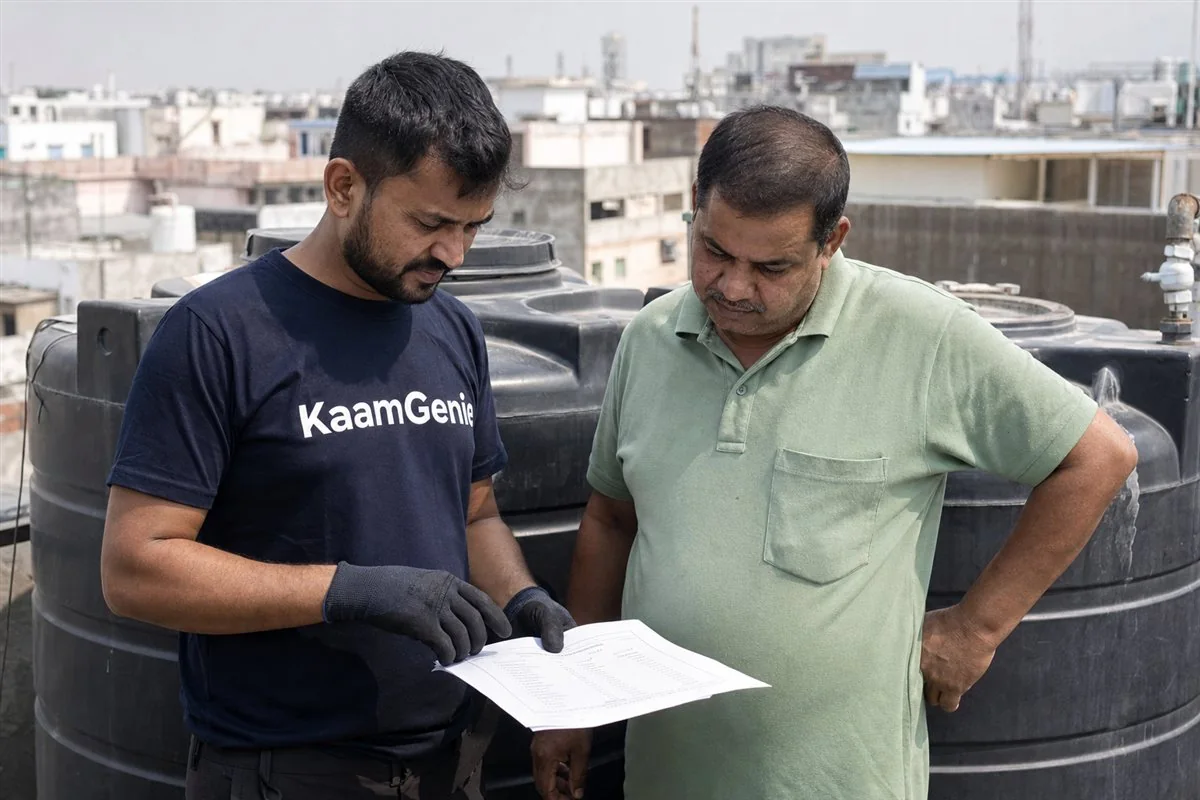
The short version — what moves the charge
- Capacity (litres) sets the labour-hours — the single biggest driver
- Tank type & material — sump > RCC concrete > plastic/Sintex for effort
- Condition — years of neglect mean sludge + scale, and scale means descaling
- Access — floors, stairs, no lift, awkward terrace = more time and effort
- Number of tanks — doing several together earns a bundle discount
- Location / zone — travel and local hard water nudge the rate
- Add-ons — descaling, lab test, same-day, society scale
This post is the why behind the number. For the actual price bands by tank type, see our water tank cleaning cost guide.
The same job almost never is
The most common complaint we hear is that water tank cleaning rates in Delhi are “all over the place.” And on the surface they are — quotes for what sounds like the same tank can run from ₹200 to ₹3,000. But once you break a quote into the work behind it, the spread stops looking random. A charge is really just labour-hours plus equipment plus chemical plus travel, and every one of those moves with the specifics of your tank.
So instead of asking “what’s the rate?” the better question is “what is this price actually buying?” Below are the seven factors that decide where your quote lands, each as a short section. If you just want the headline numbers for plastic, concrete and sump tanks, our cost guide has the breakdown — this page is about understanding the variables so you can judge any quote you’re given.
| Price factor | How it moves the charge | Why |
|---|---|---|
| Capacity (litres) | Up with size | More litres = more surface to scrub and more water to drain = more labour-hours |
| Tank type / material | Sump > RCC > plastic | Confined-space sumps and porous concrete take longer and need more care than smooth plastic |
| Condition / neglect | Up sharply with neglect | Thick sludge and baked-on scale need descaling: extra chemical, contact time and scrubbing |
| Access / floors | Up with difficulty | Carrying a vacuum, jet washer and pump up stairs with no lift is real extra effort |
| Number of tanks | Down per tank | One trip, one setup, shared travel — bundling spreads fixed costs |
| Location / zone | Mild up or down | Travel distance and local water hardness (more descaling) shift the rate slightly |
| Add-ons | Up, line by line | Descaling, lab test, same-day, society scale are genuine extra work or materials |
Get a clear, itemised quote
One fixed price, every step documented, before/after photos and a certificate — no vague extras. ₹699 onwards.
1. Tank capacity / size (litres)
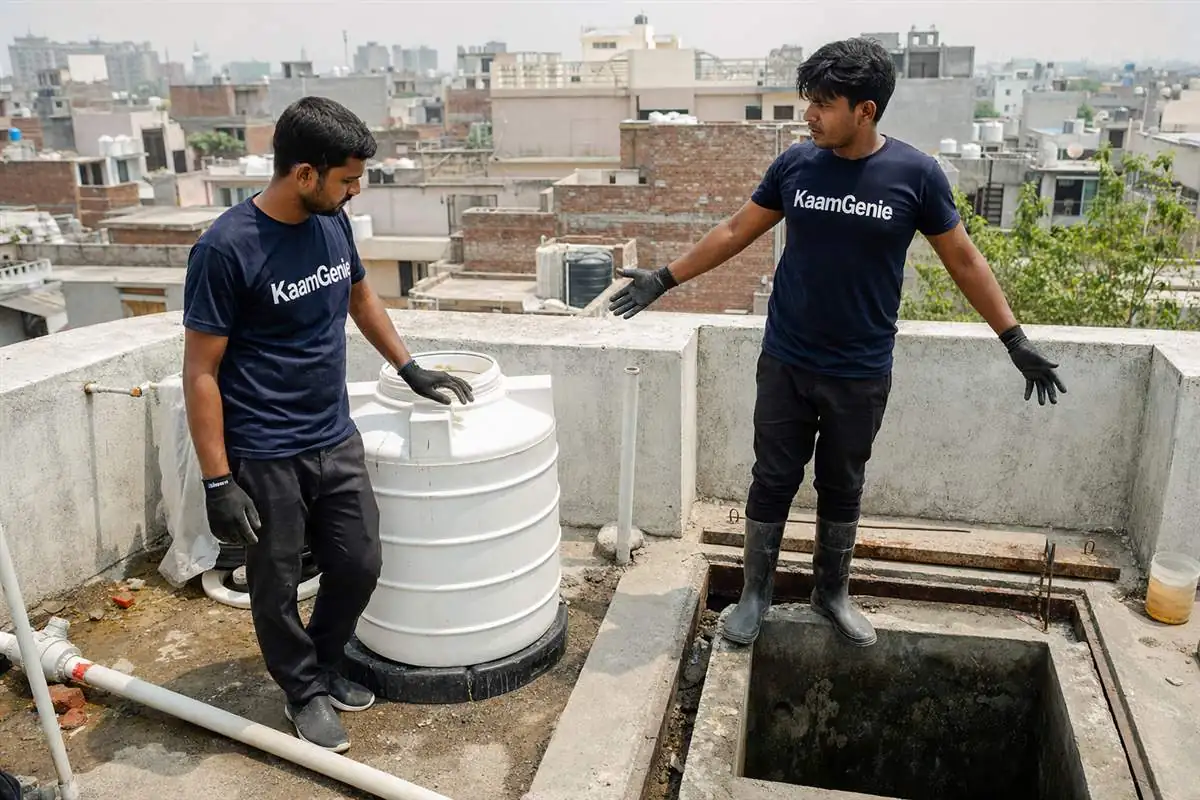
Capacity is the first number any honest cleaner asks for, because it sets the labour-hours before anything else. A 500–1,000L rooftop plastic tank can be drained, scrubbed, disinfected and refilled inside an hour. A 2,000L tank takes meaningfully longer; a 5,000L sump is a two-hour-plus job for the scrubbing and pump-out alone.
Charges don’t scale perfectly with litres — there’s a fixed minimum for showing up with a crew and equipment — but past that minimum, every extra thousand litres adds scrubbing surface and drain time. This is why a 1,000L tank and a 5,000L tank are never the same rate, even if both are “just one tank.”
2. Tank type & material
Two tanks of the same litres can cost different amounts purely because of what they’re made of and where they sit:
- Plastic / Sintex (overhead): the easiest and usually cheapest. Smooth walls release sludge and bio-film with less effort, and rooftop access is straightforward.
- RCC concrete: more effort. Concrete is porous, so over the years bio-film and scale work into the surface texture and need more jet-wash time to clear. Often larger, too.
- Underground sump: typically the most expensive per litre. Sumps hold more water and more settled sludge, the pump-out is slower, and a confined space needs safety gear and careful, slower work.
If you want the deeper comparison of how material changes the work, our plastic vs concrete and overhead vs underground guides cover it. For charges, the rule of thumb is simple: sump > concrete > plastic for the same capacity.
3. Condition / years of neglect
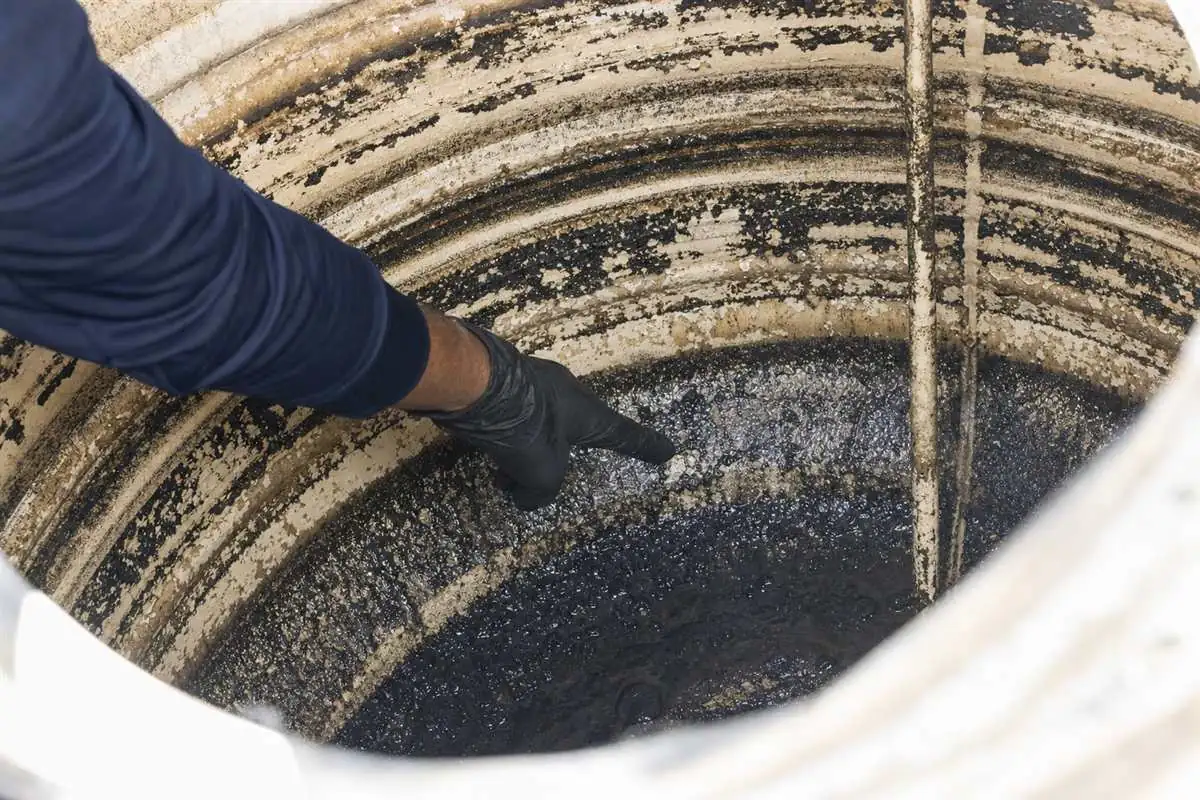
This is the factor that surprises people most, because it can add more to a quote than size does. A tank cleaned every year is a quick job — a thin film, light sediment, done. The same tank left untouched for three or four years is a different beast: half an inch of compacted sludge on the floor and hard calcium scale baked onto the walls.
Scale is the expensive part. It doesn’t rinse or wipe off — it needs descaling: more food-grade chemical, longer contact time, and a lot more scrubbing labour. Heavy borewell water areas, where the supply is hard, scale faster and hit this stage sooner. So two identical 1,000L plastic tanks can carry quite different charges purely because one was neglected and now needs descaling and the other didn’t.
The honest takeaway: cleaning on a regular schedule keeps each visit in the cheap band. Letting it slide doesn’t save money — it just moves the cost to a bigger, harder job later. (Our guide on how long cleaning takes shows how condition stretches the time, which is the same thing as cost.)
4. Rooftop access & floors
A water tank cleaning isn’t one person with a bucket — it’s a crew carrying a wet vacuum, a jet washer, a submersible pump, hoses and sometimes water drums. Where that equipment has to go matters. A ground-floor or second-floor tank with lift access is easy. A fourth-floor tank up a narrow staircase with no lift, or an awkward terrace with poor footing and a tank wedged in a corner, is more time and more effort for the same litres.
Most fair quotes simply absorb this into one number. But genuinely difficult access — many floors, no lift, long carry distance from where the vehicle can park — can add a modest surcharge. The thing to watch for is honesty: a good cleaner tells you about it when quoting, not as a surprise after the job is done.
5. Number of tanks
This is the one factor that pushes the price down. A big chunk of any single quote is fixed cost — the crew and equipment travelling to you, setting up, and packing down. When there’s more than one tank at the same address, those fixed costs get shared.
So a house cleaning its overhead tank and its underground sump on the same visit pays less than booking them as two separate jobs. A building doing six flats together pays noticeably less per tank than each flat arranging its own cleaner on a different day. If you have more than one tank, always ask for the bundle or per-tank rate — it’s one of the easiest ways to bring the effective charge down. Societies and RWAs get the most benefit here; our RWA annual contracts guide goes into that.
6. Location / zone within Delhi NCR
Where you are nudges the rate in two ways. The obvious one is travel: a job far from the crew’s base, or in a pocket that’s slow to reach, carries a little more travel time. The less obvious one is water hardness. Parts of Delhi NCR running heavily on borewell water get harder supply that scales tanks faster — which means descaling comes up more often in those zones, and descaling costs more (see factor 3). Areas on softer DJB supply tend to need it less.
None of this is dramatic — the core cleaning charge is broadly consistent across the NCR. Location mostly shows up as a small travel component and as how frequently your tank lands in the “needs descaling” category. If you want the local picture for your water, our borewell vs DJB water guide explains why hardness varies so much across the city.
7. Add-ons
Beyond the base cleaning, a quote may include genuine extras. These aren’t hidden mark-ups — each is real extra labour, chemical or time — but you should see them as separate line items, not folded silently into a big number:
- Heavy descaling — for tanks with thick, hardened scale that the standard wash won’t shift.
- Lab water test — a sample sent for analysis to document water quality before and/or after, useful for families with health concerns or for compliance.
- Same-day / emergency — squeezing a job into a full schedule, often at short notice.
- Society scale — large reservoirs need extra crew, confined-space safety gear, and sometimes after-hours work to avoid disrupting residents.
The test of a fair add-on is simple: it’s quoted before the work, with a reason. If extras only appear on the final bill, that’s a red flag — and our guide to choosing the best service covers more of those.
Roughly how much each factor moves a typical residential charge
Illustrative weighting, not a price list — for actual numbers see the cost guide
Capacity and condition do most of the work; number of tanks pulls the other way as a bundle discount. Weightings are illustrative — the actual rupee figures live in our cost guide.
How to read and compare a quote
Once you know the factors, comparing quotes stops being guesswork. A fair, itemised quote tells you what you’re buying. It should state:
- Tank type and capacity — so you know they actually accounted for your tank, not a generic one.
- What the base price covers — ideally the full process: drain, sludge removal, manual scrub, jet wash, food-grade disinfection, refill, before/after photos and a certificate. (Our sibling guide on what’s included in a cleaning spells this out.)
- Any add-ons, listed separately — descaling, lab test, same-day — each with a reason.
- One final number — no “extras decided on site.”
Now the hard truth about the cheapest quote. A genuine cleaning has unavoidable fixed costs: crew time, a jet washer, a wet vacuum, food-grade chemical, and proper sludge disposal. You cannot do all of that and still earn at ₹200–300. So a rock-bottom price almost always means the expensive, slow steps were dropped — no sludge scoop, no jet wash, no food-grade disinfection, no documentation. That’s a top-down rinse, and you’re paying less because you’re getting less. The cleaning that looks cheapest today is the one you pay for again in a few months when the tank is dirty just as fast.
The smarter comparison isn’t lowest number wins — it’s “which quote, factor for factor, is buying a real cleaning at a fair rate.” If you want help spotting the difference, our guide on finding a trusted cleaner walks through the checks.
Want the actual numbers for your tank?
Tell us your tank type, size and last cleaning date — we’ll give you one clear price with no surprises. Residential ₹699 onwards.
Ready for a fair quote on your tank?
Now you can read any quote you’re given — you know which factors should move it and which “extras” are real. When you’re ready for a fixed, itemised price with the full process and a certificate, see pricing and booking on our water tank cleaning service page, or read the actual rupee bands in our cost guide.
To book, call +91 95603 66362 or use the booking form on this site — we’ll confirm shortly.
Frequently asked questions
Why is one quote ₹300 and another ₹1,500 for the same tank?
Because they are almost never the same job. A ₹300 quote is usually a top-down rinse — no sludge scoop, no jet wash, no food-grade disinfection, no documentation. A ₹1,500 quote on a larger or neglected tank is paying for the full process plus the real cost drivers: capacity, condition, access and chemicals. The charge tracks the labour-hours and equipment actually used, so a wildly cheaper number normally means steps are being skipped.
What is the single biggest factor in water tank cleaning charges?
Tank capacity in litres, because it sets the labour-hours. A 500L tank scrubs out in well under an hour; a 5,000L sump can take 2-2.5 hours of physical work. Condition is the close second — a tank neglected for years needs descaling and extra chemical, which can add more to the charge than size alone.
Does an underground sump cost more to clean than an overhead tank?
Usually yes. Sumps tend to hold more water, hold more sludge, and are a confined space that needs safety gear and slower, more careful work. The pump-out alone takes longer. So even at the same nominal litres, a sump generally carries a higher charge than a rooftop plastic tank.
Why does a neglected tank cost more even if it’s the same size?
Years of neglect mean thick sludge and heavy calcium scale baked onto the walls. Scale doesn’t rinse off — it needs descaling: extra contact time, more food-grade chemical, and far more scrubbing labour. A 1,000L tank cleaned yearly is a quick job; the same tank untouched for four years can take twice as long, so it costs more.
Do upper floors or hard rooftop access raise the charge?
They can. If the crew has to carry a wet vacuum, jet washer, pump and water drums up four floors with no lift, or the tank sits on an awkward terrace with poor footing, that is extra time and effort. Most fair quotes fold this into a single price, but very difficult access can add a modest surcharge — a good cleaner will tell you why upfront rather than spring it later.
Is it cheaper to clean several tanks at once?
Yes. The crew and equipment travel to you once, set up once, and move between tanks without a fresh trip charge. So a building doing six flats together, or a house cleaning its overhead tank and sump on the same visit, almost always pays less per tank than booking each separately. Ask for the bundle or per-tank rate when there is more than one tank.
Does my area in Delhi NCR change the rate?
A little. Distance and travel time, local water hardness (heavy borewell areas scale faster and need more descaling), and how concentrated jobs are in a zone all nudge the rate. The core cleaning charge is broadly consistent across Delhi NCR; location mainly affects travel and how often hard-water descaling is needed.
What add-ons increase water tank cleaning charges?
The common ones are heavy descaling for old scale, a lab water-quality test for a before/after report, same-day or emergency slots, and society-scale work that needs extra crew and confined-space safety gear. Each is genuine extra labour, chemical or time — so each is a legitimate line item, not a hidden mark-up, as long as it’s quoted before the work.
What does a fair, itemised water tank cleaning quote look like?
A fair quote states the tank type and capacity, what the base price covers (drain, sludge removal, scrub, jet wash, disinfection, refill, photos and a certificate), lists any add-ons separately with reasons, and gives one final number with no vague extras. If a quote is just a single low figure with no detail, you usually can’t tell whether you’re buying a real cleaning or a rinse.
Why is the cheapest quote usually a rinse?
A genuine cleaning has fixed costs — crew time, a jet washer, a wet vacuum, food-grade chemical and disposal. You cannot do all of that for ₹200-300 and still earn. So a rock-bottom price almost always means the expensive, time-consuming steps (sludge removal, jet wash, food-grade disinfection, documentation) have been dropped. You’re paying less because you’re getting less.
Sources & references
- Bureau of Indian Standards (BIS) — IS 10500:2012 is the canonical Indian Standard for drinking water specification, defining acceptable limits for physical, chemical, and biological parameters.
- WHO Guidelines for Drinking-water Quality, 4th edition — the global reference for water quality standards, including guidance on storage and disinfection.
- Food Safety and Standards Authority of India (FSSAI) — defines water quality requirements for food businesses, including hygiene standards for stored water and acceptable disinfection chemicals.
- WHO Fact Sheet on Drinking Water — overview of safe drinking water requirements and contamination risks.
- CPHEEO — Manual on Water Supply and Treatment — the Government of India’s engineering manual covering tank design, cleaning protocols, and disinfection practices.
Last verified: 24 June 2026. If you find any of these links broken, please let us know.