
What’s included — the short version
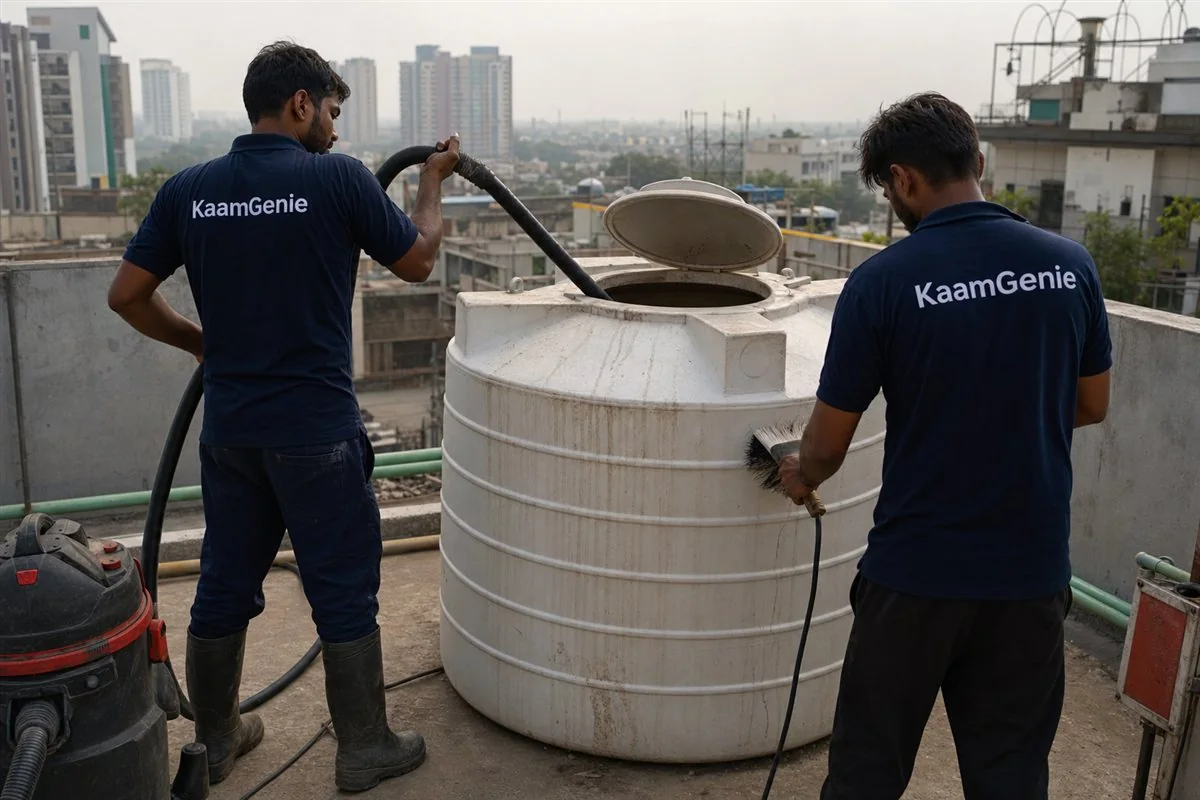
- Seven cleaning steps: drain → de-sludge → scrub → jet wash → vacuum → disinfect → rinse
- Food-grade disinfection with contact time — included, never charged separately
- Sludge carried away off-site, not flushed down your building drain
- Before/after photos on WhatsApp
- A dated cleaning certificate (date, tank type, chemicals, crew)
- A proper GST bill
Paid extras: heavy hard-water descaling, sump/UGR cleaning, large society tanks, and any repairs. Standard residential overhead tank: ₹699 onwards.
Noida is a city built on stored water. The Authority-planned sectors, the IT and corporate belt around Sector 62 and the Noida Expressway, the high-rise townships of Sectors 137, 150 and 168, and the fast-growing towers of Greater Noida West all depend on the same basic setup: water arrives — piped Ganga Jal or hard borewell groundwater — sits in an underground reservoir or sump, and gets pumped up to rooftop tanks before it reaches your tap. Every one of those storage points needs cleaning, and the word “cleaning” covers everything from a genuine professional job to a man with a bucket who rinses the top and leaves. This guide is about knowing the difference before you pay.
| Item | Included? | Notes |
|---|---|---|
| Drain old water | Included | Inlet shut, usable water preserved in a drum where possible |
| De-sludge the floor | Included | Scooped by hand, carried away off-site |
| Manual scrub | Included | Food-grade brushes, walls + floor + corners + lid |
| High-pressure jet wash | Included | Reaches seams and behind fittings a brush can’t |
| Wet vacuum | Included | Removes the dirty rinse before disinfection |
| Disinfection + contact time | Included | Food-grade sodium hypochlorite, 50-100 PPM |
| Final clean-water rinse | Included | No chemical residue left behind |
| Photos + certificate + GST bill | Included | Your proof of service |
| Heavy hard-water descaling | Extra | For thick calcium scale on long-neglected tanks |
| Sump / UGR / society tanks | Custom quote | Bigger, confined-space, more crew + time |
| Repairs & new fittings | Extra | Cracks, broken lids, failed valves quoted separately |
Book a cleaning that includes everything
All seven steps, disinfection, photos and a certificate — nothing quietly left out. Fixed price, ₹699 onwards.
The seven steps that should always be included
A real cleaning is a sequence, not a single action. Each step does work the others cannot replace, and the corner-cutters earn their cheap price by quietly dropping the hardest three. Here is what each included step actually means at your tank.
1. Drain the old water
The inlet valve is shut first so no fresh water keeps trickling in mid-job, then the tank is drained through the outlet or by a submersible pump. If your tank was filled that morning, the crew can pump the usable water into a drum so it isn’t wasted — you can use it for washing or plants. You cannot clean the most contaminated part, the bottom, with water sitting on top of it, so draining fully is non-negotiable.
2. De-sludge the floor
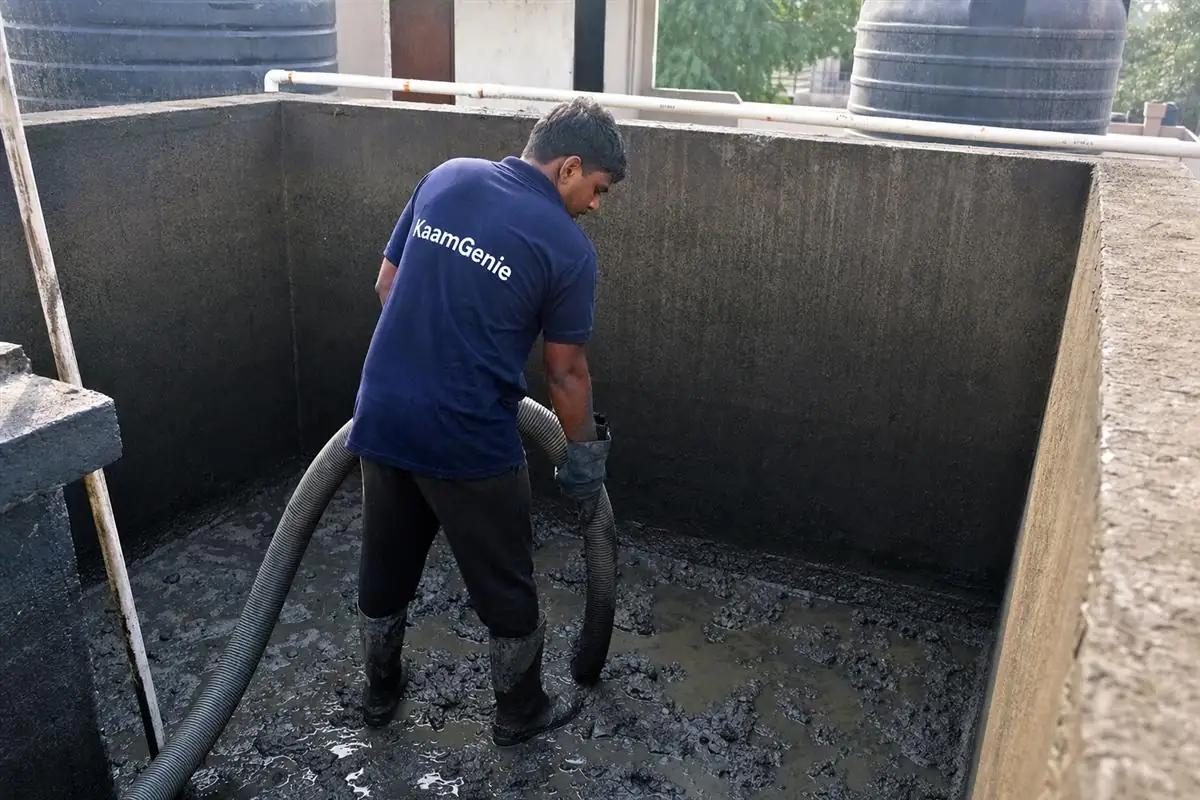
Every Noida tank has a layer of sediment on the floor — borewell sand, rust flecks from old pipes, calcium scale, dried algae, the odd dead insect. On hard groundwater in Greater Noida West and the older sectors, a tank left two or three years can carry half an inch of black sludge. The crew scoops this into a sealed bucket and carries it away off-site. It is never flushed down the building drain, because in a Noida high-rise that sludge simply settles in the downpipe and becomes the lower floors’ problem. If nobody walks away carrying a dirty bucket, this step didn’t happen.
3. Manual scrub
With the sludge gone, the walls and floor still hold a thin bio-film and scale that water alone won’t shift. The crew scrubs every wall top-to-bottom, the floor in overlapping passes, the corners and seams where bio-film hides, the area around the inlet and outlet, and the underside of the lid. They use food-grade nylon brushes — never metal, which scratches plastic and creates new homes for bacteria. This is the longest step and the clearest line between a real cleaning and a rinse.
4. High-pressure jet wash
A 100-150 PSI jet blasts off whatever scrubbing didn’t fully dislodge and reaches into corners, behind fittings and into the lid threads where a brush physically can’t. For the older RCC (concrete) underground reservoirs common under Noida societies, the jet is essential — concrete develops a textured, porous surface that bio-film clings into, and only pressure clears it.
5. Wet vacuum
After the jet wash, an inch or two of dirty water sits at the bottom, full of dislodged scale and flakes. A wet/dry vacuum removes it completely. Skip this and gravity leaves a thin contaminated layer that redistributes everything back into the fresh water on refill — which is why a proper service includes the vacuum rather than just opening the drain.
6. Disinfection (this is the one to protect)
Food-grade sodium hypochlorite at 50-100 PPM is applied to all interior surfaces and left to dwell for its contact time. This is the step that actually kills the bacteria, and it is the one cheap operators either skip or fake with hardware-shop bleach. Disinfection is included in the standard price — it is not an upsell. If a quote looks suspiciously low and then disinfection appears as a separate line, you’re looking at a rinse dressed up as a cleaning.
7. Final clean-water rinse
After contact time, the tank is rinsed with clean water and vacuumed once more so no chemical residue is left behind, then refilled. Within about 30 minutes of refill the water is safe for normal use. This is the same careful sequence we follow for water tank cleaning services right across the NCR, and the same one behind every booking for water tank cleaning in Noida.
Where your time and money go — what’s included in a 1,000L Noida cleaning
Disinfection and scrubbing take the most time; both are included in the base price
Total: ~89 minutes for a 1,000L overhead tank including setup and pack-up — within the typical 75–90 minute range. Sumps and society reservoirs scale the scrub and disinfection steps up proportionally.
What you actually get to keep — the deliverables
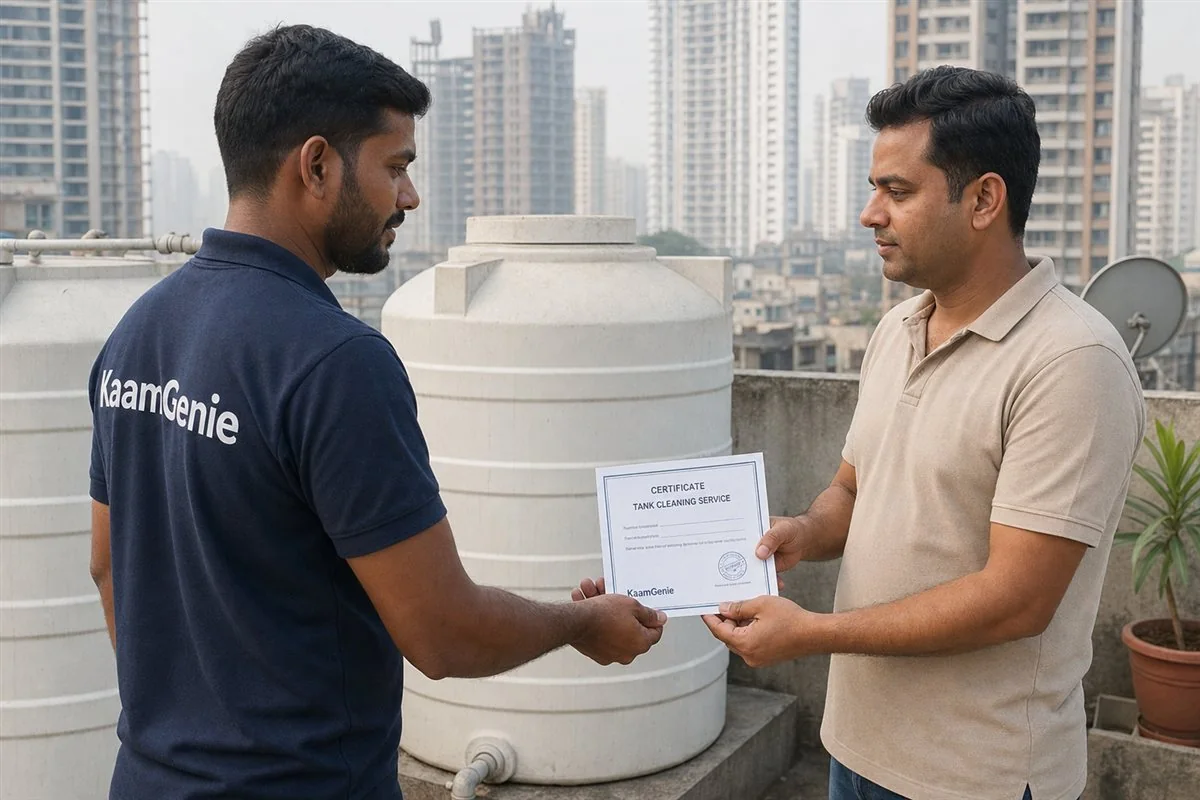
The steps are what the crew does; the deliverables are what you keep. A standard included cleaning gives you three things in your hand:
- Before/after photos — the same angles shot before and after, sent to you on WhatsApp. These often surprise even long-time owners who assumed their tank was “basically fine.”
- A dated cleaning certificate — listing the date, tank type and capacity, the chemicals used, and the crew names.
- A proper GST bill — not a scrap of paper, a real invoice.
This paperwork is not a formality in Noida. Apartment Owners’ Associations and RWAs in the high-rise belt increasingly ask flat owners and the facility team for proof that tanks are on an annual cleaning schedule, and the certificate is that proof. For the city’s many tenants — the student and working-professional population around Amity, the colleges and the Sector 62 offices — a certificate from the cleaning is what you show a landlord who claims it was “just done.” And any food business facing an FSSAI inspection needs exactly this record on file.
What’s usually NOT included — the honest list of extras
An honest service is clear about where the standard price stops. These are the genuine extras — not hidden traps, just work that needs more time, material or a different crew:
- Heavy hard-water descaling. Light scale comes off in the normal scrub, but Noida and Greater Noida West run on hard borewell groundwater. A tank neglected for two or three years can have thick calcium scale that needs a dedicated descaling treatment, which is a paid add-on quoted on arrival.
- Underground sumps and reservoirs (UGRs). The big underground reservoirs that feed rooftop tower tanks along the Noida Expressway are larger, confined-space jobs needing more crew and safety gear, so they are custom-quoted, not ₹699. If your home has a shared sump, our guide to underground sump cleaning in Noida walks through what that involves.
- Large society and commercial tanks. A shared reservoir for a tower or an office block is a different scale of job — see how society water tank cleaning in Noida is priced and scheduled.
- Repairs and new fittings. We clean accessible inlet, outlet and overflow connections, but if a tank is cracked, the lid is broken, or an inlet valve has failed, the repair or replacement is quoted separately. We flag these honestly rather than refilling over a problem.
For a full breakdown of how these line up against the base price across tank types, our water tank cleaning cost guide for Noida lays out the numbers.
Five things to confirm before you book
Most “that wasn’t included” arguments are avoidable. Get these five points in writing on WhatsApp before the crew arrives and there are no surprises at the end:
- Is disinfection included? It should be part of the base price, not a separate charge.
- Do I get photos, a certificate and a GST bill? All three, every job.
- What’s the all-in price for my tank size and type? Overhead, sump, or society reservoir — pin the number.
- Does descaling or sump work apply to me? Ask the crew to assess and price any extra before they start, not after.
- How long will you need access? A residential tank is 75-90 minutes; budget more for a sump or society job.
This is exactly the local crew and the same fixed inclusions whether you’re in the old Authority sectors or the new towers — from Sector 18 and Sector 50 to the Expressway high-rises of Sector 137.
Not sure what your tank needs?
Tell us your tank type and sector — we’ll confirm what’s included and the all-in price before any visit. Residential cleaning ₹699 onwards.
The bottom line on what’s included
A real water tank cleaning in Noida includes seven hands-on steps, food-grade disinfection that’s never charged separately, the sludge carried away, and a set of deliverables — photos, certificate, GST bill — you keep as proof. The extras are honest and specific: heavy descaling for hard-water scale, sump and UGR work, large society tanks, and any repairs. If you know that list before you book, no one can dress a rinse up as a cleaning or spring a surprise charge at the end. Ready when you are — explore pricing and book on the Noida water tank cleaning hub, or just message us your sector and tank type.
Frequently asked questions
What exactly is included in a standard water tank cleaning in Noida?
A standard residential cleaning includes seven hands-on steps — draining the old water, scooping out the bottom sludge, manual scrubbing with food-grade detergent, a high-pressure jet wash, wet-vacuuming the dirty rinse, food-grade disinfection with contact time, and a final clean-water rinse. It also includes the deliverables: before/after photos, a dated cleaning certificate and a GST bill. At KaamGenie this is the standard residential job from ₹699 onwards.
Do I get a certificate and bill, or just a verbal confirmation?
You get both in writing. Every job ends with a cleaning certificate listing the date, tank type and capacity, chemicals used and crew names, plus a proper GST invoice. Before/after photos go to you on WhatsApp. This paperwork matters in Noida — AOAs and RWAs ask for the certificate as proof of the annual cleaning schedule, and FSSAI inspections at food businesses want to see it too.
Is disinfection included or is it charged extra?
Disinfection with food-grade sodium hypochlorite is included in the standard price — it is not an add-on. It is the step that actually makes the water safe, so any service that quotes a rock-bottom price and then charges separately for disinfection (or skips it) is not giving you a real cleaning. The 50-100 PPM solution and its contact time are part of the base job.
What is NOT included in the standard Noida tank cleaning price?
Heavy hard-water descaling on badly scaled tanks, underground reservoir (UGR) or sump cleaning, large society tanks above residential size, and any repairs — cracked tanks, broken lids, failed inlet valves or new fittings. These are quoted separately because they need extra time, material or a confined-space crew. A residential overhead tank cleaning is ₹699 onwards; sumps, UGRs and society/commercial jobs are custom-quoted.
Does the cleaning include the sludge being carried away?
Yes. The thick sediment scooped from the tank floor — borewell sand, rust, scale, dead insects — goes into a sealed bucket and is disposed of off-site. We do not flush it down your building drain, because in Noida high-rises that sludge just settles in the downpipe and causes problems for the floors below. Carrying the sludge away is part of the job, not an extra.
Is the inlet, outlet and overflow pipe cleaning included?
Yes — the inlet, outlet and overflow connections plus the underside of the lid are scrubbed and disinfected as part of the standard process. If we find mineral buildup or corrosion in the pipes that is beyond cleaning, we flag it for separate repair rather than quietly ignoring it. The cleaning of accessible fittings is included; replacement of damaged fittings is the paid extra.
How long does an included standard cleaning take in Noida?
A typical 1,000L residential overhead tank takes 75-90 minutes for the full included process. A shared rooftop tank for a builder floor takes 90-120 minutes. Underground sumps and the big UGRs that feed Noida Expressway high-rises take 2.5-4 hours and are quoted as separate jobs. If a cleaner finishes a residential tank in 20 minutes, they skipped the de-sludge, scrub or disinfection step.
Do I need to be present for everything that’s included?
No — you only need to arrange rooftop and tank access. Many Noida customers, especially tenants and working professionals in the Sector 62 and Expressway belt, leave the crew to it and check the before/after photos and certificate on WhatsApp afterwards. One point of contact — owner, family member, household help or the society caretaker — is enough.
What should I confirm before booking so nothing is left out?
Confirm five things: that disinfection with food-grade chemical is included (not extra), that you get before/after photos plus a certificate and GST bill, the all-in price for your tank size and type, whether descaling or sump work applies to you, and roughly how long the crew will need access. Getting these in writing on WhatsApp before the visit prevents the ‘that’s extra’ surprise at the end.
Is hard-water descaling part of the standard Noida cleaning?
Light scale removed during normal scrubbing is included. But Noida and Greater Noida West run on hard borewell groundwater, so tanks that have not been cleaned in two or three years often have thick calcium scale that needs a dedicated descaling treatment. That heavy descaling is a paid add-on because it needs extra time and material — the crew assesses it on arrival and tells you the price before starting.
Sources & references
- Bureau of Indian Standards (BIS) — IS 10500:2012 is the canonical Indian Standard for drinking water specification, defining acceptable limits for physical, chemical, and biological parameters.
- WHO Guidelines for Drinking-water Quality, 4th edition — the global reference for water quality standards, including guidance on storage and disinfection.
- Food Safety and Standards Authority of India (FSSAI) — defines water quality requirements for food businesses, including hygiene standards for stored water and acceptable disinfection chemicals.
- WHO Fact Sheet on Drinking Water — overview of safe drinking water requirements and contamination risks.
- CPHEEO — Manual on Water Supply and Treatment — the Government of India’s engineering manual covering tank design, cleaning protocols, and disinfection practices.
Last verified: 30 June 2026. If you find any of these links broken, please let us know.