
Plastic vs Concrete Tank Cleaning
Raj Babbar · 8 min read
Home › Water Tank Cleaning › Overhead Tank Cleaning › Ghonda
In old riverside Ghonda near the Yamuna embankment, low-lying humidity speeds algae and scale inside rooftop tanks, and the ageing tanks on worn lids let dust and sediment in easily. KaamGenie cleans these overhead tanks by hand. From ₹699.
Ghonda is an old riverside quarter of trans-Yamuna near Bhajanpura and the Yamuna embankment, decades-old lanes of plot houses and builder floors. Supply mixes DJB pipeline with borewell that runs hard near the river, so the tanks here carry both a light scale and ordinary sediment. What accelerates the fouling is the setting: Ghonda is low-lying and close to the river, and that damp riverside humidity speeds algae and biofilm inside rooftop tanks, much as it does in nearby Yamuna Vihar. On top of that, the tanks here are old, sitting on decades-old buildings with worn, ill-fitting lids, so terrace dust and airborne sediment reach the water easily through the gaps. Between the humidity-driven algae, the hard riverside borewell scale, and the dust let in by worn lids, an old Ghonda rooftop tank fouls on several fronts at once. Residents in the old quarter often clean irregularly, so the buildup sets in between visits.
KaamGenie cleans Ghonda's ageing tanks by hand: we drain, scoop out the settled sediment, jet-wash the scale and algae film off the walls, hand-scrub the corners and worn surfaces, then finish with an anti-bacterial disinfectant wash before refilling, and we send before-and-after photos. We check the worn lids after cleaning and will advise a replacement to keep the dust out between visits. This page is part of our wider water tank cleaning in Ghonda service, and it focuses specifically on the overhead (rooftop) tanks that feed your taps.
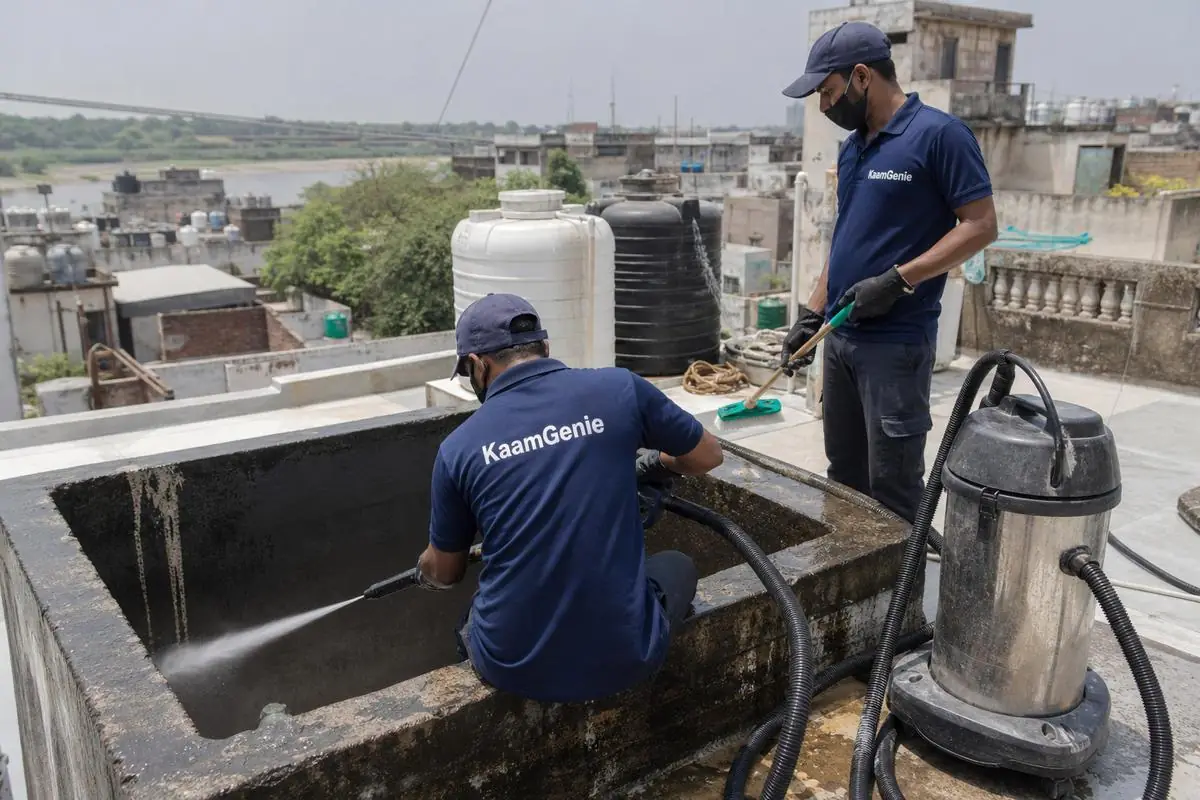
Ghonda's riverside setting is what drives the fouling. The old quarter sits low and close to the Yamuna embankment, and that damp humidity keeps rooftop tanks warm and moist, which is exactly what algae and biofilm need to creep up the walls between cleanings. The hard borewell share of the supply, harder near the river, adds a light scale over that film. So even before you account for the tanks themselves, the location alone speeds the algae and scale faster than a drier inland colony would ever see.
The ageing tanks are the second front. On decades-old buildings, the lids have worn and no longer seal, so terrace dust and airborne sediment drift straight into the water, adding a gritty layer to the algae and scale. Because residents in the old quarter tend to clean irregularly, all three fronts, the algae, the scale, and the dust, compound between visits. Part of our job here is checking and advising on the worn lids, since a better-sealing lid keeps the dust out, and a yearly clean before the monsoon keeps the humidity-driven algae in check.
No travel charge anywhere in Ghonda. The final price is confirmed on the call before we come — it depends only on tank size and access.
See it done in 45 seconds
Watch our web story on how a tank is really cleaned — drain, de-sludge, jet-wash, disinfect.
We reach every pocket of Ghonda — and there’s no travel charge to any of them:
Every locality in Delhi stores different water, and that decides how fast a tank fouls. This is Ghonda’s profile from The Delhi Water Index, built from our field observations across 250+ localities.
Indicative field characterisation, not a certified lab test. BIS IS 10500: TDS 500 mg/L acceptable, 2,000 permissible. Check any Delhi area →
“Why does my Ghonda tank grow algae so fast?” Because the old riverside quarter is low-lying and damp, and that humidity keeps your rooftop tank warm and moist, which is perfect for algae and biofilm creeping up the walls. Our anti-bacterial disinfectant wash strips that film, and a clean before the monsoon keeps the algae from returning quickly.
“My Ghonda tank lid is worn, does that matter?” Yes, a worn lid lets terrace dust and sediment drift straight into the water, adding to the algae and scale. On the decades-old buildings here that is common. We check the lid after cleaning and will advise a replacement, since a well-sealing lid keeps a lot of the dust out between visits.
“What does a rooftop tank clean cost in Ghonda?” A standard 500-litre tank starts at ₹699 and a 1,000-litre tank is ₹899. Larger or shared tanks of 1,001 to 2,000 litres run ₹1,299 to ₹1,499, and a whole building of several tanks gets a bulk discount when done together.
“Do you clean the old tanks in the narrow Ghonda lanes near the embankment?” Yes, the old quarter's narrow lanes near the Yamuna embankment are no obstacle. Our crew carries portable equipment on foot up to the terrace. Just share your lane and a landmark like Ghonda Chowk or the embankment side when you book.
“How often should a Ghonda riverside tank be cleaned?” Because the riverside humidity speeds algae and the worn lids let dust in, twice a year is ideal here, with one clean timed just before the monsoon. Once a year is the minimum. A tank left irregularly cleaned for long should get a first deep clean, after which the routine keeps it clear.
See our complete water tank cleaning services in Delhi NCR — pricing, process, tank types and full city coverage.
Beyond water tank cleaning, KaamGenie is rolling out a full lineup of home services across Delhi NCR — see our complete list of 12 home services we offer or will be launching through 2026. New to tank cleaning? Read our guide on how to pick the right water tank cleaning service in Delhi — what to look for, what to avoid, and the questions that separate trustworthy crews from quick-job operators.
Rooftop plastic tanks
₹699+ →Kothi sumps & underground tanks
₹1,499+ →Apartments & RWAs
Bulk pricing →FSSAI-compliant cleaning
₹2,500+ →टंकी साफ़ करने वाले
हिन्दी पढ़ें →View all water tank cleaning guides →
All pockets and lanes of Ghonda covered. If your specific block or society isn’t named in the sub-areas above, just call — we almost certainly cover it.
Same crew, same 6-step process, same-day where possible. Pick any locality below for local pricing and the tanks we typically find there.
Book a slot — we can usually fit you in today or tomorrow.