
Water Tank Cleaning Charges (Delhi NCR)
Raj Babbar · 9 min read
Home › Water Tank Cleaning › Overhead Tank Cleaning › Mayur Vihar Phase 1
Mother Dairy and the Noida Link Road frame Mayur Vihar Phase 1, where dozens of 1980s CGHS societies still store their water in shared rooftop banks and per-block Sintex tanks. KaamGenie descales and disinfects those overhead tanks so the last stop before your tap stays clean. From ₹699.
Laid out as a planned Trans-Yamuna colony in the 1980s, Phase 1 runs in numbered pockets from Acharya Niketan down to the Mother Dairy crossing. Most of its housing is DDA flats and cooperative group-housing, and the water arrives as DJB pipeline supply lifted into society overhead banks on each roof. A handful of pockets top up from borewell through the summer, but the pipeline is the mainstay here. Because a single rooftop tank on a society block feeds many families, it is opened far less often than a private one, and scale settles quietly on the walls in the meantime.
Our crew drains the tank fully, lifts out the settled sediment, jet-washes the mineral film off the walls, hand-scrubs the corners and rim, then finishes with a anti-bacterial sanitiser rinse and hands over dated before-and-after photos. This page is about rooftop tanks alone; for the full scope in the colony see water tank cleaning in Mayur Vihar Phase 1.
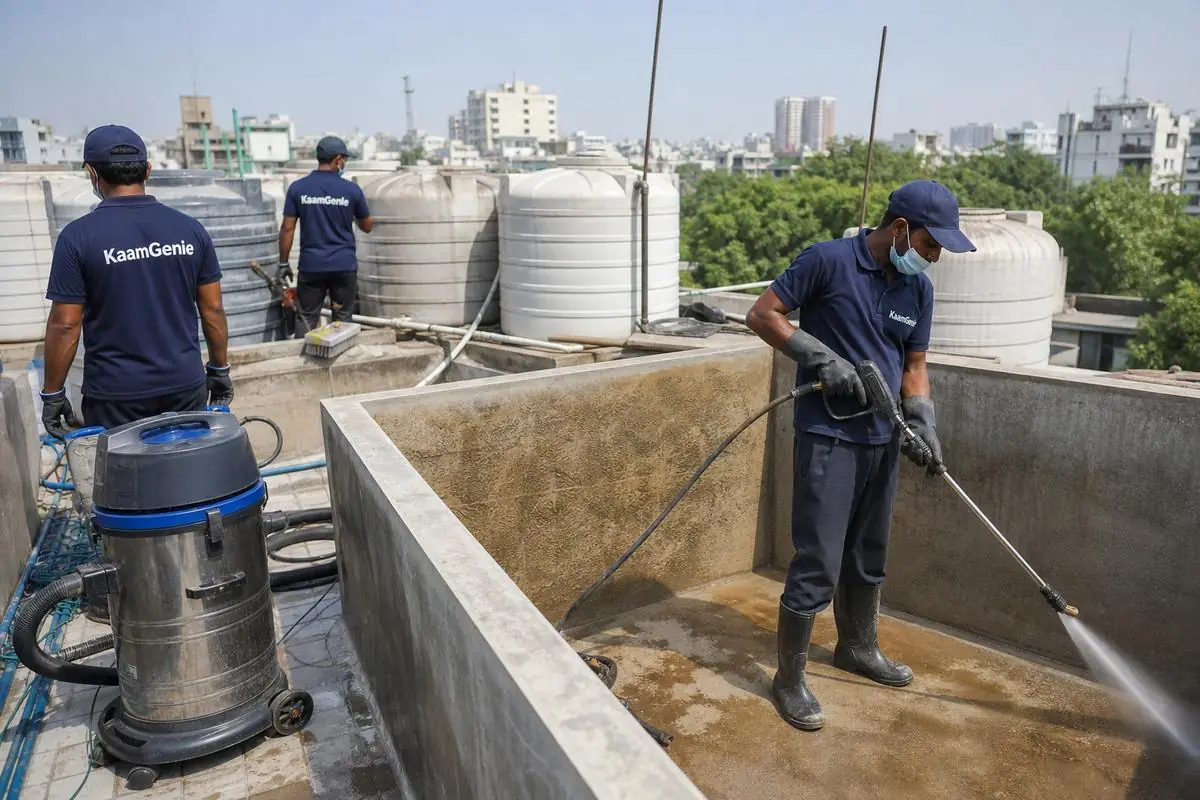
The DJB supply that fills these tanks is treated, but it still carries dissolved minerals that leave a thin film every fill cycle, and forty years of daily fills add up. On the society blocks one overhead bank serves a whole staircase of flats, so the tank rarely sits empty long enough for anyone to inspect it. The result is a mineral lining that thickens season after season without anyone noticing until the water turns cloudy on first draw.
What collects at the bottom is a soft grey sediment mixed with the odd fleck of GI rust from ageing risers, and along the walls a biofilm takes hold below the waterline. That combination dulls the taste, clogs tap aerators and shortens the life of geyser elements downstream. A clean twice a year, booked by the RWA for the whole block at once, keeps every flat on the riser drinking clear water.
No travel charge anywhere in Mayur Vihar Phase 1. The final price is confirmed on the call before we come — it depends only on tank size and access.
See it done in 45 seconds
Watch our web story on how a tank is really cleaned — drain, de-sludge, jet-wash, disinfect.
We reach every pocket of Mayur Vihar Phase 1 — and there’s no travel charge to any of them:
Every locality in Delhi stores different water, and that decides how fast a tank fouls. This is Mayur Vihar Phase 1’s profile from The Delhi Water Index, built from our field observations across 250+ localities.
Indicative field characterisation, not a certified lab test. BIS IS 10500: TDS 500 mg/L acceptable, 2,000 permissible. Check any Delhi area →
“How is the price set for a shared society tank?” ₹699 covers a tank up to 500L and ₹899 a tank from 501 to 1,000L, including drain, de-sludge, jet-wash, scrub and anti-bacterial disinfection with photos. Many Phase 1 society banks are larger, so for those we confirm the capacity on a call and quote before the visit; the RWA usually books the full block together.
“Can the RWA get a quality report for its records?” Yes. Every clean closes issued in the society's name plus before-and-after photographs, which office-bearers file for the annual maintenance record. It is the proof most Phase 1 RWAs want when residents ask when the overhead bank was last serviced.
“How do you work around the DJB supply hour?” We start right after the morning fill so the tank is drawn down and easy to empty, finish the cleaning and sanitising, and have it ready before the evening supply returns. Scheduling around the timed pipeline means no pocket is left without water during the job.
“Our block has both a rooftop bank and an underground tank. Do both need doing?” If your building lifts water from a sump into the rooftop bank, cleaning only the roof leaves the source dirty, so the settled silt gets pumped straight back up. We recommend doing both in one visit; this page prices the overhead stage, and the sump is quoted separately by size.
“Can you come the same day if the water suddenly smells off?” Call before 10 AM and a same-day slot in Phase 1 is usually possible. A musty smell in a shared bank reaches every flat on that riser together, so we treat it as a priority and bring the disinfection stage forward.
See our complete water tank cleaning services in Delhi NCR — pricing, process, tank types and full city coverage.
Beyond water tank cleaning, KaamGenie is rolling out a full lineup of home services across Delhi NCR — see our complete list of 12 home services we offer or will be launching through 2026. New to tank cleaning? Read our guide on how to pick the right water tank cleaning service in Delhi — what to look for, what to avoid, and the questions that separate trustworthy crews from quick-job operators.
Rooftop plastic tanks
₹699+ →Kothi sumps & underground tanks
₹1,499+ →Apartments & RWAs
Bulk pricing →FSSAI-compliant cleaning
₹2,500+ →टंकी साफ़ करने वाले
हिन्दी पढ़ें →View all water tank cleaning guides →
All pockets and lanes of Mayur Vihar Phase 1 covered. If your specific block or society isn’t named in the sub-areas above, just call — we almost certainly cover it.
Same crew, same 6-step process, same-day where possible. Pick any locality below for local pricing and the tanks we typically find there.
Book a slot — we can usually fit you in today or tomorrow.