
Water Tank Cleaning Rules & Norms
Raj Babbar · 9 min read
Home › Water Tank Cleaning › Overhead Tank Cleaning › Ibrahimpur
Ibrahimpur runs largely on borewell water, and that hardness bakes a chalky scale onto the walls of every rooftop tank. KaamGenie jet-washes and scrubs those overhead tanks so the scale and grit stop reaching your taps. From ₹699.
Ibrahimpur is an outer North Delhi urban village that has densified into narrow-lane builder floors on the fringe of the city. Unlike the DJB-fed walled city, supply here leans heavily on borewell and harder groundwater, and that changes what builds up in the tank. Hard water carries dissolved minerals that come out of solution the moment it sits still in a warm rooftop tank, coating the walls with a chalky white scale. Alongside that, the quickly built homes have unlined tanks that trap gritty sediment on the floor. Because these tanks are seldom opened, deposits harden over months into a stubborn layer. The narrow lanes and compact terraces make access awkward, so cleaning is rarely done on schedule. By the time anyone looks inside, the scale is thick and the floor holds real grit.
KaamGenie cleans these borewell-fed rooftop tanks the way hard water demands: we drain the tank, scoop out the gritty sludge, then jet-wash the mineral scale firmly off the walls before hand-scrubbing the corners and inlet. A anti-bacterial disinfectant wash goes in before we refill, and before-and-after photos reach your WhatsApp. This is our dedicated page for water tank cleaning in Ibrahimpur, focused on the overhead (rooftop) tanks that hard groundwater scales up fastest. We match the jet pressure to your tank material, softer on Sintex, firmer on concrete.
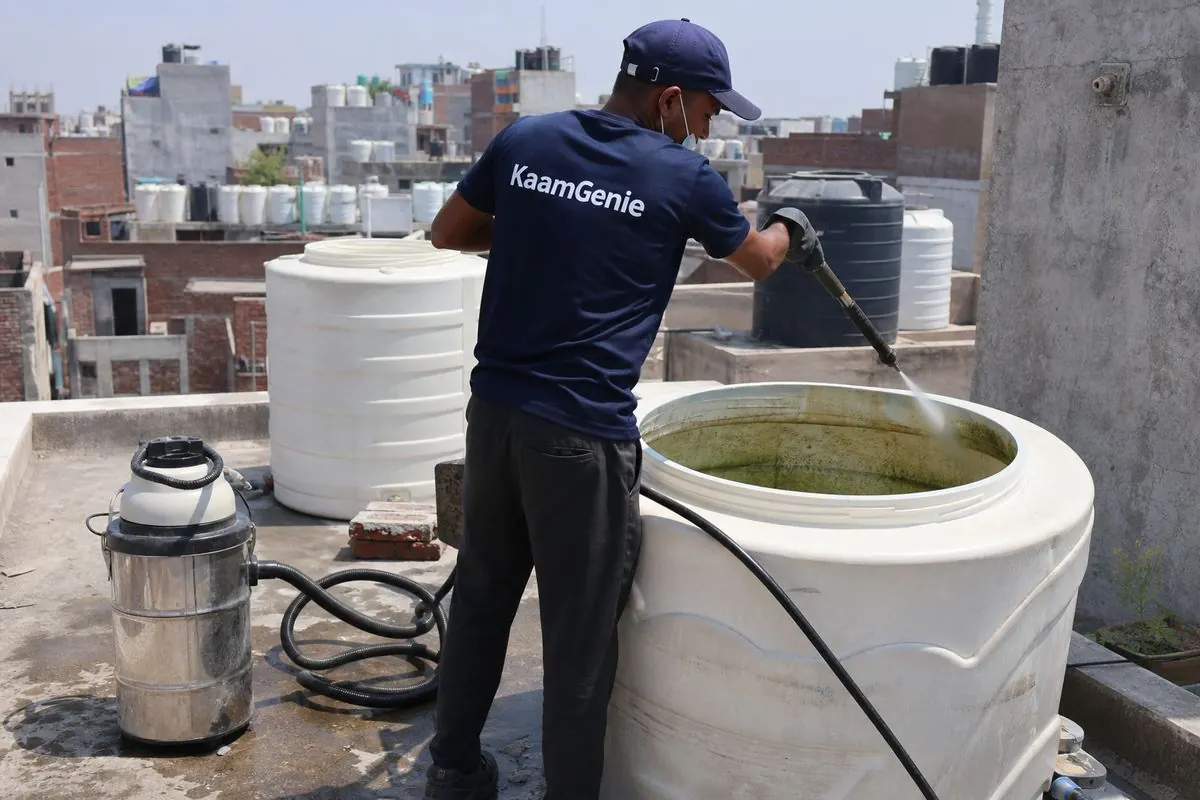
Groundwater in this outer belt is high in dissolved calcium and other minerals, and hard water behaves very differently in a rooftop tank than piped supply. As the water warms and sits still, those minerals crystallise onto the tank walls as a chalky scale that thickens with every fill. That scale is not just cosmetic: it roughens the surface so biofilm and grit cling more easily.
The builder floors here went up fast, and many run unlined tanks that trap sediment on the floor rather than letting it flush. With narrow-lane access making the climb a nuisance, tanks are seldom opened, so both the scale and the grit are left to harden for months. That is why a borewell-fed Ibrahimpur rooftop tank benefits from a firmer, more frequent clean than a DJB-fed one in the inner city.
No travel charge anywhere in Ibrahimpur. The final price is confirmed on the call before we come — it depends only on tank size and access.
See it done in 45 seconds
Watch our web story on how a tank is really cleaned — drain, de-sludge, jet-wash, disinfect.
We reach every pocket of Ibrahimpur — and there’s no travel charge to any of them:
Every locality in Delhi stores different water, and that decides how fast a tank fouls. This is Ibrahimpur’s profile from The Delhi Water Index, built from our field observations across 250+ localities.
Indicative field characterisation, not a certified lab test. BIS IS 10500: TDS 500 mg/L acceptable, 2,000 permissible. Check any Delhi area →
“Why is there white chalky buildup inside my tank here?” That is mineral scale from the hard borewell water most of Ibrahimpur runs on. As the water warms and sits in the rooftop tank, calcium crystallises onto the walls. We jet-wash it off firmly and scrub the stubborn patches, so the tank surface comes back smooth.
“Does hard-water scale need stronger cleaning than normal grit?” Yes. Scale bonds to the walls and does not simply rinse away like loose sediment, so we use higher jet pressure on concrete tanks and targeted hand-scrubbing to lift it. Then the disinfectant wash seals the job. It is more work than a DJB-fed tank, and our method is built for it.
“What does a rooftop tank clean cost in Ibrahimpur?” A standard builder-floor tank of 500 to 1,000 litres starts at ₹699 and up to ₹899. A larger 1,001 to 2,000 litre tank is ₹1,299 to ₹1,499. Whole-building cleaning where several floors share tanks runs ₹2,400 to ₹3,000.
“How often should a borewell-fed tank be cleaned?” We suggest every eight to ten months here, sooner than the usual yearly cycle, because hard water scales faster. Keeping ahead of the scale means each clean is easier and the walls never build a thick, stubborn crust.
“My tank has not been opened since the house was built, is it too late?” Not at all. Even years of hardened scale and grit come off with a proper drain, firm jetting and hand-scrubbing, followed by a disinfectant wash. The first clean takes longer, but afterwards an annual visit keeps it simple.
See our complete water tank cleaning services in Delhi NCR — pricing, process, tank types and full city coverage.
Beyond water tank cleaning, KaamGenie is rolling out a full lineup of home services across Delhi NCR — see our complete list of 12 home services we offer or will be launching through 2026. New to tank cleaning? Read our guide on how to pick the right water tank cleaning service in Delhi — what to look for, what to avoid, and the questions that separate trustworthy crews from quick-job operators.
Rooftop plastic tanks
₹699+ →Kothi sumps & underground tanks
₹1,499+ →Apartments & RWAs
Bulk pricing →FSSAI-compliant cleaning
₹2,500+ →टंकी साफ़ करने वाले
हिन्दी पढ़ें →View all water tank cleaning guides →
All pockets and lanes of Ibrahimpur covered. If your specific block or society isn’t named in the sub-areas above, just call — we almost certainly cover it.
Same crew, same 6-step process, same-day where possible. Pick any locality below for local pricing and the tanks we typically find there.
Book a slot — we can usually fit you in today or tomorrow.