
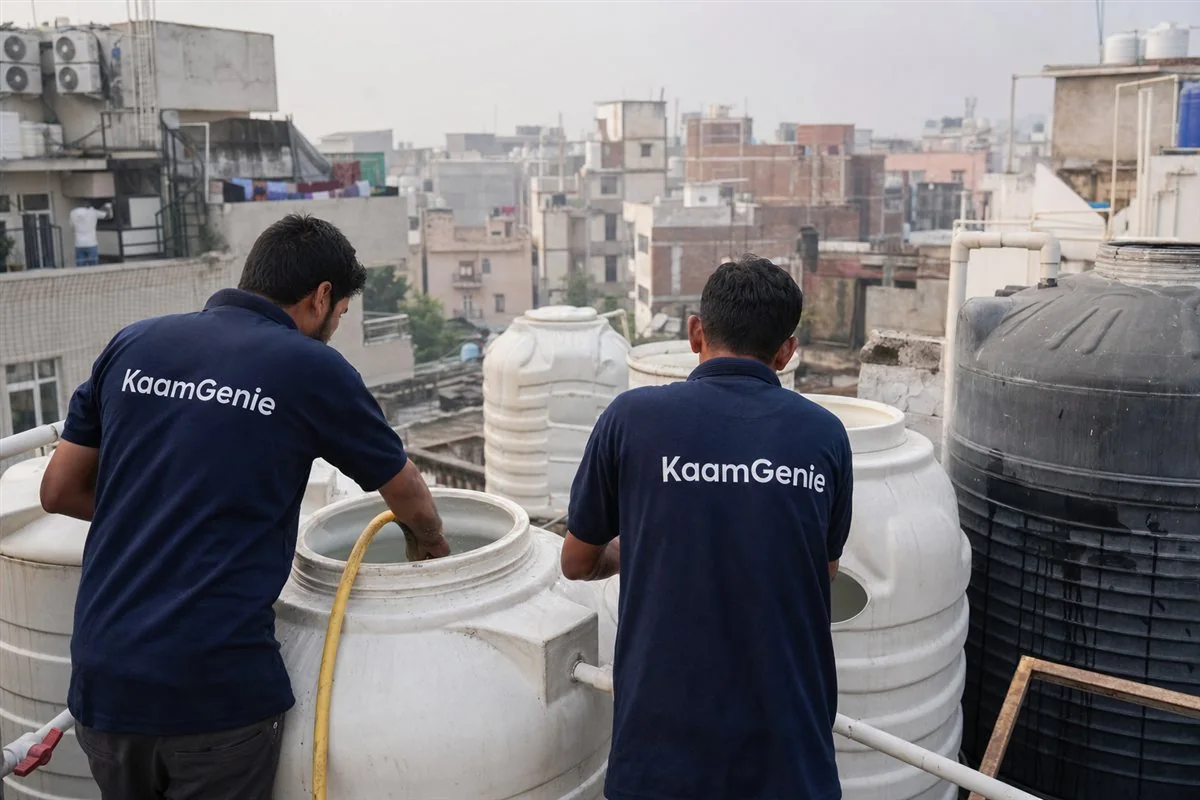
The short version
- High occupancy = fast fouling. 20–40 people on one tank build sediment and biofilm roughly twice as fast as a family home.
- Clean every 2–3 months, not every 6 — busy PGs and co-living buildings need a tighter schedule.
- It’s the owner’s / operator’s job, not the tenants’. Rent buys a hygienic stay.
- Clean the sump AND the rooftop tanks together — a dirty sump re-pollutes clean rooftop tanks within days.
- From ₹699 per tank; whole-building and quarterly plans bring the per-tank cost down.
If your PG tank hasn’t been opened in six months and 30 people drink from it, assume it needs cleaning today.
Delhi’s student and young-professional belts run on paying-guest accommodation. Munirka and Ber Sarai feed JNU and IIT, the Mukherjee Nagar and North Campus belt houses civil-services aspirants, Laxmi Nagar packs in coaching students, and Satya Niketan sits next to the South Campus colleges. Add the branded co-living clusters around Mahipalpur and the Dwarka high-rises, and you have tens of thousands of buildings where one or two tanks serve far more people than they were ever sized for.
The water reaches these buildings the same way it reaches everyone else — water tank cleaning in Delhi is shaped by Delhi Jal Board piped supply where it exists, private tankers when it doesn’t, and borewell groundwater in the outer and unauthorised colonies. The difference in a PG is not the water coming in. It’s what happens to it once it sits in a tank that 30 people draw down and refill several times a day.
| Building type | People on one tank | Daily turnover | Recommended cleaning |
|---|---|---|---|
| Family home / builder floor | 3–5 | Tank cycles once | Every 6 months |
| Small PG (single floor) | 8–15 | 2–3 times | Every 3–4 months |
| Busy PG (3–4 floors) | 20–40 | 3–5 times | Every 2–3 months |
| Co-living building | 50–120 | Sump + tanks cycle constantly | Every 2 months + AMC |
Book your PG tank cleaning
Sump plus rooftop tanks in one visit, before/after photos, dated certificate for your tenants. ₹699 onwards per tank.
Why PG tanks foul twice as fast
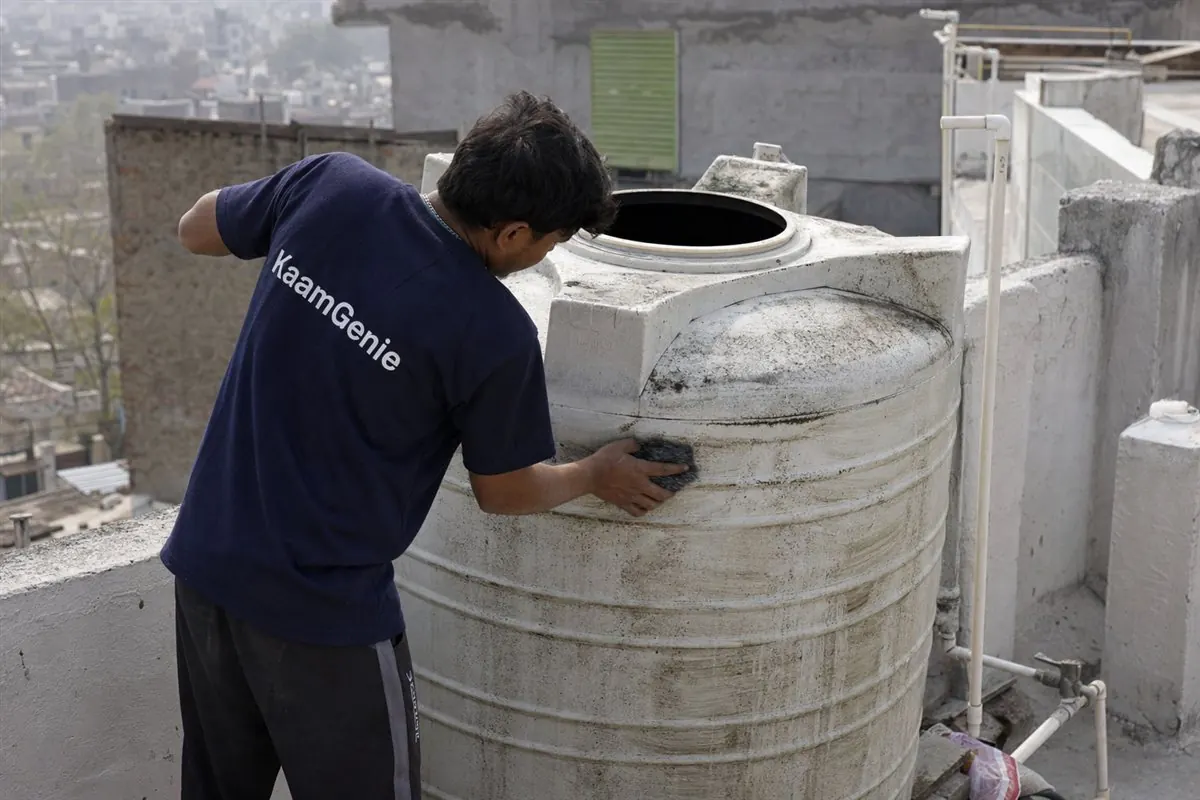
The single thing that decides how dirty a tank gets is throughput. A family of four draws their tank down once a day, so the water sits still long enough to settle and the inlet runs briefly. A 30-bed PG cycles the same tank three to five times a day. The float valve is opening constantly, fresh water keeps mixing in, and the tank never gets the long quiet hours when sediment drops out and the water clears.
That constant churn does three things. First, it keeps stirring fine sediment — sand, rust off old DJB mains, borewell silt — so it never fully settles and a thin film coats every surface. Second, the steady supply of fresh, slightly warm water is exactly what biofilm feeds on; the slimy bacterial layer that grows on tank walls thrives when it’s fed often, which in a PG is all day. Third, the sheer volume of summer top-ups matters: when DJB pressure drops, a busy PG in Munirka or Mahipalpur orders private tankers, and tanker water carries far more sediment than piped supply, dumping a fresh load into the tank each fill.
Put together, a PG tank reaches the condition a family tank takes six months to reach in roughly two. From the lid it looks fine — clear water on top. The problem is the bottom half-inch of sludge and the wall film that no one sees because no one opens a 30-person tank to look. If you want the full list of warning signs, our guide to the signs a tank needs cleaning urgently covers what tenants notice first.
The student belts where this matters most
We clean PG and co-living tanks right across the city, but the demand concentrates in a handful of belts. Around Munirka and Ber Sarai — the JNU and IIT catchment — almost every plotted house has been converted to a PG, often four floors of rooms on a single underground sump and one or two rooftop tanks. Mukherjee Nagar and the North Campus belt run the same model for civil-services students. Laxmi Nagar and Satya Niketan pack in coaching and college crowds.
Then there’s the branded co-living layer: large managed buildings around Mahipalpur near the airport and the Dwarka high-rise societies, where a single building can house 80 to 120 residents on a big reservoir feeding several rooftop tanks. These need not just cleaning but a schedule — the kind of arrangement we run as annual contracts for societies and RWAs, adapted for a co-living operator.
Whose job is it — owner, operator, or tenant?
This is the question that causes the most confusion, so let’s be plain about it. Cleaning the tank is the responsibility of the person who runs the PG and collects the rent — the owner, or the facility-management team in a co-living brand. It is not the tenants’ job, and it never was.
The logic is simple. A tenant pays rent for a habitable, hygienic place to live, and a working, clean water supply is part of that basic standard. Students rotate every few months and have no access to the rooftop or the sump anyway. Expecting a paying guest to organise tank cleaning is like expecting them to re-tile the bathroom. Where this goes wrong is when an owner treats the tank as “out of sight, out of mind” — nobody complains because nobody can see inside, so years pass between cleanings while 30 people drink from it.
Good operators flip this around and use it as a selling point. A dated cleaning certificate on the noticeboard, or sent to a parent who asks, is a cheap and powerful trust signal in a market where parents are choosing a PG for their child sight unseen. We bill the owner or operator directly and hand them that record every visit.
Sump plus rooftop tanks — clean the whole chain
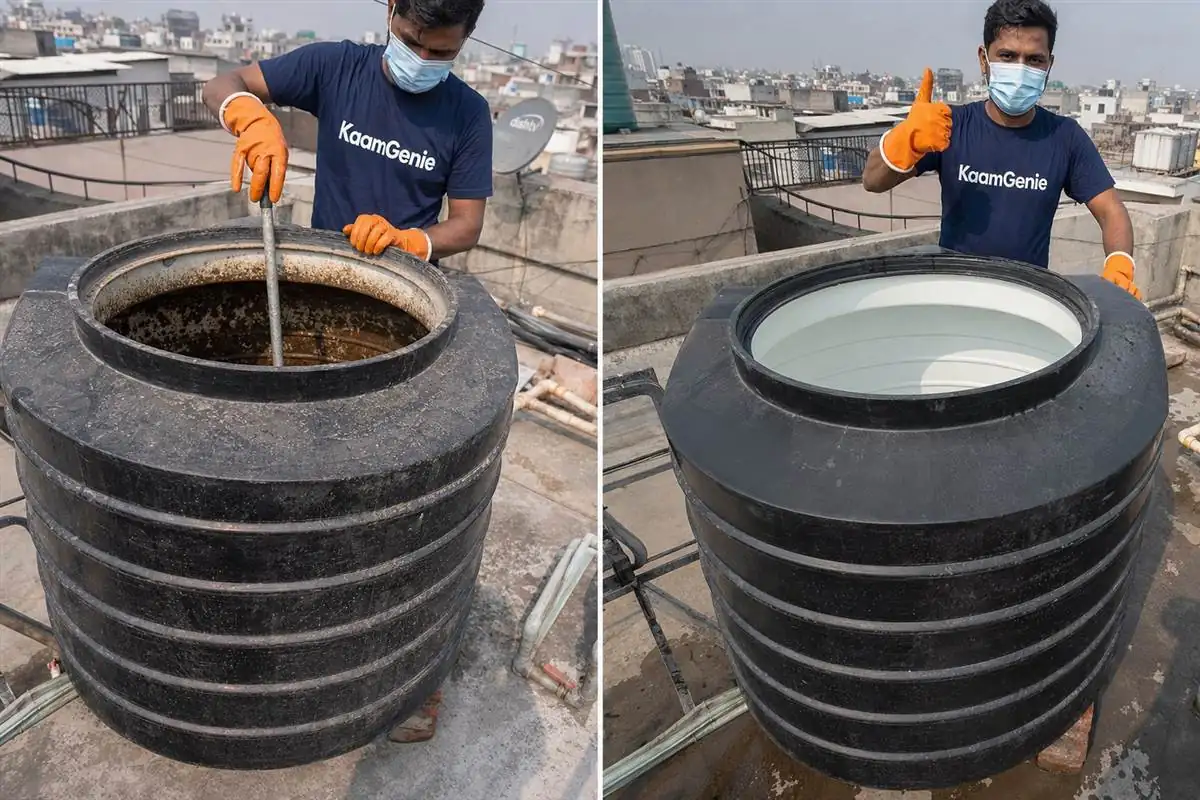
Most PGs store water in two stages: incoming DJB or tanker water fills an underground sump at ground level, and a pump lifts it to the rooftop tanks that actually feed the taps. This two-stage layout is where a lot of cheap cleanings go wrong. An operator pays someone to “clean the tank,” they rinse the rooftop tank, and the sump — the bigger, dirtier, harder-to-reach one — never gets touched.
That’s a waste of money. The sump is the first thing the water sits in, so it holds the most sediment, and the pump keeps pushing that sediment straight back up to the “clean” rooftop tank. Within days you’re back where you started. A proper PG job covers the underground sump and every overhead tank in the same visit, so the entire supply chain is clean at once. We follow the same documented method described in our 8-step cleaning process — drain, sludge removal, manual scrub, jet wash, vacuum, food-grade disinfection — scaled up for the larger sump.
This is the part corner-cutters skip and the part that actually protects tenant health. The organisms that cause stomach upsets, typhoid and skin trouble live in that bottom sludge and wall biofilm, not in the clear water on top. Disinfection with food-grade sodium hypochlorite, at the concentrations recommended in the BIS IS 10500 and WHO drinking-water frameworks, is what kills them — and it only works once the sludge is physically removed first.
Days until a tank needs cleaning again — by occupancy
More people on one tank means a shorter safe interval before sludge and biofilm return
Indicative intervals for Delhi conditions, assuming tanker top-ups in summer. Hard-water pockets and uncovered tanks shorten them further. Not a lab measurement — a field rule of thumb.
Run a PG or co-living building?
Put your tanks on a quarterly plan and stop worrying about it. Documented every visit. Standard cleaning ₹699 onwards per tank.
What it costs per tank
Standard residential cleaning starts at ₹699 per tank. Most PGs, though, don’t fit a single flat figure because they have more than one tank — typically an underground sump plus one or two rooftop tanks — so they run on a per-tank or whole-building quote. The big variables are the number and size of tanks, sump access, and how neglected they are on the first visit; a tank that hasn’t been opened in two years takes longer and may need a heavier first clean.
The way to keep the cost sensible is to book everything in one visit rather than calling someone out per tank, and to move onto a quarterly schedule once the building is on a known cycle — regular cleanings are quicker and cheaper than rescue jobs. For the full breakdown of how Delhi quotes are built up, see our water tank cleaning cost guide for Delhi; if you’re weighing how frequently to budget for it, how often to clean a water tank in Delhi goes deeper on intervals. A word of warning on the ₹200–300 quotes that circulate in the student belts: at that price the sludge removal, jet wash and food-grade disinfection are being skipped, which on a 30-person tank is exactly the wrong economy.
Beyond the residential rate, society, underground-reservoir and commercial-scale jobs are custom-quoted — the same way we price our water tank cleaning services across Delhi NCR for buildings that don’t fit the standard single-tank mould.
Book a clean tank for your tenants
If you run a PG or co-living building anywhere in Delhi and you can’t remember the last time the tanks were opened, that’s your answer — it’s overdue. We clean the sump and every rooftop tank in one visit, document it with before/after photos and a dated certificate, and can put you on a quarterly cycle so it’s never your problem again. Start from the water tank cleaning in Delhi hub or just call us. To book, call +91 95603 66362 or use the booking form on this page — we’ll confirm shortly.
Frequently asked questions
How often should a PG or co-living water tank be cleaned in Delhi?
Every 2 to 3 months for a busy PG, against the every-6-months advice for a family home. Occupancy is the deciding factor — 20 to 40 people draw and refill the same tank far more than a family of four, so sediment, soap scum and biofilm build up roughly twice as fast. Summer tanker top-ups in areas like Munirka and Mahipalpur add more sediment, which shortens the safe interval further.
Who is responsible for cleaning the tank in a PG — the owner or the tenants?
The owner or operator who runs the PG. Tenants pay rent for a habitable, hygienic stay, so maintaining the stored-water system sits with whoever collects that rent — not the students. In a co-living brand it is the facility-management team. We bill the owner or operator and hand them a dated cleaning record they can show tenants or parents who ask.
How much does PG water tank cleaning cost in Delhi?
Standard residential cleaning starts at ₹699 per tank, and most PGs run on a per-tank or whole-building quote because they have one or two overhead tanks plus an underground sump. A typical 3 to 4 storey PG with a sump and two rooftop tanks is usually a custom quote rather than a flat figure. Booking all tanks in one visit, or on a quarterly plan, brings the per-tank cost down.
Why do PG and co-living tanks get dirty so much faster than family homes?
Pure throughput. A high-occupancy building cycles the full tank volume several times a day, so the inlet runs almost constantly and the water rarely sits still long enough to settle clean. Constant warm refills feed biofilm on the walls, and frequent tanker or borewell top-ups carry in extra sediment. The result is a tank that looks fine from the lid but carries a slimy bottom layer within weeks.
Do you clean both the underground sump and the overhead tanks in a PG?
Yes, and in a PG both matter equally. Most buildings store incoming DJB or tanker water in an underground sump, then pump it to rooftop tanks. If you clean only the rooftop tanks, the sump keeps pushing sediment back up. A proper PG job covers the sump and every overhead tank in the same visit so the whole supply chain is clean at once.
Can the cleaning be done without shutting water to the whole PG?
Largely, yes. We plan around the building so disruption is short. If there are two rooftop tanks we can clean one while the other supplies the building, then switch. For single-tank buildings we schedule a low-use window — late morning after most tenants have left — and the supply is back within a couple of hours. We tell the operator the exact window in advance so they can post a notice.
How long does it take to clean all the tanks in a PG?
A single 1,000L rooftop tank takes 75 to 90 minutes. A typical PG with an underground sump and two overhead tanks is usually a 3 to 4 hour job for one crew, or a half-day for a larger co-living building with a big reservoir and several rooftop tanks. We give a time estimate when we see the layout, so the operator can plan the notice to tenants.
Do you provide a cleaning certificate tenants or owners can see?
Yes — every job ends with before and after photos and a dated cleaning record listing tank type, capacity, chemicals used and the service date. PG owners use it to reassure parents and tenants, and co-living brands keep it on file for their hygiene SOPs. It is the same documentation we provide for society RWA contracts.
What Delhi areas do you cover for PG and co-living tank cleaning?
All of Delhi, with heavy demand in the student and working-professional belts — Munirka and Ber Sarai near JNU and IIT, Mukherjee Nagar and the North Campus belt, Laxmi Nagar, Satya Niketan, plus the co-living clusters around Mahipalpur and the Dwarka high-rises. We serve overhead tanks and underground sumps across all of these on a same-day-where-possible basis.
Sources & references
- Bureau of Indian Standards (BIS) — IS 10500:2012 is the canonical Indian Standard for drinking water specification, defining acceptable limits for physical, chemical, and biological parameters.
- WHO Guidelines for Drinking-water Quality, 4th edition — the global reference for water quality standards, including guidance on storage and disinfection.
- Food Safety and Standards Authority of India (FSSAI) — defines water quality requirements for food businesses, including hygiene standards for stored water and acceptable disinfection chemicals.
- WHO Fact Sheet on Drinking Water — overview of safe drinking water requirements and contamination risks.
- CPHEEO — Manual on Water Supply and Treatment — the Government of India’s engineering manual covering tank design, cleaning protocols, and disinfection practices.
Last verified: 30 June 2026. If you find any of these links broken, please let us know.