
Water Tank Cleaning Rules & Norms
Raj Babbar · 9 min read
Home › Water Tank Cleaning › Overhead Tank Cleaning › Civil Lines
Civil Lines was one of the first parts of Delhi laid out for gracious living, and the same large bungalows that carry its heritage also carry large, slow-turning rooftop tanks. KaamGenie cleans those overhead tanks for the colony's kothis, government quarters and institutional buildings. From ₹699.
Civil Lines carries the memory of colonial-era Delhi in its wide, tree-lined avenues, its sprawling bungalows and its cluster of old institutional buildings. Almost every one of them runs on steady DJB piped supply drawn into a big underground sump and lifted to a generous rooftop overhead tank. The trouble with generous capacity is turnover: a tank sized for a large house empties slowly, so the water inside sits still for long spells. Still water is exactly what lets sediment settle out and an organic film creep across the tank walls. The older masonry sumps common here take in grit through hairline cracks, and that grit rides up into the overhead tank on every pump cycle. So even where the piped water arrives looking crystal clear, the rooftop vessel it lands in is quietly ageing the supply.
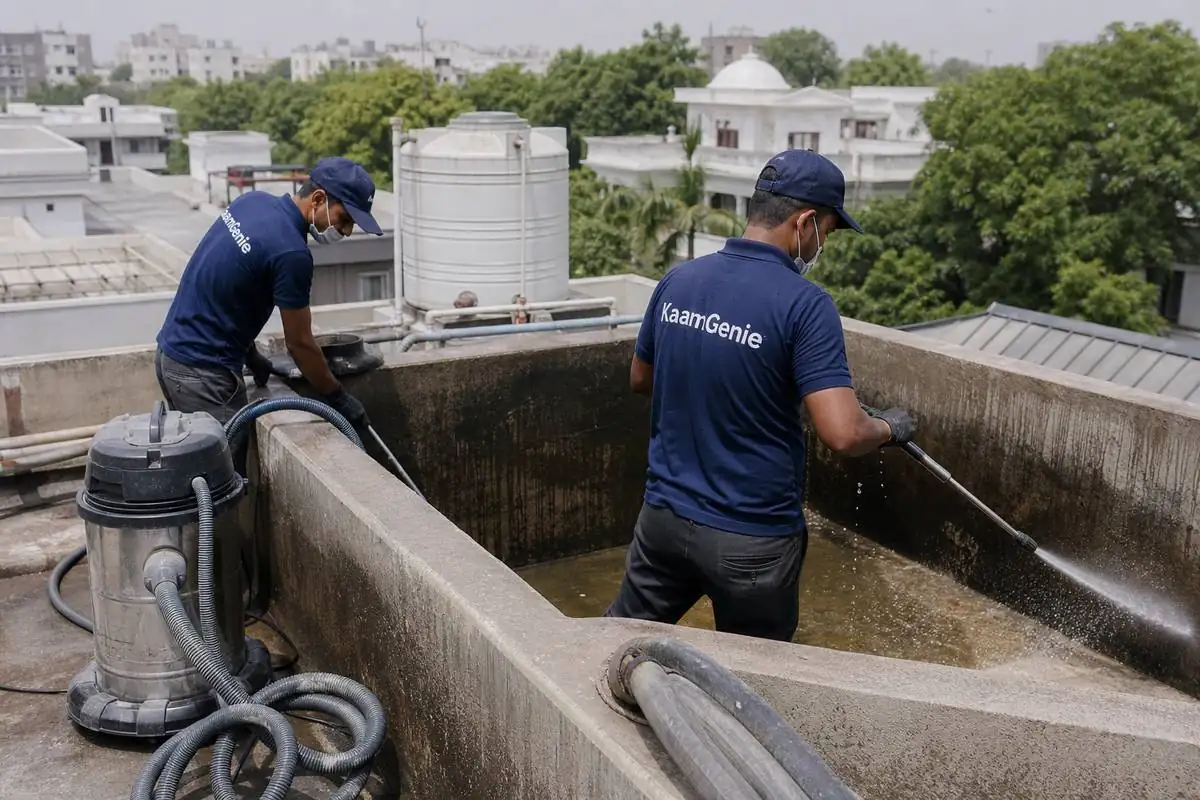
We clean these heritage-home rooftop tanks without cutting corners. The crew drains the tank fully, lifts out the settled sludge, jet-washes the scale from the walls, hand-scrubs the corners and the outlet, then applies an anti-bacterial disinfectant wash before refilling. Dated before-and-after photos come to you on WhatsApp. This page is part of our broader water tank cleaning in Civil Lines service and deals specifically with the overhead (rooftop) tanks rather than the underground storage.
Low density is the quiet culprit here. A large bungalow with only a handful of residents draws far less than its rooftop tank can hold, so the same water can linger for days before it is fully replaced. That long dwell time gives calcium time to drop out onto the walls and gives biofilm the still conditions it needs to spread. The clearer the water looks going in, the easier it is to assume the tank behind the tap is fine.
The institutional and government buildings in the precinct add their own version of the same problem, with oversized tanks feeding wings that are only partly occupied. Their maintenance often falls between departments, so the rooftop tanks go years without a proper drain-down. Whether it is a private kothi or a shared official block, the fix is the same steady annual clean that keeps a slow-turning tank from souring the water it holds.
No travel charge anywhere in Civil Lines. The final price is confirmed on the call before we come — it depends only on tank size and access.
See it done in 45 seconds
Watch our web story on how a tank is really cleaned — drain, de-sludge, jet-wash, disinfect.
We reach every pocket of Civil Lines — and there’s no travel charge to any of them:
Every locality in Delhi stores different water, and that decides how fast a tank fouls. This is Civil Lines’s profile from The Delhi Water Index, built from our field observations across 250+ localities.
Indicative field characterisation, not a certified lab test. BIS IS 10500: TDS 500 mg/L acceptable, 2,000 permissible. Check any Delhi area →
“Can you work around a heritage bungalow without disturbing the structure?” Yes. We work off your existing terrace access and never drill or alter the tank or the roof. The jet-wash and hand-scrubbing are done inside the tank, so nothing about the building fabric is touched. On the older Civil Lines kothis we take extra care with fragile lids and parapets, and we leave the terrace as we found it.
“The tank is very large and rarely used. Is one clean a year really enough?” For a low-occupancy Civil Lines home an annual clean is the right baseline, because it is the still, slow-turning water that causes the buildup, not heavy use. If the house sits empty for long stretches or the water starts tasting flat between visits, we would suggest every eight or nine months. We can set a reminder for you so it does not get forgotten.
“Do you handle the shared tanks on the government and institutional blocks here?” We do. We clean large shared rooftop tanks on official quarters and institutional buildings, and we can raise a single invoice for the estate or split it per block, whichever the office prefers. For multiple tanks in one visit we quote ₹2,400 to ₹3,000 for the building depending on count and size.
“How long will the water be off during the clean?” A single large overhead tank takes about two hours end to end, and the water is only interrupted while we drain and refill, so most of that time you can still draw from the sump-fed lines. If you tell us your preferred window we schedule around it, and the supply is back to normal the same day.
“What exactly do you do about the film on the tank walls?” The film is organic biofilm that thin municipal chlorine cannot shift on its own. We jet-wash it off under pressure, hand-scrub the stubborn corners where it clings, then apply an anti-bacterial disinfectant wash across every surface. That combination lifts the film and leaves the walls clean rather than just rinsed.
See our complete water tank cleaning services in Delhi NCR — pricing, process, tank types and full city coverage.
Beyond water tank cleaning, KaamGenie is rolling out a full lineup of home services across Delhi NCR — see our complete list of 12 home services we offer or will be launching through 2026. New to tank cleaning? Read our guide on how to pick the right water tank cleaning service in Delhi — what to look for, what to avoid, and the questions that separate trustworthy crews from quick-job operators.
Rooftop plastic tanks
₹699+ →Kothi sumps & underground tanks
₹1,499+ →Apartments & RWAs
Bulk pricing →FSSAI-compliant cleaning
₹2,500+ →टंकी साफ़ करने वाले
हिन्दी पढ़ें →View all water tank cleaning guides →
All pockets and lanes of Civil Lines covered. If your specific block or society isn’t named in the sub-areas above, just call — we almost certainly cover it.
Same crew, same 6-step process, same-day where possible. Pick any locality below for local pricing and the tanks we typically find there.
Book a slot — we can usually fit you in today or tomorrow.