
Waterborne Diseases & Tank Cleaning
Raj Babbar · 10 min read
Home › Water Tank Cleaning › Society / RWA Tank Cleaning › Ambedkar Nagar
Society & RWA water tank cleaning across Ambedkar Nagar. We survey and clean the whole building’s bank of shared overhead and underground tanks in one coordinated visit, then hand your RWA a dated cleaning quality report for the maintenance file. Bulk pricing for the entire block — typically ₹1,500–2,000 per tank when six or more are done together.
Ambedkar Nagar is a dense 1970s resettlement colony of narrow-plot walk-up houses and small builder-floor blocks near Govindpuri and Madangir, where several flats often draw from one shared overhead and underground tank per building. DJB pressure runs low and borewells fill the gap, so nearly every block leans on stored water — and that shared storage is exactly what gets forgotten. In a colony this tightly packed, the RWA or building committee usually owns a whole bank of Sintex overhead tanks and small ground sumps feeding many households at once.
Because these tanks serve everyone in the block, sediment and borewell scale that build up in one neglected sump affect every flat above it. We handle the entire bank in a single planned visit, the same crew and standard behind our water tank cleaning in Ambedkar Nagar, scaled up for society-sized storage. That means one schedule, one quality report and clean water restored to every home in the building.
Low DJB pressure means Ambedkar Nagar blocks refill from a mix of pipeline and borewell water, and borewell water carries fine silt and mineral scale that settles fast in a shared sump. When one underground tank feeds a dozen flats, that sediment layer becomes a breeding bed for bacteria and biofilm that no amount of surface flushing removes. Cleaning every 3–4 months keeps the whole bank ahead of the buildup instead of chasing complaints after the water already smells.
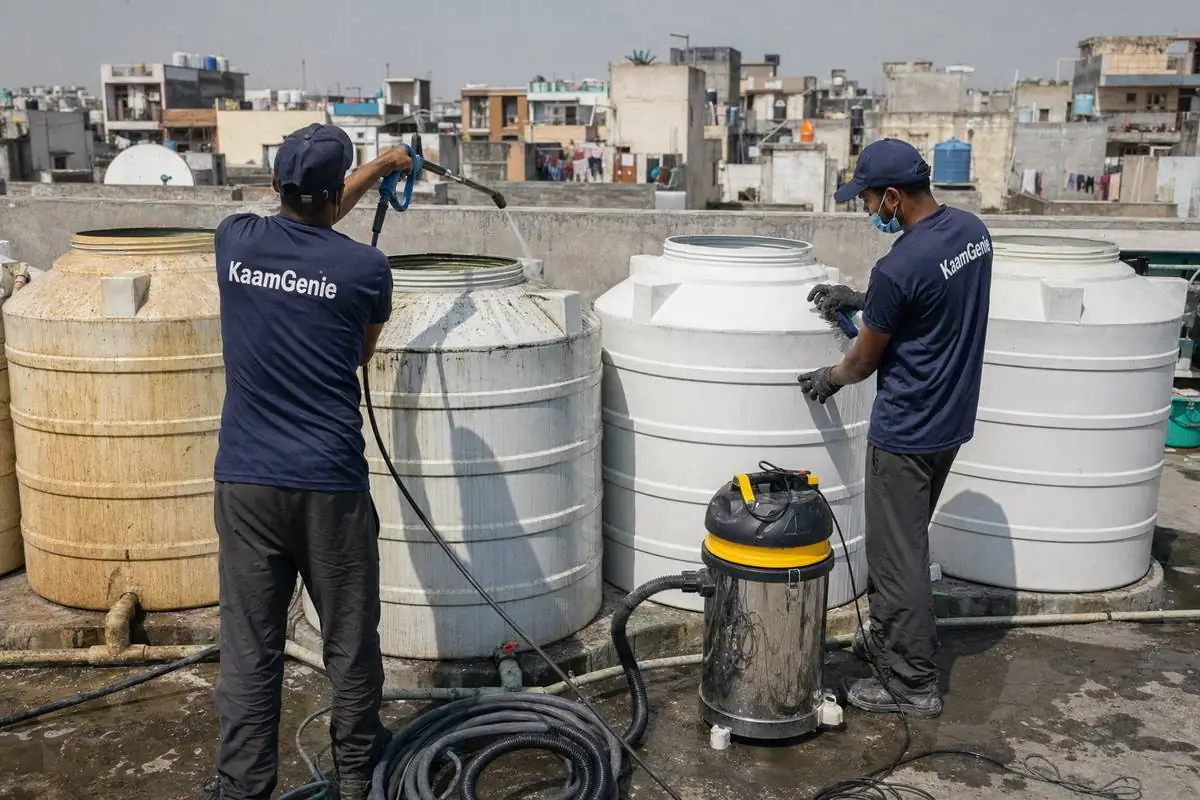
For an RWA the practical win is doing it once for the whole building rather than flat by flat. We isolate and drain each tank in turn so supply is never cut off across the block, remove the sludge, jet-wash and hand-scrub every surface, then apply anti-bacterial disinfectant tank by tank. You get before-and-after photos of each tank, which makes the quarterly clean an easy line item to approve at the RWA meeting.
No travel charge anywhere in Ambedkar Nagar. The final price is confirmed on the call before we come — it depends only on tank size and access.
See it done in 45 seconds
Watch our web story on how a tank is really cleaned — drain, de-sludge, jet-wash, disinfect.
We reach every pocket of Ambedkar Nagar — and there’s no travel charge to any of them:
Every locality in Delhi stores different water, and that decides how fast a tank fouls. This is Ambedkar Nagar’s profile from The Delhi Water Index, built from our field observations across 250+ localities.
Indicative field characterisation, not a certified lab test. BIS IS 10500: TDS 500 mg/L acceptable, 2,000 permissible. Check any Delhi area →
“Can you clean our whole building’s tanks in one visit in Block C, Ambedkar Nagar?” Yes. We start with a quick site survey to count every overhead tank and underground sump the block shares, then clean them all in one coordinated visit. For a typical Block C builder floor with two or three shared tanks that is a single half-day; larger banks are scheduled tank by tank so we finish the same day. You get one quality report covering the entire building.
“Will water supply be cut off to the flats while you clean?” No. We isolate and drain one tank at a time and keep the others in service, so at least part of the bank is always feeding the block. Most Ambedkar Nagar buildings have enough overhead storage that residents never notice an interruption. We time the work around your morning and evening supply hours so pumps refill normally afterwards.
“Do you give a quality report we can keep in the maintenance file?” Yes. Every job ends with a dated cleaning quality report listing each tank cleaned, plus before-and-after photos of every tank. RWAs in Ambedkar Nagar use it to show residents the shared storage is maintained and to keep an audit trail between cleans. It is issued in the building or society’s name.
“How often should a resettlement-colony block here get its tanks cleaned?” Because Ambedkar Nagar runs on low-pressure DJB water topped up by borewells, we recommend every 3–4 months for shared society tanks. Borewell scale and silt settle quickly in the ground sump, so a quarterly clean keeps the whole bank ahead of it. Buildings that skip a season usually see complaints about smell or cloudy water first.
“What is the bulk price for cleaning six to eight shared tanks?” For a full bank of six or more tanks we charge roughly ₹1,500–2,000 per tank rather than a single flat figure, since sizes vary between overhead Sintex and larger ground sumps. Doing the whole building together brings the per-tank rate down compared with one-off cleans. We give the RWA a firm quote after the survey, and an AMC option locks the rate for the year.
See our complete water tank cleaning services in Delhi NCR — pricing, process, tank types and full city coverage.
Beyond water tank cleaning, KaamGenie is rolling out a full lineup of home services across Delhi NCR — see our complete list of 12 home services we offer or will be launching through 2026. New to tank cleaning? Read our guide on how to pick the right water tank cleaning service in Delhi — what to look for, what to avoid, and the questions that separate trustworthy crews from quick-job operators.
Rooftop plastic tanks
₹699+ →Kothi sumps & underground tanks
₹1,499+ →Apartments & RWAs
Bulk pricing →FSSAI-compliant cleaning
₹2,500+ →टंकी साफ़ करने वाले
हिन्दी पढ़ें →View all water tank cleaning guides →
All pockets and lanes of Ambedkar Nagar covered. If your specific block or society isn’t named in the sub-areas above, just call — we almost certainly cover it.
Same crew, same 6-step process, same-day where possible. Pick any locality below for local pricing and the tanks we typically find there.
Book a slot — we can usually fit you in today or tomorrow.