
How Long Does Tank Cleaning Take?
Raj Babbar · 8 min read
Home › Water Tank Cleaning › Society / RWA Tank Cleaning › Chand Bagh
The borewell that fills Chand Bagh's shared tanks pulls very hard water from this low-lying riverside pocket, and it leaves its mark on every tank it touches. We clean the whole building in one coordinated visit, staggering the tanks so supply is never fully cut. The building is quoted in bulk, then split across the flats above.
Chand Bagh sits low along the Wazirabad Road drain, a congested riverside belt where the groundwater runs very hard. The shared tanks on these buildings are filled from that borewell, and the mineral load leaves a stubborn scale and a chalky sediment on the tank floor. Most buildings here are shopfronts with residential floors stacked above, and a single shared tank commonly feeds those packed upper floors. With many families drawing off one tank, the deposits keep getting churned back into the water. The tank belongs to the whole building rather than any one flat, so cleaning it slides down everyone's list. A coordinated clean of the shared tanks is the sensible way to reset the water for the building.
Should you only want your own flat's tank and line attended to, our regular water tank cleaning in Chand Bagh handles that on its own. This page covers the shared building tanks that feed the residential floors above the shops, where one survey and a single split invoice work far better than flat-by-flat bookings. We count the shared tanks per building and quote them together in bulk. The floors then divide one figure rather than each chasing a separate job.
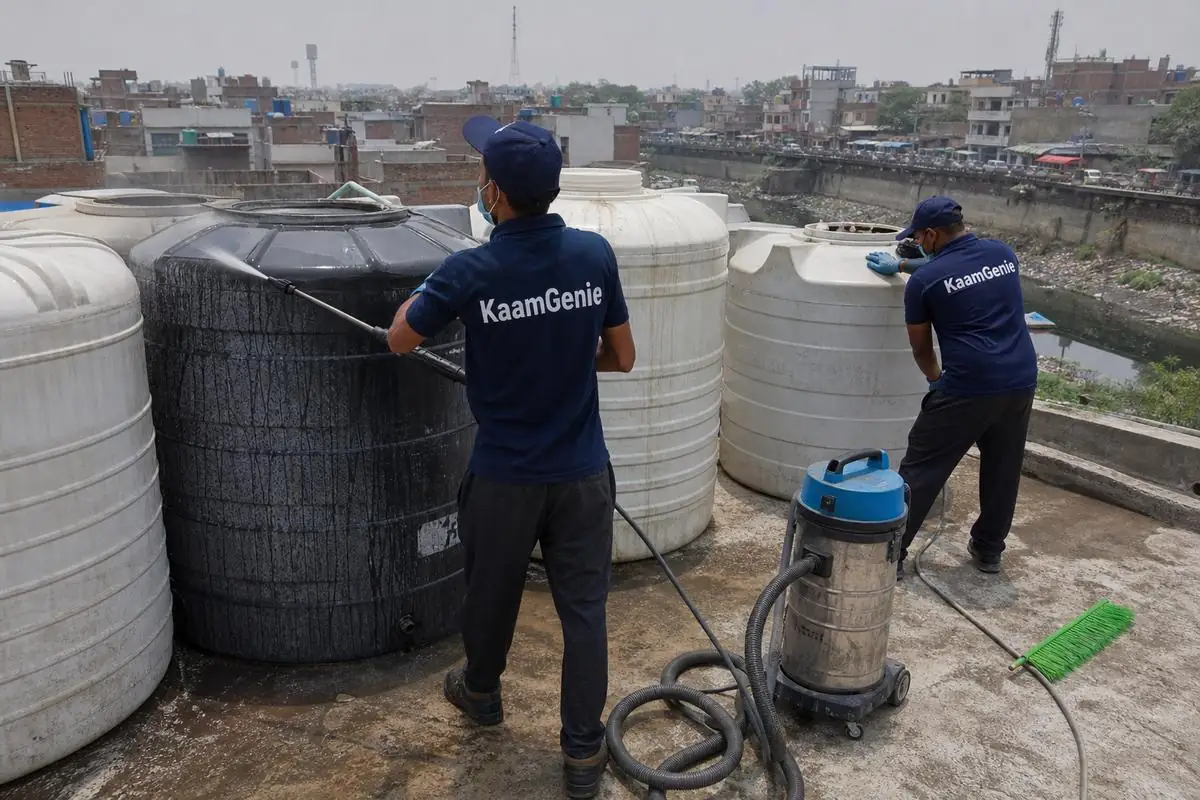
The riverside water chemistry drives everything here. This low-lying belt sits on very hard groundwater, so the shared tanks accumulate a thick mineral scale and a fine chalky sediment faster than tanks on softer supply. Every family drawing from that tank draws the same deposits, and the film keeps rebuilding on the walls between cleans. Only a proper clean of the shared tank strips that scale back and clears the water for all the floors it feeds.
In shopfront buildings the shared tank tends to be out of sight and out of mind, so its cleaning is forever put off. We lift that off the residents entirely. One person shows us up to the roof, we survey and quote the shared tanks in a single bulk figure, clean them in a staggered order so no floor loses its supply, and settle it with one invoice split across the flats. A shared 2,000 to 3,000L tank sits around ₹1,500 to ₹2,000, buildings running several small tanks nearer ₹699 to ₹899 each, with about 15 to 20 percent off for doing the whole building.
No travel charge anywhere in Chand Bagh. The final price is confirmed on the call before we come — it depends only on tank size and access.
See it done in 45 seconds
Watch our web story on how a tank is really cleaned — drain, de-sludge, jet-wash, disinfect.
We reach every pocket of Chand Bagh — and there’s no travel charge to any of them:
Every locality in Delhi stores different water, and that decides how fast a tank fouls. This is Chand Bagh’s profile from The Delhi Water Index, built from our field observations across 250+ localities.
Indicative field characterisation, not a certified lab test. BIS IS 10500: TDS 500 mg/L acceptable, 2,000 permissible. Check any Delhi area →
“Will the shops and flats lose water while you clean the shared tank?” No. We stagger the tanks so one is cleaned while the others stay in service, keeping the residential floors supplied throughout. The shops below are unaffected. Only the single tank being scrubbed goes briefly offline.
“How does the bill split between the floors above the shops?” We quote the building's shared tanks as one bulk figure and divide it across the flats that draw from them. A 2,000 to 3,000L shared tank is about ₹1,500 to ₹2,000, and a building on many small tanks can work out nearer ₹699 to ₹899 per tank. You get a single invoice, split by flat, rather than separate bills.
“Given the hard water here, how often should the shared tanks be cleaned?” With very hard riverside borewell water and several families on one tank, twice a year is the practical minimum in Chand Bagh. The mineral scale rebuilds quickly, so a longer gap lets the chalky film return across every floor. Our annual plan books both cleans upfront at roughly 20 to 25 percent off.
“Can you reach buildings in the congested lanes near the drain?” Yes, we work the tight riverside lanes here regularly and carry equipment in on foot where vehicles cannot pass. The access does not change our method or the quote. We clean the shared rooftop tanks the same way regardless of how narrow the approach is.
“What if the shared tank has not been cleaned in years?” That first deep clean is exactly where a long-neglected Chand Bagh tank turns around. We remove the built-up scale and settled sediment, then finish with an anti-bacterial wash so the water clears for every floor. After the initial clean a twice-yearly plan keeps it from building back up.
See our complete water tank cleaning services in Delhi NCR — pricing, process, tank types and full city coverage.
Beyond water tank cleaning, KaamGenie is rolling out a full lineup of home services across Delhi NCR — see our complete list of 12 home services we offer or will be launching through 2026. New to tank cleaning? Read our guide on how to pick the right water tank cleaning service in Delhi — what to look for, what to avoid, and the questions that separate trustworthy crews from quick-job operators.
Rooftop plastic tanks
₹699+ →Kothi sumps & underground tanks
₹1,499+ →Apartments & RWAs
Bulk pricing →FSSAI-compliant cleaning
₹2,500+ →टंकी साफ़ करने वाले
हिन्दी पढ़ें →View all water tank cleaning guides →
All pockets and lanes of Chand Bagh covered. If your specific block or society isn’t named in the sub-areas above, just call — we almost certainly cover it.
Same crew, same 6-step process, same-day where possible. Pick any locality below for local pricing and the tanks we typically find there.
Book a slot — we can usually fit you in today or tomorrow.