
Water Tank Disinfection Explained
Raj Babbar · 10 min read
Home › Water Tank Cleaning › Society / RWA Tank Cleaning › Chandni Chowk
Whole-building tank cleaning for the old havelis and shop-cum-residence buildings of Chandni Chowk, where one owner or the shop association books the shared terrace tanks for the whole structure. Cleaned in a single coordinated visit. Bulk pricing for the whole building.
Above the shopfronts of Chandni Chowk sit the old havelis, three and four floors of residence stacked over the trade below, and each one stores its water in a shared terrace tank or two rather than tank-per-flat. Ownership of those tanks sits with one haveli owner or the shop association, so upkeep is a whole-building decision, not a residents' vote. The walled-city DJB lines are old and the bazaar throws up constant dust, so sediment and scale collect in the small tanks quietly. Getting to the terrace means climbing steep, narrow haveli staircases, which is exactly why owners let cleaning slide for a year at a time. The same stored water then feeds the family kitchens and the shop washrooms below. A tank left that long turns the whole building's supply cloudy and unsafe.
KaamGenie cleans every shared tank a Chandni Chowk haveli runs in one visit, arranged with the owner or the shop association so the shops and homes are not cut off. We stagger the tanks to keep supply moving through the building, break down the walled-city sediment and scale by jet and hand scrub, finish with an anti-bacterial / disinfectant wash, and leave a dated record with before-and-after photos of each tank. For a single unit, see water tank cleaning in Chandni Chowk. This page focuses on shared building and society tanks.
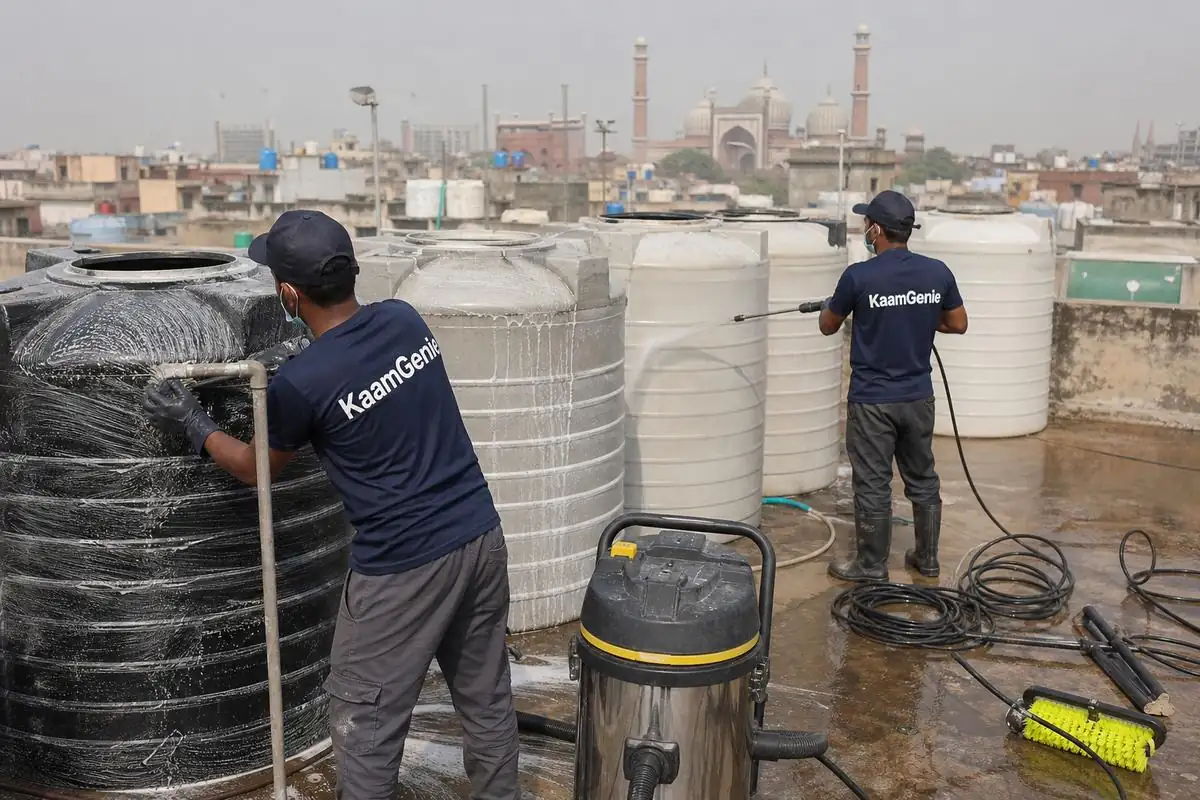
A haveli tank feeds the whole building, family floors and shop below, so it is drawn on all day and the sediment load stacks up. Bazaar dust and the fine silt in the old DJB water settle together in the small terrace tanks, and the tight terraces mean nobody opens them to check. After months the layer thickens into a bed that holds bacteria and taints the water rising to every tap in the building. In a structure where people live above their trade, that reaches everyone. A clean every three to four months keeps the shared supply clear across the whole haveli.
Owners here defer the job because the steep haveli stairs and the crowded terrace make it feel like a major undertaking. We take that on: one survey plans the access and counts the tanks, and one scheduled visit clears the building with trade carrying on below. Cleaning all the tanks together costs less than calling us for each in turn, and an annual AMC of four visits keeps the dust-heavy tanks in hand while handing the owner before-and-after photos for the maintenance file each time.
No travel charge anywhere in Chandni Chowk. The final price is confirmed on the call before we come — it depends only on tank size and access.
See it done in 45 seconds
Watch our web story on how a tank is really cleaned — drain, de-sludge, jet-wash, disinfect.
We reach every pocket of Chandni Chowk — and there’s no travel charge to any of them:
Every locality in Delhi stores different water, and that decides how fast a tank fouls. This is Chandni Chowk’s profile from The Delhi Water Index, built from our field observations across 250+ localities.
Indicative field characterisation, not a certified lab test. BIS IS 10500: TDS 500 mg/L acceptable, 2,000 permissible. Check any Delhi area →
“Do you clean shared terrace tanks in an old Chandni Chowk haveli?” Yes. We clean the full set of tanks a haveli runs, booked by the owner or the shop association, in one coordinated visit. A survey first works out the tank count and how we reach the terrace up the haveli stairs, then we fix a slot that suits the shops and the families.
“The staircase is very narrow. Is that a problem for your crew?” No. Our teams work the walled city regularly and are set up for tight haveli stairs and small terraces. We check the route during the survey and bring compact gear, so the clean goes ahead without needing structural changes to the building.
“How do you price a whole haveli building?” Each shared tank of 2,000 to 3,000 litres is ₹1,500 to ₹2,000. A Chandni Chowk haveli usually has one or two terrace tanks for the whole structure, so we bulk-quote them together, about 15 to 20 percent off the per-tank rate for a single visit.
“Can one family in the building book on its own?” Yes. A single family or a couple of floors can book their own tank even if the owner has not arranged a full clean. We leave a dated report afterwards, which owners often use to schedule the whole building's tanks the next time round.
“Is there an annual arrangement for haveli owners?” Yes. The yearly AMC runs four visits covering all the building's tanks at 20 to 25 percent off the per-visit rate. Given the steady bazaar dust, quarterly cleaning keeps the small tanks clear, and each visit finishes with photos for the building's file.
See our complete water tank cleaning services in Delhi NCR — pricing, process, tank types and full city coverage.
Beyond water tank cleaning, KaamGenie is rolling out a full lineup of home services across Delhi NCR — see our complete list of 12 home services we offer or will be launching through 2026. New to tank cleaning? Read our guide on how to pick the right water tank cleaning service in Delhi — what to look for, what to avoid, and the questions that separate trustworthy crews from quick-job operators.
Rooftop plastic tanks
₹699+ →Kothi sumps & underground tanks
₹1,499+ →Apartments & RWAs
Bulk pricing →FSSAI-compliant cleaning
₹2,500+ →टंकी साफ़ करने वाले
हिन्दी पढ़ें →View all water tank cleaning guides →
All pockets and lanes of Chandni Chowk covered. If your specific block or society isn’t named in the sub-areas above, just call — we almost certainly cover it.
Same crew, same 6-step process, same-day where possible. Pick any locality below for local pricing and the tanks we typically find there.
Book a slot — we can usually fit you in today or tomorrow.