
Water Tank Cleaning AMC Plans
Raj Babbar · 8 min read
Home › Water Tank Cleaning › Society / RWA Tank Cleaning › Gujranwala Colony (Kingsway Camp)
Society and RWA tank cleaning for the group-housing blocks and cooperative societies of Gujranwala Colony (Kingsway Camp), where shared sumps and rooftop tanks feed whole buildings of flats. Cleaned in one coordinated visit. Bulk pricing for the whole building.
Gujranwala Colony around Kingsway Camp is an older planned pocket where independent houses sit alongside genuine group-housing blocks and cooperative societies with working RWAs. In the society blocks the water is stored the shared way: an underground sump takes the DJB fill, pumps lift it, and a set of rooftop overhead tanks feeds the flats above. Student-PG turnover across the colony pushes usage hard, so those shared tanks run heavy yet get cleaned rarely. The ageing mix of overhead and underground tanks holds sediment and scale as the buildings age. Because the tanks serve many flats at once, no single resident treats their upkeep as their own job. The result is a shared system carrying more sediment than the committee realises.
KaamGenie cleans the full chain a Gujranwala Colony society runs in one visit, the underground sump, the pumps and every rooftop tank, coordinated with the RWA or the caretaker. We stagger the drain so blocks are not cut off, clear the sump silt and scale by jet and hand scrub, finish each tank with an anti-bacterial / disinfectant wash, and hand the committee a dated record with before-and-after photos of every tank. For a single flat, see water tank cleaning in Gujranwala Colony (Kingsway Camp). This page focuses on shared building and society tanks.
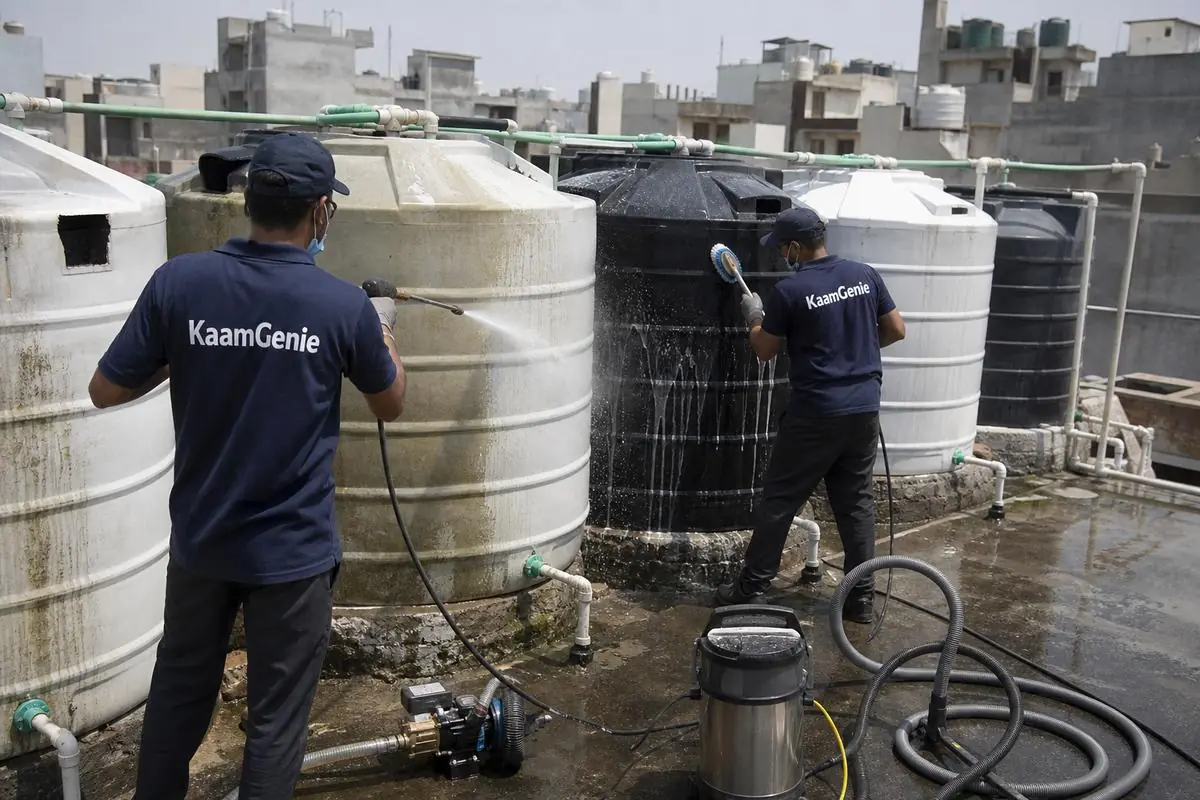
A society tank here feeds a full block of flats plus their PG tenants, so the combined daily draw is heavy and the sediment builds quickly. The DJB water carries fine silt into the sump, which sits out of sight and rarely gets opened, and from there the pump lifts it up to every rooftop tank. Once the sump floor thickens with sludge, that layer feeds bacteria into the water rising to every kitchen in the block. With student turnover keeping usage high, the load never eases. Cleaning the whole chain every three to four months keeps the shared supply safe.
RWAs here often leave the sump for years because coordinating a full block feels like a big organisational job. That is exactly what we take off the committee: one survey counts the tanks and checks pump access, and one scheduled visit clears the whole building with minimal disruption. Booking every tank together earns bulk pricing over piecemeal calls, and a four-visit annual AMC gives the committee a standing record for the file without chasing it each quarter.
No travel charge anywhere in Gujranwala Colony (Kingsway Camp). The final price is confirmed on the call before we come — it depends only on tank size and access.
See it done in 45 seconds
Watch our web story on how a tank is really cleaned — drain, de-sludge, jet-wash, disinfect.
We reach every pocket of Gujranwala Colony (Kingsway Camp) — and there’s no travel charge to any of them:
Every locality in Delhi stores different water, and that decides how fast a tank fouls. This is Gujranwala Colony’s profile from The Delhi Water Index, built from our field observations across 250+ localities.
Indicative field characterisation, not a certified lab test. BIS IS 10500: TDS 500 mg/L acceptable, 2,000 permissible. Check any Delhi area →
“Do you clean cooperative society tanks in Gujranwala Colony?” Yes. We clean the full set a society block runs, the underground sump, the pumps and every rooftop tank, in one coordinated visit with the RWA or caretaker. A survey fixes the tank count and pump access before we schedule a single-visit slot.
“The block has a lot of PG tenants. Does high usage change how you clean?” It means the tanks carry more sediment, so we plan the clean around the heaviest-use tanks first and check the sump carefully. The method is the same, but the survey pays extra attention to the tanks the PG floors draw on hardest.
“What does a whole society block cost to clean?” Each shared tank of 2,000 to 3,000 litres is ₹1,500 to ₹2,000, and the underground sump is quoted by capacity. We bulk-quote the block together, usually 15 to 20 percent off the per-tank rate for cleaning them all in one visit.
“Can a single flat owner book if the RWA has not arranged it?” Yes. An owner can book their own rooftop tank, and we leave a dated report the committee can act on. The shared sump, though, needs the RWA to authorise, and we are glad to bring the committee a quote for the whole block.
“Do you offer an annual contract for the society?” Yes. The whole-building AMC covers four visits a year for the sump, pumps and rooftop tanks at 20 to 25 percent off the per-visit rate. Quarterly cleaning keeps the sediment down given the heavy usage, and each visit ends with photos for the maintenance file.
See our complete water tank cleaning services in Delhi NCR — pricing, process, tank types and full city coverage.
Beyond water tank cleaning, KaamGenie is rolling out a full lineup of home services across Delhi NCR — see our complete list of 12 home services we offer or will be launching through 2026. New to tank cleaning? Read our guide on how to pick the right water tank cleaning service in Delhi — what to look for, what to avoid, and the questions that separate trustworthy crews from quick-job operators.
Rooftop plastic tanks
₹699+ →Kothi sumps & underground tanks
₹1,499+ →Apartments & RWAs
Bulk pricing →FSSAI-compliant cleaning
₹2,500+ →टंकी साफ़ करने वाले
हिन्दी पढ़ें →View all water tank cleaning guides →
All pockets and lanes of Gujranwala Colony (Kingsway Camp) covered. If your specific block or society isn’t named in the sub-areas above, just call — we almost certainly cover it.
Same crew, same 6-step process, same-day where possible. Pick any locality below for local pricing and the tanks we typically find there.
Book a slot — we can usually fit you in today or tomorrow.