
Water Tank Cleaning AMC Plans
Raj Babbar · 8 min read
Home › Water Tank Cleaning › Society / RWA Tank Cleaning › Harsh Vihar
Harsh Vihar lies on the seam where the Mandoli fringe runs into the Karawal Nagar spread, one of the last pockets the piped network never really found. Its shared roof stores lean entirely on ferrous groundwater and, come the dry months, on bought loads. Clearing that store and dating the call is the service here. From ₹1,500 per tank.
Harsh Vihar occupies the seam between the Mandoli fringe and the Karawal Nagar spread, a scatter of self-built floors and small blocks threaded along cramped lanes. With the piped network effectively absent this far out, buildings share a roof store drawing purely on groundwater, which comes up markedly ferrous and hard. When the dry-season table sinks, households fall back on bought loads to keep the store topped. Nothing softer ever dilutes what goes in, so the ferrous content works on the store undiluted. Left through a year of that, a shared store lines its inside a deep orange.
KaamGenie clears the shared roof stores of a Harsh Vihar building for the owner or the residents together, in one call fitted to whatever water is running. We empty each store, lift the orange ferrous crust off the inner face, work the sides down, treat to a potable-grade standard and pass over dated before-and-after frames for the file. A household wanting only its own line can read water tank cleaning in Harsh Vihar. This page speaks to the shared stores feeding a whole Harsh Vihar building.
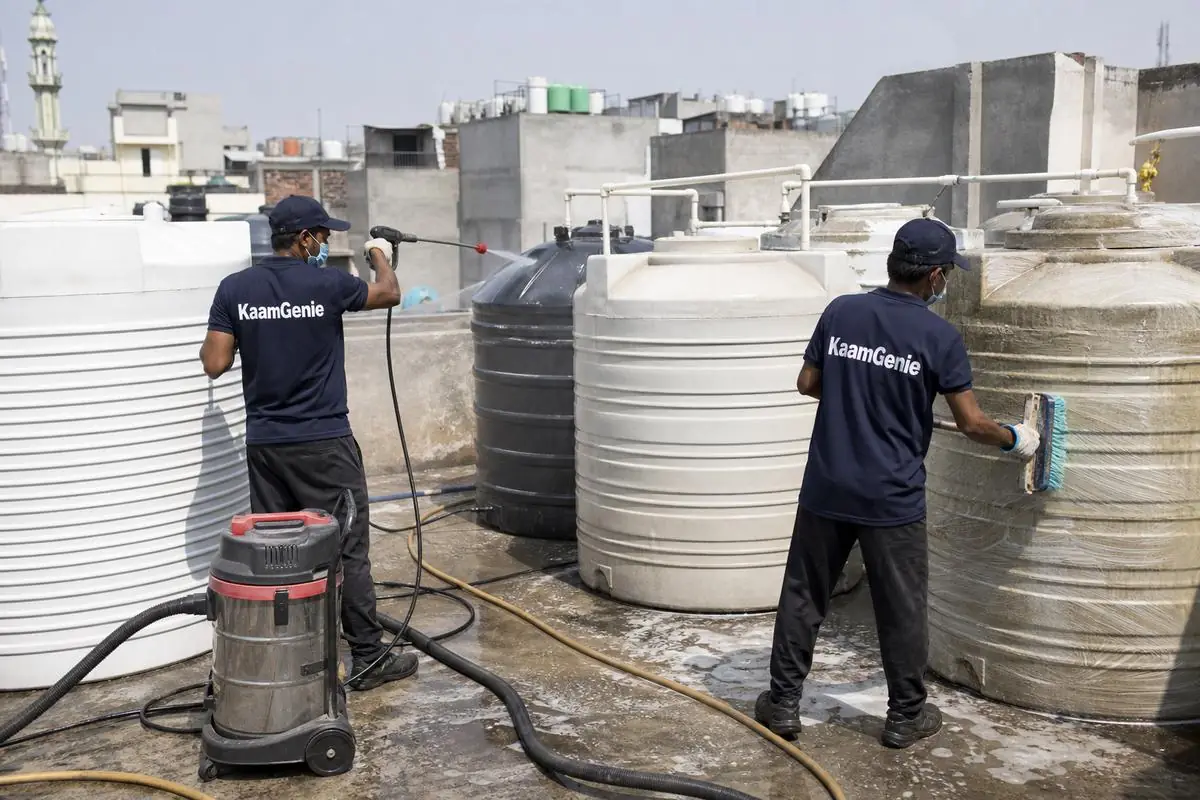
Groundwater on this seam comes up hard and heavily ferrous, and ferrous water both dyes a store and thickens what beds in it. With no piped share to soften the mix and dry-season loads bought in on top, the store meets an unbroken run of mineral-heavy water renewing the deposit at every fill. An orange crust sets on the inner face while grit gathers below, and neither shifts on its own. Where floors turn over to new tenants often, no one keeps an eye on the store. A year of this is plenty to line the inside orange.
The ferrous crust and settled grit give the film a foothold and sharpen the metallic edge and orange cast the groundwater already carries into every home on the store. The particles travel into the shared pump and the outlets, tinting wash-water and furring the fittings throughout the building. Dry-season bought loads can add their own fines to the mix. With the floors mostly let, the store is opened only once the water has plainly turned. Clearing it twice a year is the barest cycle this ferrous shared supply will accept.
No travel charge anywhere in Harsh Vihar. The final price is confirmed on the call before we come — it depends only on tank size and access.
See it done in 45 seconds
Watch our web story on how a tank is really cleaned — drain, de-sludge, jet-wash, disinfect.
We reach every pocket of Harsh Vihar — and there’s no travel charge to any of them:
Every locality in Delhi stores different water, and that decides how fast a tank fouls. This is Harsh Vihar’s profile from The Delhi Water Index, built from our field observations across 250+ localities.
Indicative field characterisation, not a certified lab test. BIS IS 10500: TDS 500 mg/L acceptable, 2,000 permissible. Check any Delhi area →
“Our wash-water comes out tinted orange. Will clearing the store settle it?” Clearing lifts the ferrous crust and the settled deposit inside the store, both of which feed the orange cast, so wash-water usually runs cleaner afterwards. The groundwater stays ferrous at source, so a filter covers the rest, but the store itself should stop worsening it.
“With no piped supply out here, does that hit the store harder?” It does. The store holds only ferrous groundwater and bought dry-season loads, with nothing softer to thin it, so the crust and deposit set faster than in a colony that gets a piped share. That is why these shared stores want a tighter clearing cycle.
“What is the charge for the shared stores on our building?” A shared store runs ₹1,500 to ₹2,000 by size. More than one store on a building is quoted as a set with a bulk cut for handling them in a single trip.
“We buy loads through the dry months. Do those add to what beds in the store?” Yes. A bought load brings its own fine matter, so a dry season of topping up adds to the ferrous deposit already in the store. A clearing at the close of the hot months takes out what the loads have left behind.
“How often does a ferrous Harsh Vihar store want clearing?” Twice a year as a floor. The ferrous water rebuilds the crust and floor deposit inside roughly six months, and the dry-season loads pile on, so a half-yearly call is the sensible least for the shared stores here.
See our complete water tank cleaning services in Delhi NCR — pricing, process, tank types and full city coverage.
Beyond water tank cleaning, KaamGenie is rolling out a full lineup of home services across Delhi NCR — see our complete list of 12 home services we offer or will be launching through 2026. New to tank cleaning? Read our guide on how to pick the right water tank cleaning service in Delhi — what to look for, what to avoid, and the questions that separate trustworthy crews from quick-job operators.
Rooftop plastic tanks
₹699+ →Kothi sumps & underground tanks
₹1,499+ →Apartments & RWAs
Bulk pricing →FSSAI-compliant cleaning
₹2,500+ →टंकी साफ़ करने वाले
हिन्दी पढ़ें →View all water tank cleaning guides →
All pockets and lanes of Harsh Vihar covered. If your specific block or society isn’t named in the sub-areas above, just call — we almost certainly cover it.
Same crew, same 6-step process, same-day where possible. Pick any locality below for local pricing and the tanks we typically find there.
Book a slot — we can usually fit you in today or tomorrow.