
Water Tank Cleaning Methods Explained
Raj Babbar · 10 min read
Home › Water Tank Cleaning › Society / RWA Tank Cleaning › Kailash Nagar
Residents here often ask the same thing: how do a few flats sharing one ageing tank actually get it cleaned without a fuss? The answer is one coordinated visit for the whole building, tanks staggered so supply is never fully cut. The building is quoted in bulk, then the cost splits across the flats.
In the Gandhi Nagar belt near the Yamuna bridge, Kailash Nagar is older 3 to 4 storey plot houses rather than newer builder floors. Many of these buildings run an ageing shared Sintex tank per floor, some of them decades old, feeding long-term owner-occupier families. The supply is moderate DJB water, so the deposits build slower than on the harder borewell belts, but the tanks are old and the cleaning has always been irregular. Because a tank is shared across the flats on a floor, coordinating a clean has never had a clear owner, so it happens rarely. Sediment and biofilm collect quietly in tanks that have not been opened in years. A single coordinated visit is the cleanest way to bring these ageing shared tanks back up to standard.
If you only want your own flat's tank and line seen to, our standard water tank cleaning in Kailash Nagar covers that on its own. This page is for the shared building tanks, the ageing Sintex units feeding several flats per floor, where one survey and a single split invoice work better than each family arranging its own. We count the shared tanks across the building and quote them together in bulk. The flats then divide one figure rather than each booking separately.
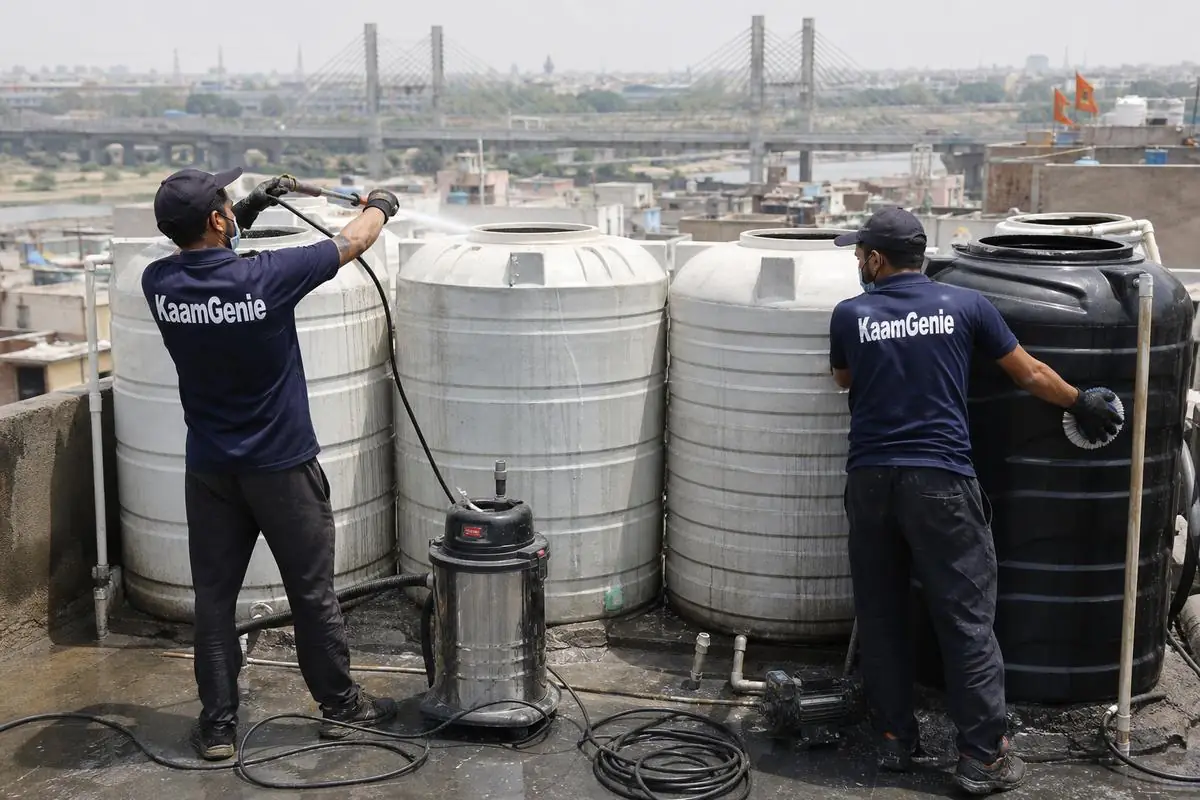
The age of these tanks is the crux. A shared Sintex tank that has served a floor for decades carries a settled layer of sediment and a biofilm on its inner walls that no amount of DJB flushing shifts. Even on moderate supply, an old, rarely opened tank holds contaminants that reach every flat drawing from it. The plastic itself grows brittle and scaled with the years. A proper clean of the ageing shared tanks is the only way to give long-standing residents genuinely fresh water again.
With settled owner-occupiers, the clean gets skipped simply because nobody has ever taken charge of the shared tank, and the years slide by. We take that off the building. One resident points us at the tanks, we survey and quote the shared Sintex units in a single bulk figure, clean them in a staggered order so no floor loses supply, and finish with one invoice split across the flats. A shared 2,000 to 3,000L tank is around ₹1,500 to ₹2,000, and doing the whole building together saves roughly 15 to 20 percent.
No travel charge anywhere in Kailash Nagar. The final price is confirmed on the call before we come — it depends only on tank size and access.
See it done in 45 seconds
Watch our web story on how a tank is really cleaned — drain, de-sludge, jet-wash, disinfect.
We reach every pocket of Kailash Nagar — and there’s no travel charge to any of them:
Every locality in Delhi stores different water, and that decides how fast a tank fouls. This is Kailash Nagar’s profile from The Delhi Water Index, built from our field observations across 250+ localities.
Indicative field characterisation, not a certified lab test. BIS IS 10500: TDS 500 mg/L acceptable, 2,000 permissible. Check any Delhi area →
“Our shared Sintex tank is decades old. Can it still be cleaned safely?” Yes. We clean ageing Sintex tanks regularly and work carefully around older, more brittle plastic. We remove the settled sediment, scrub off the biofilm on the walls and finish with an anti-bacterial wash. If a tank is genuinely past use we will tell you honestly rather than just cleaning it.
“How does the cost split across the flats on a floor?” We quote the building's shared tanks as one bulk figure and divide it across the flats that draw from them. A 2,000 to 3,000L shared Sintex tank is about ₹1,500 to ₹2,000. It comes as one invoice, split by flat, so the families settle a single number between them.
“The water looks fine on DJB. Why clean a shared tank at all?” Clear-looking water can still be sitting in a tank that has not been opened in years, picking up biofilm and settled sediment the eye misses. Ageing shared Sintex holds contaminants regardless of how good the DJB supply looks. A clean removes what has quietly accumulated for every flat on the tank.
“How do we coordinate a date across a few families?” We only need one point of contact to survey the shared tanks and agree a slot that suits the building. Because the families here are long-term residents, a single visit on an agreed day usually covers everyone. The bulk quote and split invoice keep the money side simple between the flats.
“Do you offer an annual plan for an older building?” Yes, and it suits these ageing tanks well by scheduling regular cleans so they never go years untouched again. The annual plan runs about 20 to 25 percent cheaper than one-off visits. We hold the dates so no resident has to keep track.
See our complete water tank cleaning services in Delhi NCR — pricing, process, tank types and full city coverage.
Beyond water tank cleaning, KaamGenie is rolling out a full lineup of home services across Delhi NCR — see our complete list of 12 home services we offer or will be launching through 2026. New to tank cleaning? Read our guide on how to pick the right water tank cleaning service in Delhi — what to look for, what to avoid, and the questions that separate trustworthy crews from quick-job operators.
Rooftop plastic tanks
₹699+ →Kothi sumps & underground tanks
₹1,499+ →Apartments & RWAs
Bulk pricing →FSSAI-compliant cleaning
₹2,500+ →टंकी साफ़ करने वाले
हिन्दी पढ़ें →View all water tank cleaning guides →
All pockets and lanes of Kailash Nagar covered. If your specific block or society isn’t named in the sub-areas above, just call — we almost certainly cover it.
Same crew, same 6-step process, same-day where possible. Pick any locality below for local pricing and the tanks we typically find there.
Book a slot — we can usually fit you in today or tomorrow.