
Hard Water Tank Cleaning in Delhi
Raj Babbar · 9 min read
Home › Water Tank Cleaning › Society / RWA Tank Cleaning › Nand Nagri (C Block)
In Nand Nagri's C-block the resettlement grid has been built up higher than A, its rebuilt floors stacked over shared tanks that leave a chalky borewell scale behind. Cleaning that shared storage and dating the job is the service here. From ₹1,500 per tank.
C-block is the more built-up part of the Nand Nagri resettlement grid, where the original EWS plots have grown into taller rebuilt floors on crowded lanes. More floors on each plot means a shared tank feeds more families than the lower A-block runs, and the storage works harder for it. Water is largely borewell and tanker, hard enough to leave a chalky scale, drawn into small rooftop tanks. High occupancy and slow turnover keep the tank rarely fully emptied, so the chalky sediment settles and stays. The denser the block has grown, the more each shared tank has to carry.
KaamGenie cleans the shared C-block tank for the resident group or the caretaker, in one visit fitted to the supply. We pump the tank out, clear the chalky sediment from the base, work the walls over by hand, sanitise to hygienic and hand over dated photographs for the record. A single household after its own tank can look at water tank cleaning in Nand Nagri (C Block). This page is about the shared tanks that supply a built-up C-block building.
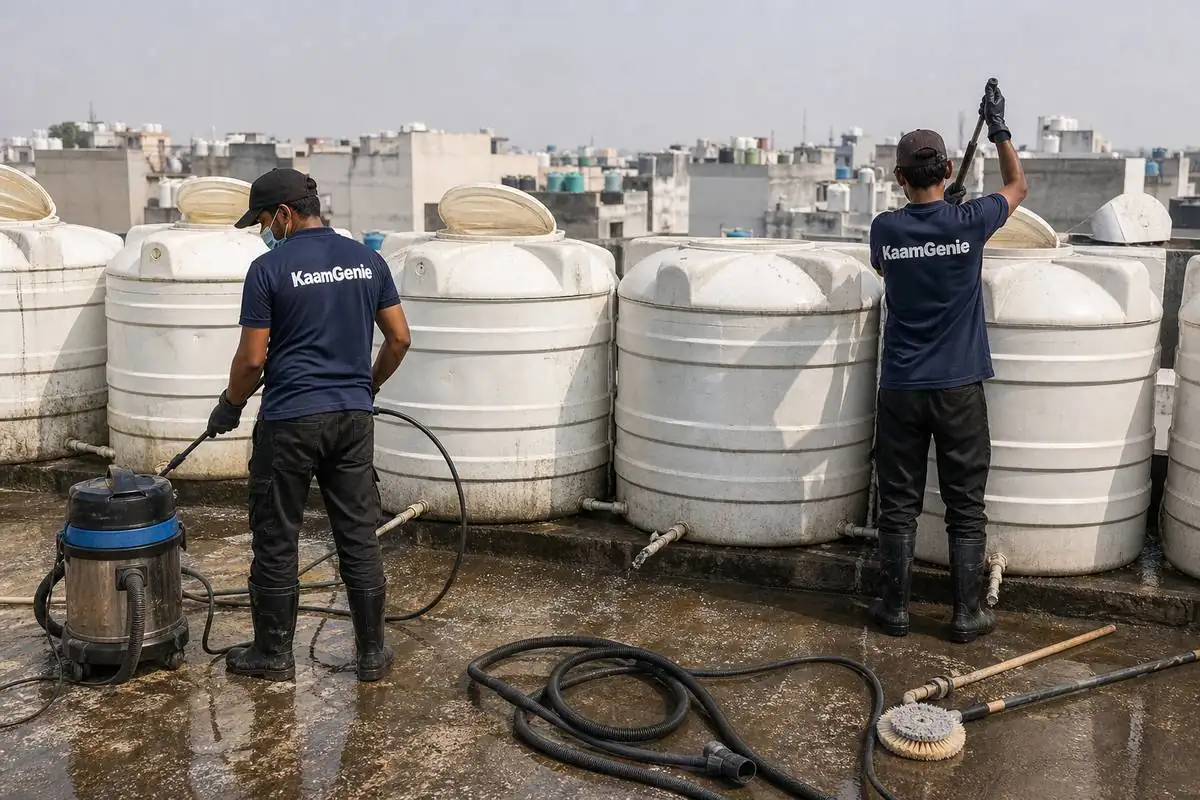
Where A-block runs are lower, C-block has built upward, so a shared tank there often feeds more floors and more families off the same capacity. That means more refills a day, and each fill of hard, chalky borewell or tanker water adds mineral matter to the walls and floor. The heavier draw gives sediment less chance to be flushed and more chance to settle. The chalky scale that residents scrub off their taps builds inside the tank too. A busier tank in a taller block lines up faster.
The chalky bed and wall scale harbour biofilm and give the shared water a flat, mineral taste every floor notices. The fine deposit clogs aerators and RO units across the flats, a recurring nuisance in a built-up block. When one tank feeds this many families, a single dirty tank clouds the supply for all of them. A clean two or three times a year suits a denser C-block building better than a yearly one.
No travel charge anywhere in Nand Nagri (C Block). The final price is confirmed on the call before we come — it depends only on tank size and access.
See it done in 45 seconds
Watch our web story on how a tank is really cleaned — drain, de-sludge, jet-wash, disinfect.
We reach every pocket of Nand Nagri (C Block) — and there’s no travel charge to any of them:
Every locality in Delhi stores different water, and that decides how fast a tank fouls. This is Nand Nagri (C Block)’s profile from The Delhi Water Index, built from our field observations across 250+ localities.
Indicative field characterisation, not a certified lab test. BIS IS 10500: TDS 500 mg/L acceptable, 2,000 permissible. Check any Delhi area →
“C-block buildings are taller and busier. Does the tank need cleaning more than in A-block?” Generally yes. A taller C-block building feeds more floors off the same tank, so it refills more often and settles its chalky deposit faster than a lower A-block run. That heavier use is why we suggest a slightly tighter cleaning cycle here.
“Our taps get a chalky coating. Is the tank scaling too?” Yes. The chalky coating on the taps is the hard borewell's mineral content, and the same scale builds on the tank walls and floor. Cleaning strips it from inside the tank so it stops flaking into the shared water, though the borewell itself stays hard.
“What does it cost for a shared C-block tank?” A shared C-block tank runs ₹1,500 to ₹2,000. A taller building's several tanks are quoted together with a bulk cut for the single visit.
“The RO filters clog quickly across the flats. Could the tank be the reason?” Very likely. The fine chalky deposit drawn off the tank floor reaches the RO inlets and clogs the pre-filters early. Clearing the tank at source usually stretches how long the filters in each flat last between changes.
“How often for a built-up C-block tank?” Two to three times a year, a touch more often than the lower A-block runs. The extra floors and the chalky borewell rebuild the deposit within a few months, so a longer gap lets the whole building taste the settled layer.
See our complete water tank cleaning services in Delhi NCR — pricing, process, tank types and full city coverage.
Beyond water tank cleaning, KaamGenie is rolling out a full lineup of home services across Delhi NCR — see our complete list of 12 home services we offer or will be launching through 2026. New to tank cleaning? Read our guide on how to pick the right water tank cleaning service in Delhi — what to look for, what to avoid, and the questions that separate trustworthy crews from quick-job operators.
Rooftop plastic tanks
₹699+ →Kothi sumps & underground tanks
₹1,499+ →Apartments & RWAs
Bulk pricing →FSSAI-compliant cleaning
₹2,500+ →टंकी साफ़ करने वाले
हिन्दी पढ़ें →View all water tank cleaning guides →
All pockets and lanes of Nand Nagri (C Block) covered. If your specific block or society isn’t named in the sub-areas above, just call — we almost certainly cover it.
Same crew, same 6-step process, same-day where possible. Pick any locality below for local pricing and the tanks we typically find there.
Book a slot — we can usually fit you in today or tomorrow.