
Water Tank Cleaning Rules & Norms
Raj Babbar · 9 min read
Home › Water Tank Cleaning › Underground Sump Cleaning › Badli
Badli’s tanks work in the shadow of its industrial area — soot and metal dust from the units, worker-housing tanks stretched across many tenants, and supply that swings between borewell and DJB by lane. KaamGenie cleans underground and ground-level storage across the village, the units and the housing rows. From ₹1,499.
On the GT Road corridor with a Yellow Line terminus of its own, Badli layers an industrial estate, an old village and dense worker-housing lanes into one water system with two supplies. The village side draws mostly DJB; the industrial side leans on borewells that run harder — and the quality swing between the two is something residents taste when they move a few lanes over. Storage follows the same split: unit tanks for process and canteen water, shared worker-housing tanks stretched across many tenants, and village ground tanks feeding roofs by motor.
KaamGenie cleans across that whole map. Every job gets the full sequence — ventilate and air-test, pump down, remove the silt and soot-laden sediment, jet-wash, anti-bacterial disinfection, dated photos — and unit jobs get a report formatted for compliance files. If the overhead tanks need the same attention, our water tank cleaning in Badli page covers those; here we deal with the tanks at and below ground.
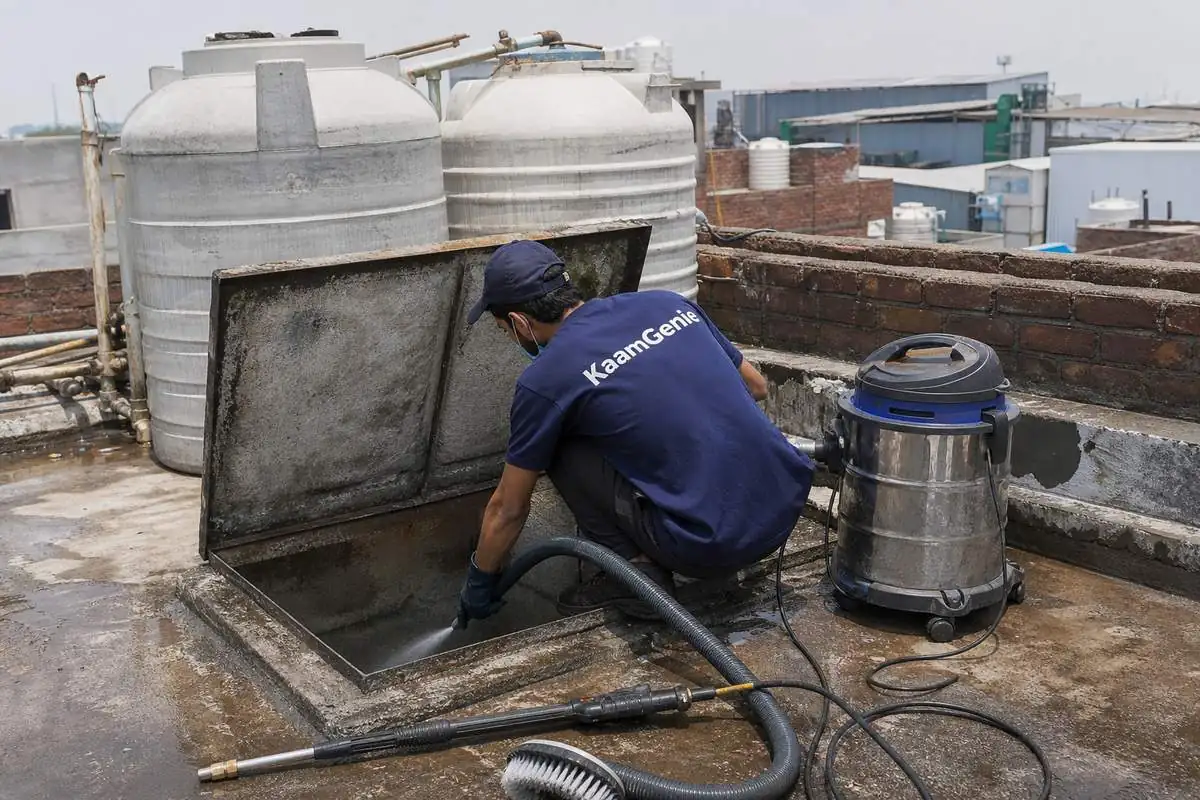
Near the units, the enemy is what falls from the air and what the borewell carries. Industrial soot and metal dust settle through loose lids and give ground storage a dark, greasy sediment; the borewell fills add hard-water scale and sand on top. A worker-housing tank near the estate can need cleaning twice as often as a village tank three lanes away — same locality, different water, different air.
On the village side, DJB supply is gentler but timed, so homes bank water in ground tanks that sit part-full between windows — stagnation conditions that let fine sediment and biofilm settle in peace. And everywhere in Badli, the shared-tank ownership gap applies: many tenants, one tank, nobody’s job. We price low enough to split easily, document everything, and treat every manhole entry as confined-space work with ventilation and an air test first.
No travel charge anywhere in Badli. The final price is confirmed on the call before we come — it depends only on tank size and access.
See it done in 45 seconds
Watch our web story on how a tank is really cleaned — drain, de-sludge, jet-wash, disinfect.
We reach every pocket of Badli — and there’s no travel charge to any of them:
Every locality in Delhi stores different water, and that decides how fast a tank fouls. This is Badli’s profile from The Delhi Water Index, built from our field observations across 250+ localities.
Indicative field characterisation, not a certified lab test. BIS IS 10500: TDS 500 mg/L acceptable, 2,000 permissible. Check any Delhi area →
“Do you clean tanks in Badli Industrial Area units?” Yes — process and canteen storage in the estate is core work for us, scheduled around your shifts. The clean removes soot-laden sediment as well as silt and scale, finishes with anti-bacterial disinfection, and the dated photo report goes straight into your audit file. Call 95603 66362 with capacity and gali number.
“Our worker-housing tank serves ten families. How does pricing work?” The tank is priced by capacity, not by families: from ₹1,499 up to 1,000 litres, ₹1,799–2,200 for 1,001–2,000 litres, all inclusive. Split ten ways it is trivial per household. The owner or the employer housing the workers usually books; either way the whole row gets clean storage the same day.
“Why does our tank get dirty faster than my brother’s in the village side?” Almost certainly because you are nearer the units. The industrial side’s borewells run harder and the air carries soot and metal dust that settles into ground storage, so the sediment bed rebuilds faster than on the DJB-fed village lanes. For estate-side tanks we suggest roughly a four-month cycle instead of six.
“Can you come today?” If you call before 10 AM on 95603 66362, usually yes — Badli sits on our GT Road run with Samaipur and Libaspur, so crews pass daily. Unit jobs with large tanks are better fixed a day ahead so the pump capacity and shift timing line up.
“Do you check the tank condition while cleaning?” Yes. Once the tank is empty and washed we inspect the floor and walls for cracks, seepage and inlet problems — older village tanks and hard-worked housing tanks in Badli often show early damage. Anything we find is photographed and flagged in the report so you can repair it before it contaminates the next fill.
See our complete water tank cleaning services in Delhi NCR — pricing, process, tank types and full city coverage.
Beyond water tank cleaning, KaamGenie is rolling out a full lineup of home services across Delhi NCR — see our complete list of 12 home services we offer or will be launching through 2026. New to tank cleaning? Read our guide on how to pick the right water tank cleaning service in Delhi — what to look for, what to avoid, and the questions that separate trustworthy crews from quick-job operators.
Rooftop plastic tanks
₹699+ →Kothi sumps & underground tanks
₹1,499+ →Apartments & RWAs
Bulk pricing →FSSAI-compliant cleaning
₹2,500+ →टंकी साफ़ करने वाले
हिन्दी पढ़ें →View all water tank cleaning guides →
All pockets and lanes of Badli covered. If your specific block or society isn’t named in the sub-areas above, just call — we almost certainly cover it.
Same crew, same 6-step process, same-day where possible. Pick any locality below for local pricing and the tanks we typically find there.
Book a slot — we can usually fit you in today or tomorrow.