
How Often Should You Clean Your Water Tank?
Raj Babbar · 7 min read
Home › Water Tank Cleaning › Underground Sump Cleaning › Gujranwala Colony (Kingsway Camp)
Underground sump cleaning in Gujranwala Colony and Kingsway Camp — the below-ground kothi and builder-floor tanks that take the first fill for student PGs and families, gather silt, and sit forgotten under the driveway. Confined-space safe, documented. From ₹1,499.
The kothis and builder floors around Kingsway Camp were laid out with proper ground storage in mind, so most plots here run an underground sump under the driveway or set-back before pumps lift water to the rooftop tanks. Supply comes largely through DJB pipes, with a borewell backup on many plots that adds sand and hardness to the mix. With the GTB Nagar student and PG crowd packed into these buildings, water use runs high and the sump refills constantly through the day. All that throughput means sand and grit keep settling out at the bottom faster than the owners realise. And because the tank is buried and out of sight, it goes years between cleanings while attention stays on the rooftop tanks upstairs.
KaamGenie cleans these buried kothi and builder-floor sumps in full. We open and ventilate the tank, air-test it, pump out the standing water, scoop and wet-vacuum the settled silt, then jet the caked mud and biofilm from the floor and walls before an anti-bacterial disinfectant wash and a clean rinse, with before and after photos on WhatsApp. A closed sump can hold stale, low-oxygen air, so we treat every one as a confined space, ventilating and air-testing before entry with a spotter at the hatch. If you want the rooftop tanks serviced together, see our water tank cleaning in Gujranwala Colony (Kingsway Camp); this page is specifically about the underground sump.
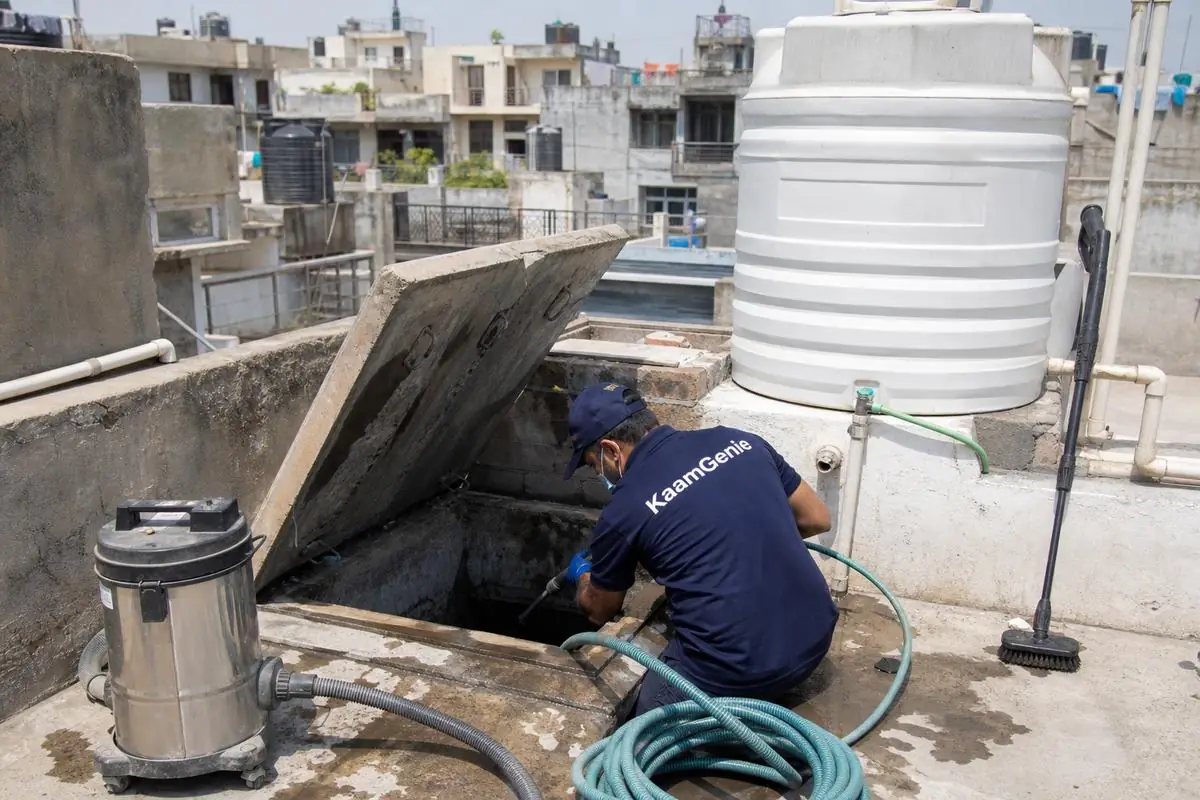
The sump takes the first fill of every cycle, so the sand and grit carried in the borewell backup line settle out and stay on the floor while the cleaner water is pumped upstairs. In a plot packed with PG tenants the volume through the tank is high, so the sludge bed rebuilds quickly between cleanings. The borewell content is also hard, and that leaves a chalky scale on the sump walls over time.
Because the sump sits buried under the driveway, most owners simply forget it is there, tending the rooftop tanks while the ground one goes untouched. That is where the risk gathers: standing water over a thick sludge bed, poor ventilation in a sealed tank, and hairline cracks in ageing concrete that let ground seepage in. Our crews ventilate and air-test every Kingsway Camp sump before entry and check the structure while it is open.
No travel charge anywhere in Gujranwala Colony (Kingsway Camp). The final price is confirmed on the call before we come — it depends only on tank size and access.
See it done in 45 seconds
Watch our web story on how a tank is really cleaned — drain, de-sludge, jet-wash, disinfect.
We reach every pocket of Gujranwala Colony (Kingsway Camp) — and there’s no travel charge to any of them:
Every locality in Delhi stores different water, and that decides how fast a tank fouls. This is Gujranwala Colony’s profile from The Delhi Water Index, built from our field observations across 250+ localities.
Indicative field characterisation, not a certified lab test. BIS IS 10500: TDS 500 mg/L acceptable, 2,000 permissible. Check any Delhi area →
“We run a PG here. How often should our sump be cleaned?” A PG plot pushes heavy daily use through one sump, so twice a year is sensible because the silt bed rebuilds fast under that load. A family kothi with lighter use can usually stretch to once a year. We will suggest a cadence once we see how much comes out on the first clean.
“Does the borewell backup make the tank dirtier?” It tends to. Borewell water carries more sand and hardness than the DJB line, so the sump collects grit at the bottom and scale on the walls faster on plots that lean on the backup. We jet the caked scale off, not just the loose silt.
“What will it cost for a kothi sump?” Small sumps up to 1,000 litres start at ₹1,499. A typical 1,001 to 2,000 litre kothi or builder-floor tank runs ₹1,799 to ₹2,200, and 2,001 to 5,000 litres is ₹2,500 to ₹3,500. A combined sump-and-rooftop visit is ₹2,000 to ₹2,800.
“Can you clean it without cutting water to all the tenants?” Mostly, yes. We work around your pump schedule so the rooftop tanks stay topped up while the sump is drained and cleaned, which keeps supply to the rooms running with only a short interruption.
“What if you find a crack in the sump?” We flag it. Once the tank is empty and jet-washed we dry-check the walls and floor, and if we find a crack or seepage, common in the older concrete here, we note it in the WhatsApp report with photos so you can get it sealed before it worsens.
See our complete water tank cleaning services in Delhi NCR — pricing, process, tank types and full city coverage.
Beyond water tank cleaning, KaamGenie is rolling out a full lineup of home services across Delhi NCR — see our complete list of 12 home services we offer or will be launching through 2026. New to tank cleaning? Read our guide on how to pick the right water tank cleaning service in Delhi — what to look for, what to avoid, and the questions that separate trustworthy crews from quick-job operators.
Rooftop plastic tanks
₹699+ →Kothi sumps & underground tanks
₹1,499+ →Apartments & RWAs
Bulk pricing →FSSAI-compliant cleaning
₹2,500+ →टंकी साफ़ करने वाले
हिन्दी पढ़ें →View all water tank cleaning guides →
All pockets and lanes of Gujranwala Colony (Kingsway Camp) covered. If your specific block or society isn’t named in the sub-areas above, just call — we almost certainly cover it.
Same crew, same 6-step process, same-day where possible. Pick any locality below for local pricing and the tanks we typically find there.
Book a slot — we can usually fit you in today or tomorrow.