
How Often Should You Clean Your Water Tank?
Raj Babbar · 7 min read
Home › Water Tank Cleaning › Underground Sump Cleaning › Hari Nagar
Underground sump cleaning in Hari Nagar — the DDA colony at the Ghanta Ghar, where block sumps feed shared stair-tower RCC tanks through ageing GI risers, and clock-tower market buildings run one tank for shops and homes. Confined-space trained. From ₹1,499.
Hari Nagar is the DDA-era colony gathered around the Ghanta Ghar clock tower in west Delhi — lettered blocks of flats and plotted homes between Jail Road and the Janakpuri edge, with DDU Hospital anchoring one flank. Its water systems are classic DDA vintage: block sumps at ground level pumping to shared RCC tanks on the stair towers, connected by GI risers that have been rust-staining tank interiors for decades. The clock-tower market buildings add the mixed-use pattern — shops below, homes above, one hard-working tank chain for both.
KaamGenie cleans the buried end of these vintage chains — the block sump is opened, ventilated and air-tested, pumped down, cleared of its rust-flecked bed, jet-washed and disinfected to hygienic, with the RWA or building getting photos. The stair-tower RCC tanks upstairs are handled through our water tank cleaning in Hari Nagar — and in a colony this age, doing both ends together is the only real reset.
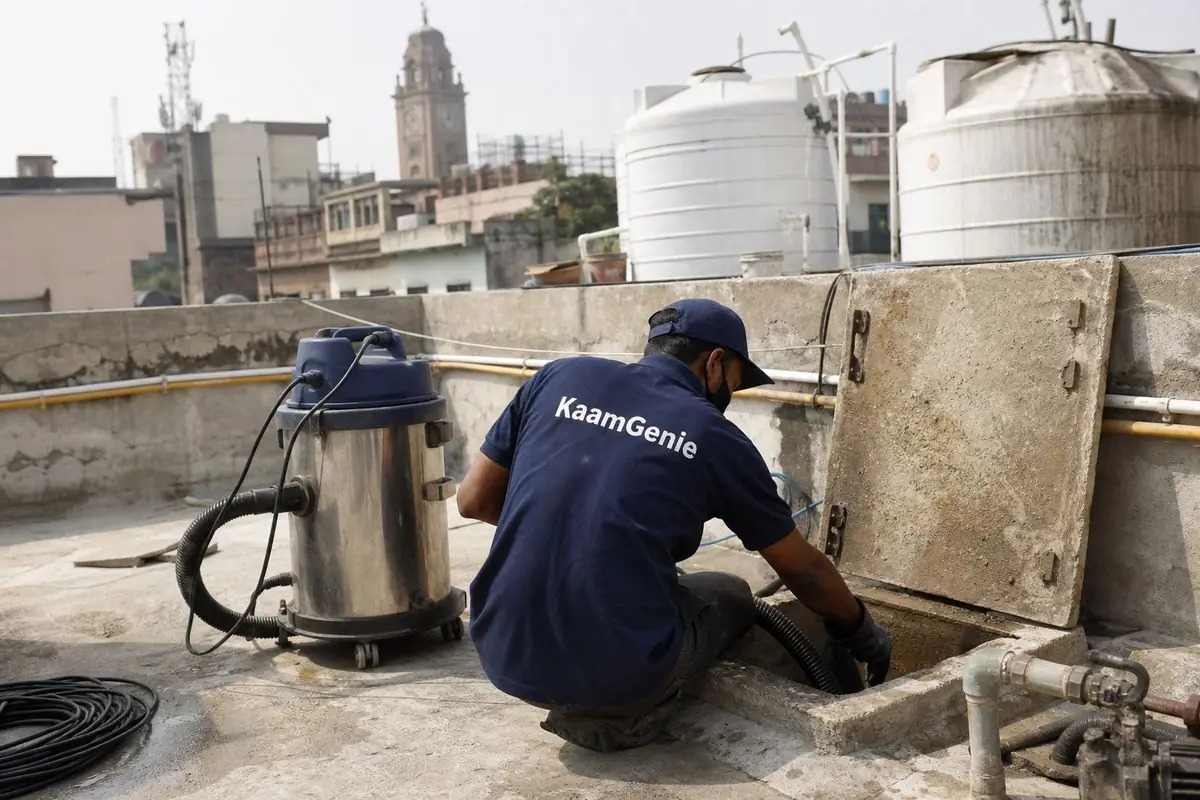
The GI riser is the thread that ties the problem together. As water is pumped from block sump to stair-tower tank, the corroding riser sheds rust in both directions — flakes settle back into the sump between cycles and travel up with the flow to the RCC tank. Decades of that, plus the fine sediment in timed DJB supply, builds beds at both ends of the chain: a dense rust-and-silt layer in the sump, mineral-and-rust staining in the stair-tower tank. Cleaning one end while ignoring the other has never worked here, and residents who have tried it know.
The colony’s block structure decides how cleaning happens: sumps are shared assets, so it takes an RWA member or a block committee to book the work, and the intervals stretch. Meanwhile the market buildings by the clock tower cycle their tanks through business hours, and the DDU Hospital side’s busy lanes keep dust moving over every cover. Our Hari Nagar pattern is well-worn now — block-by-block scheduling with the RWA, early slots for market buildings, and the quality report posted where residents can see it.
No travel charge anywhere in Hari Nagar. The final price is confirmed on the call before we come — it depends only on tank size and access.
See it done in 45 seconds
Watch our web story on how a tank is really cleaned — drain, de-sludge, jet-wash, disinfect.
We reach every pocket of Hari Nagar — and there’s no travel charge to any of them:
Every locality in Delhi stores different water, and that decides how fast a tank fouls. This is Hari Nagar’s profile from The Delhi Water Index, built from our field observations across 250+ localities.
Indicative field characterisation, not a certified lab test. BIS IS 10500: TDS 500 mg/L acceptable, 2,000 permissible. Check any Delhi area →
“Can our block committee book the sump and stair-tower tank together?” Yes, and that is the booking we recommend for Hari Nagar’s vintage chains — sump and RCC tank in one scheduled window, supply restored the same day, one quality report covering the chain. Multi-block RWA bookings get a bulk rate and a fixed crew for the day.
“What does a block sump clean cost?” From ₹1,499 up to 1,000 litres; most Hari Nagar block sumps fall in the 1,001–2,000 litre band at ₹1,799–2,200. Split across a stair tower’s flats it is a small per-household amount, and the combined sump-plus-tank booking prices better than two separate visits.
“Our tank interiors are stained brown — is that dangerous?” The staining itself is iron oxide from the GI risers — unsightly rather than acutely dangerous — but the rust bed it comes from hosts bacteria and biofilm, which is the real concern. We remove the bed, disinfect to hygienic, and show you the riser condition; blocks with active corrosion should plan riser replacement, which we flag but do not sell.
“How quickly can you reach the Ghanta Ghar side?” Call before 10 AM and same-day is usually possible — Hari Nagar sits at the centre of our Jail Road–Janakpuri circuit. Committee bookings covering multiple blocks are better fixed a few days ahead so notices can go up.
“Is confined-space entry needed for these old sumps?” Always. DDA-era chambers seal poorly and hold stale, oxygen-poor air, so every entry follows the same protocol: open, force-ventilate, air-test, and a topside partner throughout. While inside we also check the vintage RCC for cracks and seepage — common at this age — and document anything structural for the committee.
See our complete water tank cleaning services in Delhi NCR — pricing, process, tank types and full city coverage.
Beyond water tank cleaning, KaamGenie is rolling out a full lineup of home services across Delhi NCR — see our complete list of 12 home services we offer or will be launching through 2026. New to tank cleaning? Read our guide on how to pick the right water tank cleaning service in Delhi — what to look for, what to avoid, and the questions that separate trustworthy crews from quick-job operators.
Rooftop plastic tanks
₹699+ →Kothi sumps & underground tanks
₹1,499+ →Apartments & RWAs
Bulk pricing →FSSAI-compliant cleaning
₹2,500+ →टंकी साफ़ करने वाले
हिन्दी पढ़ें →View all water tank cleaning guides →
All pockets and lanes of Hari Nagar covered. If your specific block or society isn’t named in the sub-areas above, just call — we almost certainly cover it.
Same crew, same 6-step process, same-day where possible. Pick any locality below for local pricing and the tanks we typically find there.
Book a slot — we can usually fit you in today or tomorrow.