
Water Tank Disinfection Explained
Raj Babbar · 10 min read
Home › Water Tank Cleaning › Underground Sump Cleaning › Kirti Nagar
In Asia’s biggest furniture market, sawdust settles on everything — including into the water storage that workshops and homes share. KaamGenie cleans Kirti Nagar’s underground sumps and ground tanks of their sawdust-and-silt sludge, hygienic finish, from ₹1,499.
Kirti Nagar’s timber lanes run on shared water: a single storage system often serves the showroom at street level, the workshop behind and the family floors above. Where that storage includes an underground sump or ground-level tank, it collects a contamination mix unique to this colony — fine sawdust and spray-finish particles drifting off the furniture works, settling through any cover gap and binding with pipe silt into a dense, felt-like sludge on the tank floor.
We pump the sump down, wet-vacuum that bound sludge — which ordinary draining leaves behind — jet-wash the walls, hand-scrub the inlet corner where the deposit is thickest, and disinfect to a hygienic finish with photos to prove it. The rooftop tanks over the market and the residential blocks behind are covered at water tank cleaning in Kirti Nagar; this page handles the below-ground storage.
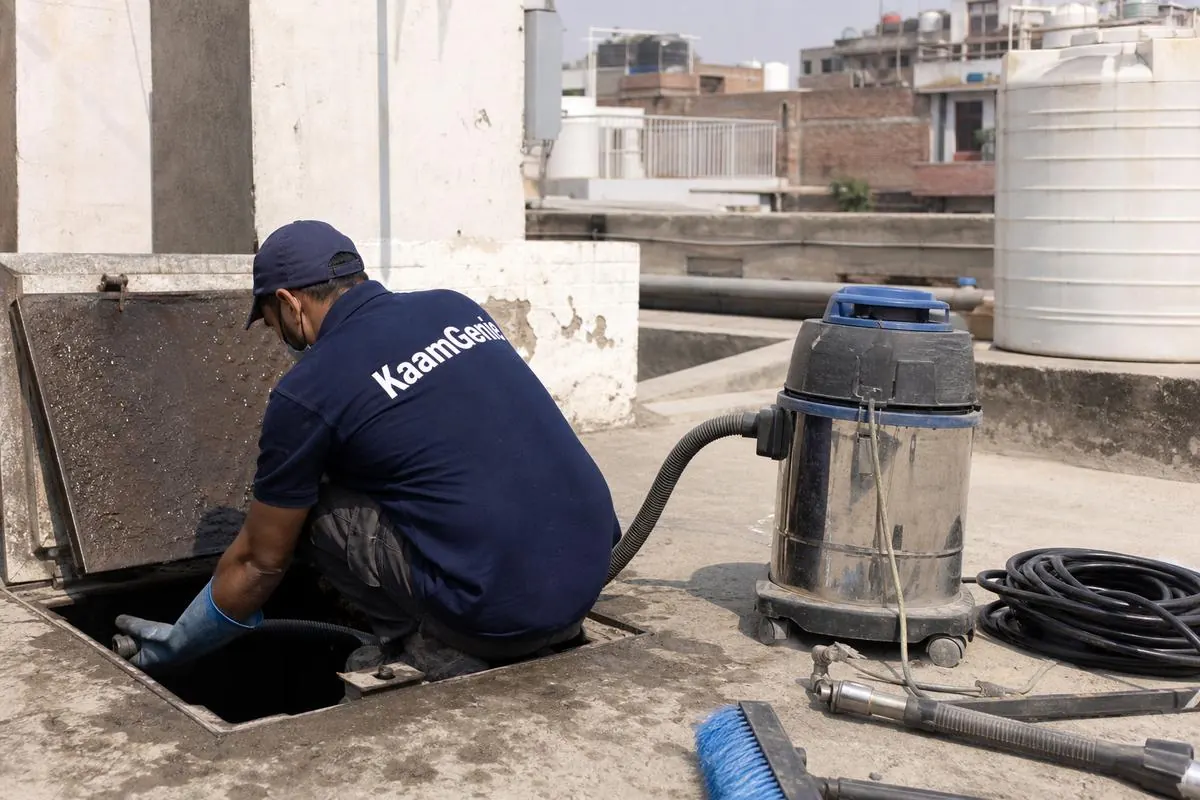
Wood dust is light enough to ride air currents through the smallest cover gap, and unlike mineral grit it does not just sit inert — organic matter in stored water feeds bacterial growth, so a sawdust-fed sump develops film and odour faster than a purely silty one. Add lacquer and spray-finish particles from the polishing sheds and you have a sludge that deserves removal, not dilution. Workshops draw heavily through the day, so the water keeps moving and the deposit keeps compacting.
The shared-use pattern raises the stakes: the same sump that feeds a workshop’s washing also feeds the kitchen upstairs, and furniture buyers visiting family showrooms notice hygiene. The residential blocks behind the market have it easier but not clean — their sumps still catch the market’s drift plus normal DJB pipe sediment. For buildings inside the timber lanes we recommend a six-month cycle; the quieter plotted blocks behind can hold a yearly one.
No travel charge anywhere in Kirti Nagar. The final price is confirmed on the call before we come — it depends only on tank size and access.
See it done in 45 seconds
Watch our web story on how a tank is really cleaned — drain, de-sludge, jet-wash, disinfect.
We reach every pocket of Kirti Nagar — and there’s no travel charge to any of them:
Every locality in Delhi stores different water, and that decides how fast a tank fouls. This is Kirti Nagar’s profile from The Delhi Water Index, built from our field observations across 250+ localities.
Indicative field characterisation, not a certified lab test. BIS IS 10500: TDS 500 mg/L acceptable, 2,000 permissible. Check any Delhi area →
“Our sump smells musty even after draining and refilling. Why?” Draining does not remove the problem — the sawdust-and-silt sludge stays bonded to the floor and re-seeds odour into every refill. Organic wood dust feeds bacterial film, which is the smell. The fix is physical removal: wet-vacuum, jet-wash, scrub, then a anti-bacterial disinfectant rinse. After that the odour does not return until the deposit rebuilds.
“Can you work around our workshop hours?” Yes. For market-lane buildings we schedule early-morning slots so the pump-out and scrub finish before the day’s work starts, and the shared supply is back before the workshop needs it. Book a day ahead on 95603 66362 — or before 10 AM for a same-day slot in the residential blocks.
“Does the ₹1,499 rate apply to a workshop-cum-residence building?” The rate is by sump size, not building type — ₹1,499 up to 1,000 litres, quoted by capacity above that. Kirti Nagar’s shared sumps often run 2,000–3,000 litres for combined draw, and heavy sawdust sludge is normal here, not a surcharge surprise. We confirm the price before starting.
“How do we stop sawdust getting back in after the clean?” The cover is the battleground. We re-seat it after every job and tell you if the seal or frame needs replacing — a gasket-tight cover keeps most drift out. Keeping the polishing shed’s exhaust pointed away from the cover area helps too. Even so, inside the timber lanes a six-monthly clean is realistic.
“Do you clean the rooftop tank as well in the same visit?” Yes, and in a market building it is worth doing — the same sawdust reaches roof tanks through cracked lids. We do the sump first, then the roof tank, so the pump is not re-contaminating what we just cleaned. One visit, one shutdown, both tanks documented with photos.
See our complete water tank cleaning services in Delhi NCR — pricing, process, tank types and full city coverage.
Beyond water tank cleaning, KaamGenie is rolling out a full lineup of home services across Delhi NCR — see our complete list of 12 home services we offer or will be launching through 2026. New to tank cleaning? Read our guide on how to pick the right water tank cleaning service in Delhi — what to look for, what to avoid, and the questions that separate trustworthy crews from quick-job operators.
Rooftop plastic tanks
₹699+ →Kothi sumps & underground tanks
₹1,499+ →Apartments & RWAs
Bulk pricing →FSSAI-compliant cleaning
₹2,500+ →टंकी साफ़ करने वाले
हिन्दी पढ़ें →View all water tank cleaning guides →
All pockets and lanes of Kirti Nagar covered. If your specific block or society isn’t named in the sub-areas above, just call — we almost certainly cover it.
Same crew, same 6-step process, same-day where possible. Pick any locality below for local pricing and the tanks we typically find there.
Book a slot — we can usually fit you in today or tomorrow.