
How Often Should You Clean Your Water Tank?
Raj Babbar · 7 min read
Home › Water Tank Cleaning › Underground Sump Cleaning › Anand Parbat
On Anand Parbat’s rocky ridge, water pressure dies uphill — so homes survive on booster pumps and oversized ground storage that collects workshop dust and churned sediment. KaamGenie cleans the hardest-working tanks on the hill, from ₹1,499.
Anand Parbat climbs a rocky ridge behind Karol Bagh, and its water follows the slope: mains pressure that manages the lower lanes gives out toward the top, so uphill homes hold oversized ground-level tanks and drums, boost aggressively when supply comes, and store deep because the next fill is never guaranteed. True buried sumps are rare on this rock — excavation is hard — but the ground tanks, courtyard cisterns and drum banks that stand in for them collect sediment the same way, with the hill’s metal-workshop dust layered on top.
We clean this ground-level storage exactly as we would a sump: drain, wet-vacuum the churned sediment bed, jet-wash the walls, scrub the corners, disinfect with a hygienic rinse and photograph the result. Roof tanks perched on the ridge’s uneven rooftops are covered at water tank cleaning in Anand Parbat; this page is for the tanks and cisterns at the bottom of each home’s system.
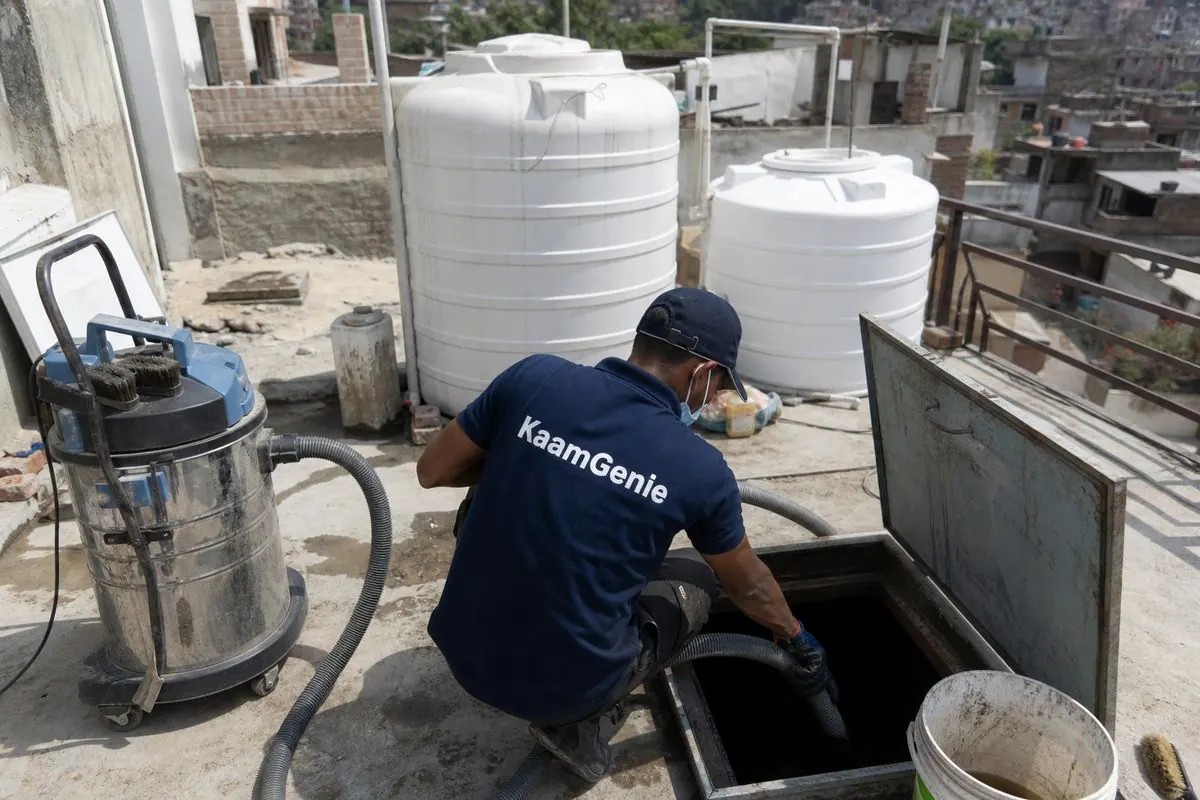
Boosting against a starved line is Anand Parbat’s daily routine and its main contamination engine: a pump dragging hard on low-pressure mains pulls sediment out of the pipe network that normal flow leaves settled, and delivers it straight into the household’s storage. The higher up the ridge, the harder the boost and the heavier the load. Uphill tanks we open carry visibly more grit than the lower lanes’ — the slope literally sorts the colony’s sediment burden.
The hill’s small manufacturing units add their layer: metal-workshop dust settles across courtyards and tank lids, and oversized storage means water stands longer between fills — time for fine particles to settle, for the metal content to rust-streak the bed, and in warm months for biofilm to take hold on the roughened surfaces. Storage this hard-worked needs cleaning twice a year, and because these are mostly ground-level tanks rather than sealed sumps, a tight lid does half the preventive work between visits.
No travel charge anywhere in Anand Parbat. The final price is confirmed on the call before we come — it depends only on tank size and access.
See it done in 45 seconds
Watch our web story on how a tank is really cleaned — drain, de-sludge, jet-wash, disinfect.
We reach every pocket of Anand Parbat — and there’s no travel charge to any of them:
Every locality in Delhi stores different water, and that decides how fast a tank fouls. This is Anand Parbat’s profile from The Delhi Water Index, built from our field observations across 250+ localities.
Indicative field characterisation, not a certified lab test. BIS IS 10500: TDS 500 mg/L acceptable, 2,000 permissible. Check any Delhi area →
“Our house is near the top of the hill. Do you charge extra for the climb?” No — the price is by tank size, not altitude. The crew carries pumps and hoses up the steep lanes routinely; ridge-top homes are a normal part of our Anand Parbat round. ₹1,499 covers storage up to 1,000 litres, quoted by capacity above that, confirmed before we start.
“Why is our stored water always gritty when neighbours downhill complain less?” Because your booster works harder. Pulling against the pressure that dies uphill drags sediment out of the mains and into your tank with every fill — the top of the ridge collects the colony’s heaviest load. You cannot change the pressure, but a twice-yearly clean, a sealed lid, and letting the first minute of boosted flow run to waste all help noticeably.
“Do you clean drum banks and cisterns, or only proper tanks?” Everything that stores your water: masonry cisterns, courtyard ground tanks, banks of plastic drums. Oversized storage is how this colony copes with unreliable supply, and it all collects sediment the same way. We clean the full set in one visit and price it as one job.
“There is a workshop next door. How do we keep its dust out of our tank?” A tight, gasketed lid is the main defence — we check and re-seat yours on every visit and tell you if it needs replacing. Positioning storage away from the workshop’s exhaust side helps, as does washing the lid area before opening it. Between those measures and a six-month clean, the metal dust stays manageable.
“How quickly can you come?” Book before 10 AM on 95603 66362 and same-day is usually possible — Anand Parbat sits right on our Karol Bagh route. Most jobs here run one to three hours depending on how much storage the household keeps, and your water is back the same afternoon.
See our complete water tank cleaning services in Delhi NCR — pricing, process, tank types and full city coverage.
Beyond water tank cleaning, KaamGenie is rolling out a full lineup of home services across Delhi NCR — see our complete list of 12 home services we offer or will be launching through 2026. New to tank cleaning? Read our guide on how to pick the right water tank cleaning service in Delhi — what to look for, what to avoid, and the questions that separate trustworthy crews from quick-job operators.
Rooftop plastic tanks
₹699+ →Kothi sumps & underground tanks
₹1,499+ →Apartments & RWAs
Bulk pricing →FSSAI-compliant cleaning
₹2,500+ →टंकी साफ़ करने वाले
हिन्दी पढ़ें →View all water tank cleaning guides →
All pockets and lanes of Anand Parbat covered. If your specific block or society isn’t named in the sub-areas above, just call — we almost certainly cover it.
Same crew, same 6-step process, same-day where possible. Pick any locality below for local pricing and the tanks we typically find there.
Book a slot — we can usually fit you in today or tomorrow.