
Water Tank Cleaning Rules & Norms
Raj Babbar · 9 min read
Home › Water Tank Cleaning › Underground Sump Cleaning › Peeragarhi
At the junction of Rohtak Road and Outer Ring Road, Peeragarhi’s sumps swallow highway dust, diesel soot and hard borewell water — often under buildings that mix godowns, offices and homes. KaamGenie cleans them all, from ₹1,499.
Peeragarhi is west Delhi’s working junction: a village core, DDA relocation flats, transport offices, warehouses and the bus depot all pressed around the metro station where two major roads meet. Water storage follows the mixed-use pattern — a single sump under a building often serves the godown below, the office in the middle and the family floor on top, filling from DJB where pressure allows and from hard borewells on the outer lanes where it does not.
We clean these working sumps around working hours: ventilated, air-tested entry, pump-out, wet-vacuum of the soot-darkened silt, jet-wash of the hard-water scale, anti-bacterial disinfectant rinse, and photo documentation for the owner or the transport office’s records. Rooftop storage across the same buildings is handled at water tank cleaning in Peeragarhi — this page covers what sits below ground.
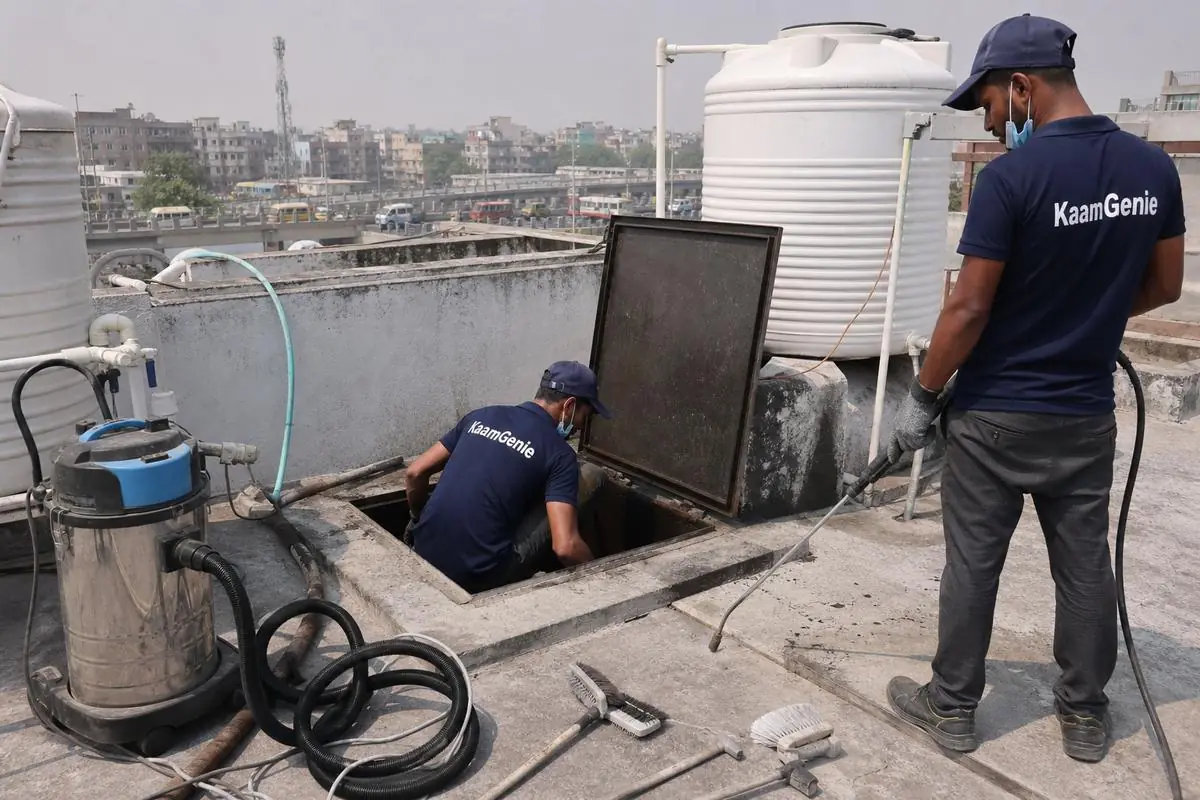
Truck-heavy corridors shed a specific mix — fine road dust, tyre particles, diesel soot — and it settles thickest exactly where Peeragarhi’s sump covers sit: courtyards, loading bays and stilt floors that face the road. Rain and floor-washing carry that film to the cover seat, and through any gap into storage. Opened sumps near the chowk show a dark, greasy-edged sediment quite different from the pale sand in a residential colony — soot binds with silt into a layer that only wet-vacuuming and a hot-pressure scrub remove properly.
The outer lanes add the borewell story: weak edge-of-network pressure pushes buildings onto groundwater that runs hard, so scale crusts the sump floor beneath the soot layer. And because many buildings here are working premises, cleaning gets deferred — nobody wants the water off mid-business. That is a scheduling problem, not a reason to skip: we run early slots that finish before loading hours, and a yearly clean (six-monthly for road-facing covers) keeps the junction out of your tanks.
No travel charge anywhere in Peeragarhi. The final price is confirmed on the call before we come — it depends only on tank size and access.
See it done in 45 seconds
Watch our web story on how a tank is really cleaned — drain, de-sludge, jet-wash, disinfect.
We reach every pocket of Peeragarhi — and there’s no travel charge to any of them:
Every locality in Delhi stores different water, and that decides how fast a tank fouls. This is Peeragarhi’s profile from The Delhi Water Index, built from our field observations across 250+ localities.
Indicative field characterisation, not a certified lab test. BIS IS 10500: TDS 500 mg/L acceptable, 2,000 permissible. Check any Delhi area →
“Can you clean the sump without stopping our godown’s work day?” Yes — we start early and finish the pump-out, scrub and disinfection before loading hours, so the building’s water is back when work starts. For premises that run early too, we agree the least disruptive window in advance. Call 95603 66362 and tell us your operating hours — residential bookings made before 10 AM can usually be done the same day.
“The sediment in our sump looks black and greasy. Is that normal here?” Near the junction, yes — diesel soot from two highways binds with road silt into that dark, greasy-edged layer. It clings more than plain sand, which is why we wet-vacuum the bed and then pressure-scrub the floor rather than just draining. It is removable, and a tighter cover seal slows its return.
“Do you serve the DDA relocation flats?” Yes. Where a block shares ground-level storage we clean it as one job and the families split the bill; individual households with drums or small ground tanks can book solo. The relocation blocks are on our regular Peeragarhi round along with the village and the outer lanes.
“What is the price for a mixed-use building’s sump?” By capacity, same as anywhere: ₹1,499 up to 1,000 litres, quoted above that once we know the size — mixed-use sumps here often run 3,000 litres and up for combined draw. Soot-bound sludge or borewell scale is factored into the upfront quote, never a mid-job revision.
“How often should a road-facing building clean its sump?” If your sump cover sits in a courtyard or stilt floor facing Rohtak Road or the Outer Ring Road, every six months — the fallout load is simply higher. Set-back buildings and the village lanes can hold a yearly cycle. Either way we check and re-seat the cover at each visit, which does half the preventive work.
See our complete water tank cleaning services in Delhi NCR — pricing, process, tank types and full city coverage.
Beyond water tank cleaning, KaamGenie is rolling out a full lineup of home services across Delhi NCR — see our complete list of 12 home services we offer or will be launching through 2026. New to tank cleaning? Read our guide on how to pick the right water tank cleaning service in Delhi — what to look for, what to avoid, and the questions that separate trustworthy crews from quick-job operators.
Rooftop plastic tanks
₹699+ →Kothi sumps & underground tanks
₹1,499+ →Apartments & RWAs
Bulk pricing →FSSAI-compliant cleaning
₹2,500+ →टंकी साफ़ करने वाले
हिन्दी पढ़ें →View all water tank cleaning guides →
All pockets and lanes of Peeragarhi covered. If your specific block or society isn’t named in the sub-areas above, just call — we almost certainly cover it.
Same crew, same 6-step process, same-day where possible. Pick any locality below for local pricing and the tanks we typically find there.
Book a slot — we can usually fit you in today or tomorrow.