
Same-Day Water Tank Cleaning in Delhi
Raj Babbar · 8 min read
Home › Water Tank Cleaning › Underground Sump Cleaning › Nimri Colony (Ashok Vihar)
Underground sump cleaning in Nimri Colony, Ashok Vihar — the shared below-ground tanks under DDA blocks and independent floors that hold the day's water for several flats, gather silt, and lack a clear caretaker. Confined-space safe, documented. From ₹1,499.
When DDA laid out Nimri Colony in orderly blocks, it built the flats to store water below ground before pumps lifted it to the rooftop tanks. Those shared underground sumps still sit under the DDA structures and independent floors, holding the day's supply for several flats at once. The water is mostly DJB, and as the buildings have aged the sediment it carries has kept settling quietly at the bottom of the buried tank. Because one sump often serves a whole block of flats, no single owner treats it as theirs, so the upkeep falls between everyone. That shared ownership is exactly why the tank goes long intervals between cleanings while the sludge bed thickens unnoticed.
KaamGenie cleans these shared DDA-block sumps in full. We open and ventilate the tank, air-test it, pump the water down to the sludge line, scoop and wet-vacuum the silt, then jet the caked mud and biofilm off the floor and walls before an anti-bacterial disinfectant wash and a clean rinse, with before and after photos on WhatsApp for the block. A closed sump can hold stale, low-oxygen air, so we treat every one as a confined space, ventilating and air-testing before entry with a spotter at the opening. If the rooftop tanks want doing together, see our water tank cleaning in Nimri Colony (Ashok Vihar); this page is about the underground sump.
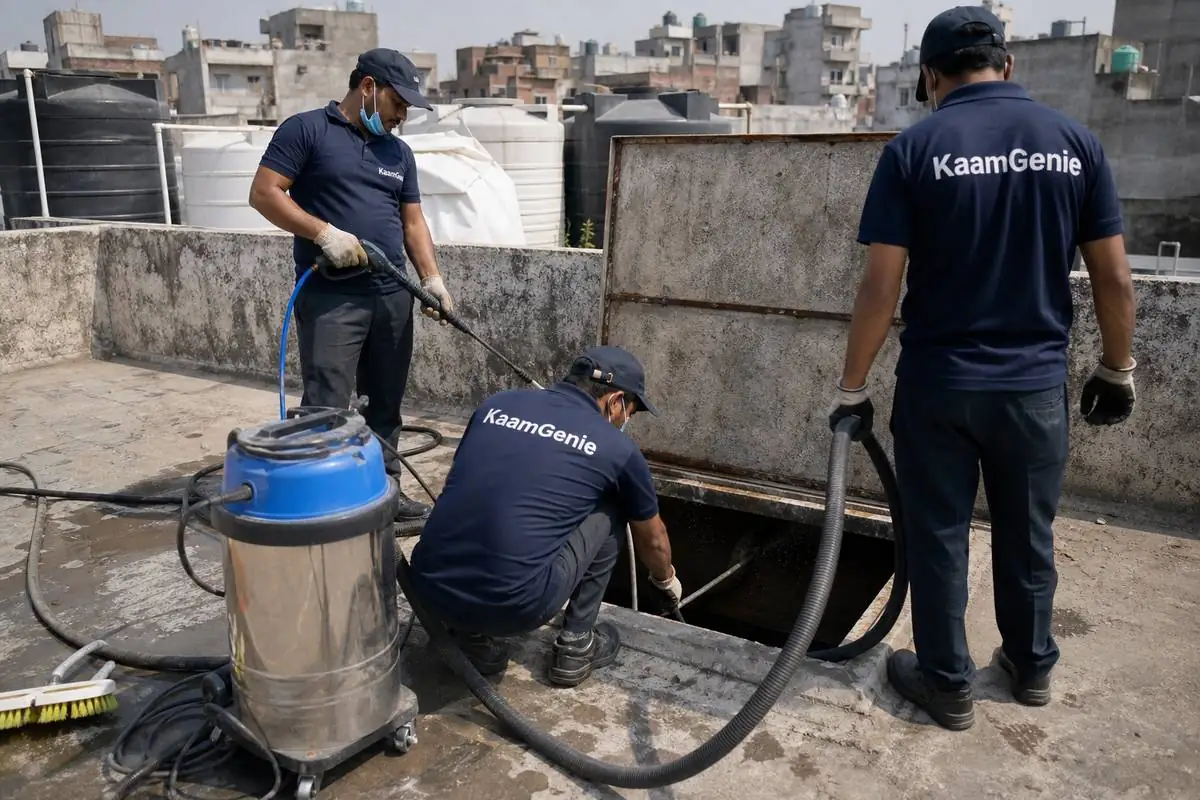
Every flat in the block draws its water through the sump first, so the sediment in the DJB line settles out and banks on the floor before the cleaner water is pumped upstairs. Feeding several flats means a large volume passes through one buried tank, so the sludge bed builds steadily. As the ageing DDA concrete weathers, a chalky scale also forms on the walls where the supply runs hard.
The catch with a shared sump is that it belongs to the whole block and therefore to no one's routine, so it is opened only when the water across the flats turns off. Ageing DDA tanks can develop hairline cracks that let ground seepage in, and a long-sealed one holds stagnant air over the sludge. Our crews ventilate and air-test every Nimri sump before entry and check the structure while it is open, so the whole block can rely on the result.
No travel charge anywhere in Nimri Colony (Ashok Vihar). The final price is confirmed on the call before we come — it depends only on tank size and access.
See it done in 45 seconds
Watch our web story on how a tank is really cleaned — drain, de-sludge, jet-wash, disinfect.
We reach every pocket of Nimri Colony (Ashok Vihar) — and there’s no travel charge to any of them:
Every locality in Delhi stores different water, and that decides how fast a tank fouls. This is Nimri Colony’s profile from The Delhi Water Index, built from our field observations across 250+ localities.
Indicative field characterisation, not a certified lab test. BIS IS 10500: TDS 500 mg/L acceptable, 2,000 permissible. Check any Delhi area →
“One sump feeds several flats. Who arranges the cleaning?” Usually the RWA, the block secretary, or a couple of residents who coordinate it, since the shared sump belongs to everyone. Whoever calls us, we clean the one tank for the whole block and send before and after photos that can be shared with all the flats.
“Will the flats lose water while you clean?” Only briefly. We work around the block's pump timing so the rooftop tanks stay topped up while the sump is drained and cleaned, which keeps supply to the flats running with just a short interruption.
“How is a shared block sump priced?” It starts at ₹1,499 for a small sump up to 1,000 litres. A typical 1,001 to 2,000 litre block sump runs ₹1,799 to ₹2,200, and a larger 2,001 to 5,000 litre reservoir is ₹2,500 to ₹3,500. Split across the flats it works out low per home.
“The DDA building is decades old. Could the sump be cracked?” It can happen, and we check. Once the tank is empty and jet-washed we dry-inspect the walls and floor for the hairline cracks and seepage ageing DDA concrete develops, and we flag anything structural in the report so the block can get it sealed.
“How often should the block clean its sump?” For a shared tank feeding several flats, once a year is a sensible minimum, and twice a year if usage is heavy. We will suggest an interval based on how much silt comes out on the first visit.
See our complete water tank cleaning services in Delhi NCR — pricing, process, tank types and full city coverage.
Beyond water tank cleaning, KaamGenie is rolling out a full lineup of home services across Delhi NCR — see our complete list of 12 home services we offer or will be launching through 2026. New to tank cleaning? Read our guide on how to pick the right water tank cleaning service in Delhi — what to look for, what to avoid, and the questions that separate trustworthy crews from quick-job operators.
Rooftop plastic tanks
₹699+ →Kothi sumps & underground tanks
₹1,499+ →Apartments & RWAs
Bulk pricing →FSSAI-compliant cleaning
₹2,500+ →टंकी साफ़ करने वाले
हिन्दी पढ़ें →View all water tank cleaning guides →
All pockets and lanes of Nimri Colony (Ashok Vihar) covered. If your specific block or society isn’t named in the sub-areas above, just call — we almost certainly cover it.
Same crew, same 6-step process, same-day where possible. Pick any locality below for local pricing and the tanks we typically find there.
Book a slot — we can usually fit you in today or tomorrow.