
Water Tank Cleaning Rules & Norms
Raj Babbar · 9 min read
Home › Water Tank Cleaning › Underground Sump Cleaning › Rajgarh Colony
Sump cleaning in Rajgarh Colony, an established East Delhi colony on regular DJB supply with nineties-era cistern stock. We clean the ageing underground sump as confined-space work, from ₹1,499.
Rajgarh Colony runs on straightforward East Delhi DJB water, which is easier than the borewell that plagues the colonies across the river, but the tanks tell a different story. This is an established colony near the Krishna Nagar border, full of older 3 to 4 storey buildings, and much of the sump and tank stock dates to the nineties. Those ageing concrete cisterns have roughened over the decades, their inner walls turning porous and pitted so they hold sediment even on relatively clean water. Each building runs a buried sump that fills first, then a pump that lifts the water to the roof tank. Residents here tend to clean only when the water visibly turns, so the sediment settles unnoticed in those old walls for a long time.
We handle the sump from start to finish: open it, ventilate and air-test before entry, pump out the old water, clear the settled sediment, scrub the ageing walls and floor, and finish with an anti-bacterial disinfectant wash. This page focuses on the underground sump, while the wider water tank cleaning in Rajgarh Colony service covers the full supply up to the overhead tank. Since one pump feeds both, we can clean the roof tank in the same visit so the whole line is done together. On nineties-era concrete we also check the walls for cracks while the sump is empty.
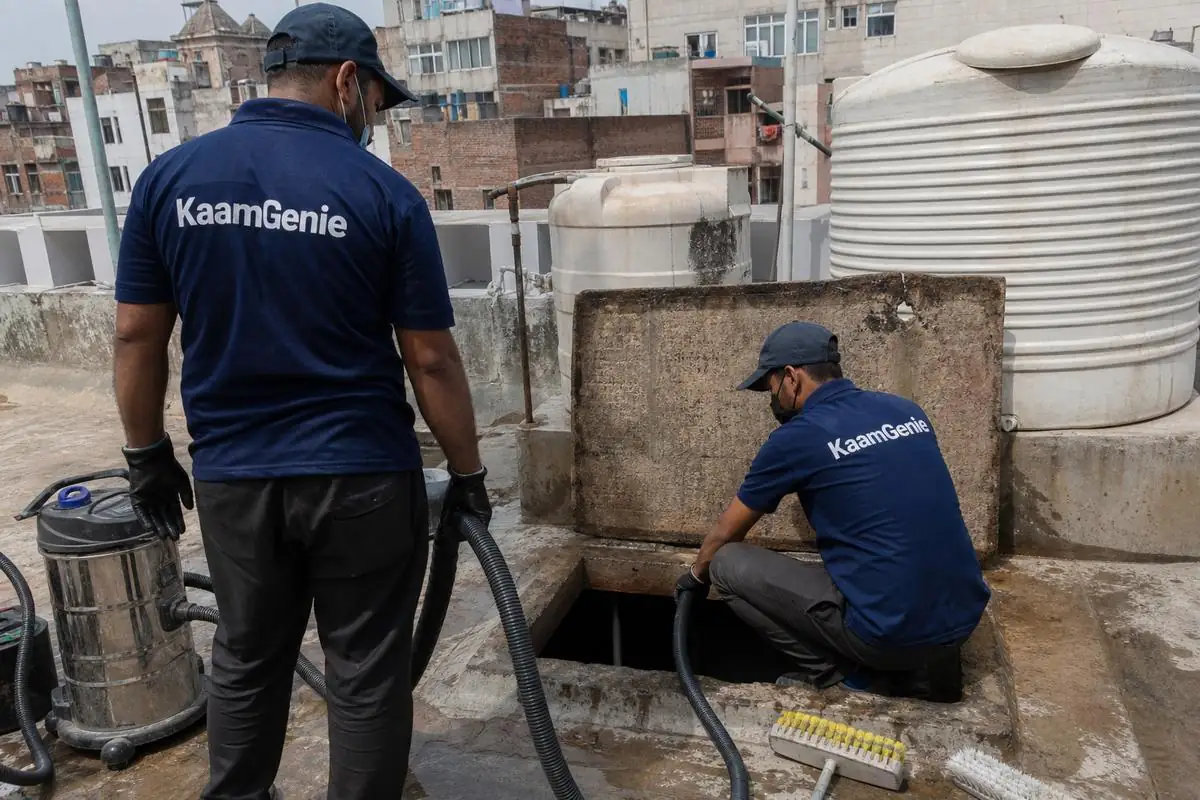
The DJB supply is the easy part, and it can lull you. Because the water is reasonably clean and only moderately hard, it rarely looks bad, so nothing prompts a clean. But water quality is not the whole picture: the ageing concrete cistern underneath is porous and rough enough to hold sediment regardless of how clear the supply looks. That mismatch, decent water in an old tank, is exactly why these sumps end up dirtier than owners expect.
The tank stock seals the case. Much of Rajgarh Colony’s cistern stock is nineties-era, and after decades the walls have roughened and can crack, giving sediment plenty to cling to and raising the risk of seepage. Residents who wait for the water to turn are already well past the point where the bed should have been cleared. Opening, ventilating and air-testing the sump before a hand scrub is the proper way to reset an old cistern, and checking the concrete for cracks at the same time is worth the trip.
No travel charge anywhere in Rajgarh Colony. The final price is confirmed on the call before we come — it depends only on tank size and access.
See it done in 45 seconds
Watch our web story on how a tank is really cleaned — drain, de-sludge, jet-wash, disinfect.
We reach every pocket of Rajgarh Colony — and there’s no travel charge to any of them:
Every locality in Delhi stores different water, and that decides how fast a tank fouls. This is Rajgarh Colony’s profile from The Delhi Water Index, built from our field observations across 250+ localities.
Indicative field characterisation, not a certified lab test. BIS IS 10500: TDS 500 mg/L acceptable, 2,000 permissible. Check any Delhi area →
“The DJB water looks clean, so why clean the sump?” Because the water is only half the story. The ageing concrete cistern underneath is rough and porous enough to hold sediment even on clean supply, so the tank can be dirty while the water looks fine. Cleaning the sump addresses the tank itself, not just the water.
“My sump is from the nineties. Can it still be cleaned safely?” Yes. Older concrete cisterns are common here and clean up well with a proper hand scrub of the roughened walls. We also check the walls for cracks while it is empty, since decades-old concrete can develop them, and flag anything worth sealing.
“What does sump cleaning cost?” From ₹1,499 for a small sump up to about 1,000 litres. Most run ₹1,799 to ₹2,200 by capacity, and larger cisterns are ₹2,500 to ₹3,500. We confirm the price after seeing the tank.
“Should I wait until the water turns before cleaning?” It is better not to. By the time the water visibly discolours, the sediment bed in the tank is already deep. A yearly clean of the cistern keeps it clear and avoids ever reaching that point.
“Is entry into the sump safe?” Yes, we treat every sump as confined-space work. The tank is opened, ventilated and air-tested before a trained worker enters, and only then does anyone go in to scrub it out. Those checks are standard on each job.
See our complete water tank cleaning services in Delhi NCR — pricing, process, tank types and full city coverage.
Beyond water tank cleaning, KaamGenie is rolling out a full lineup of home services across Delhi NCR — see our complete list of 12 home services we offer or will be launching through 2026. New to tank cleaning? Read our guide on how to pick the right water tank cleaning service in Delhi — what to look for, what to avoid, and the questions that separate trustworthy crews from quick-job operators.
Rooftop plastic tanks
₹699+ →Kothi sumps & underground tanks
₹1,499+ →Apartments & RWAs
Bulk pricing →FSSAI-compliant cleaning
₹2,500+ →टंकी साफ़ करने वाले
हिन्दी पढ़ें →View all water tank cleaning guides →
All pockets and lanes of Rajgarh Colony covered. If your specific block or society isn’t named in the sub-areas above, just call — we almost certainly cover it.
Same crew, same 6-step process, same-day where possible. Pick any locality below for local pricing and the tanks we typically find there.
Book a slot — we can usually fit you in today or tomorrow.