
PG & Hostel Tank Cleaning
Raj Babbar · 9 min read
Home › Water Tank Cleaning › Underground Sump Cleaning › Shiv Vihar
Sump cleaning in Shiv Vihar for the underground cistern below your building. People ask whether the buried tank even needs cleaning if the water looks fine, and the honest answer is yes. Confined-space work, from ₹1,499.
“The overhead tank looks okay, so does the sump underneath really need cleaning?” We get that question a lot in Shiv Vihar, and the answer is yes, more than the tank on the roof. Out here on the far edge near Karawal Nagar and Mustafabad, close to the Delhi-UP border, buildings run on a buried sump that fills first from a hard borewell, then a pump carries the water up. That underground cistern is where the heavy scale and grit actually collect, out of sight, while the overhead tank only holds what the pump has already lifted. So the roof tank can look clean while the real sediment sits below it. In these tall, packed builder floors with high occupancy, the sump often goes years without ever being opened.
When we come out, we open the sump, ventilate it and air-test before anyone enters, then pump out the water, clear the grit and scale, scrub the surfaces, and finish with an anti-bacterial disinfectant wash. This page focuses on the underground sump, and the wider water tank cleaning in Shiv Vihar service covers the full supply from the ground cistern upward. As the same pump feeds the overhead tank, we can clean that in the same visit so both ends are sorted together. What you get is a cistern cleaned at the level where the dirt really builds.
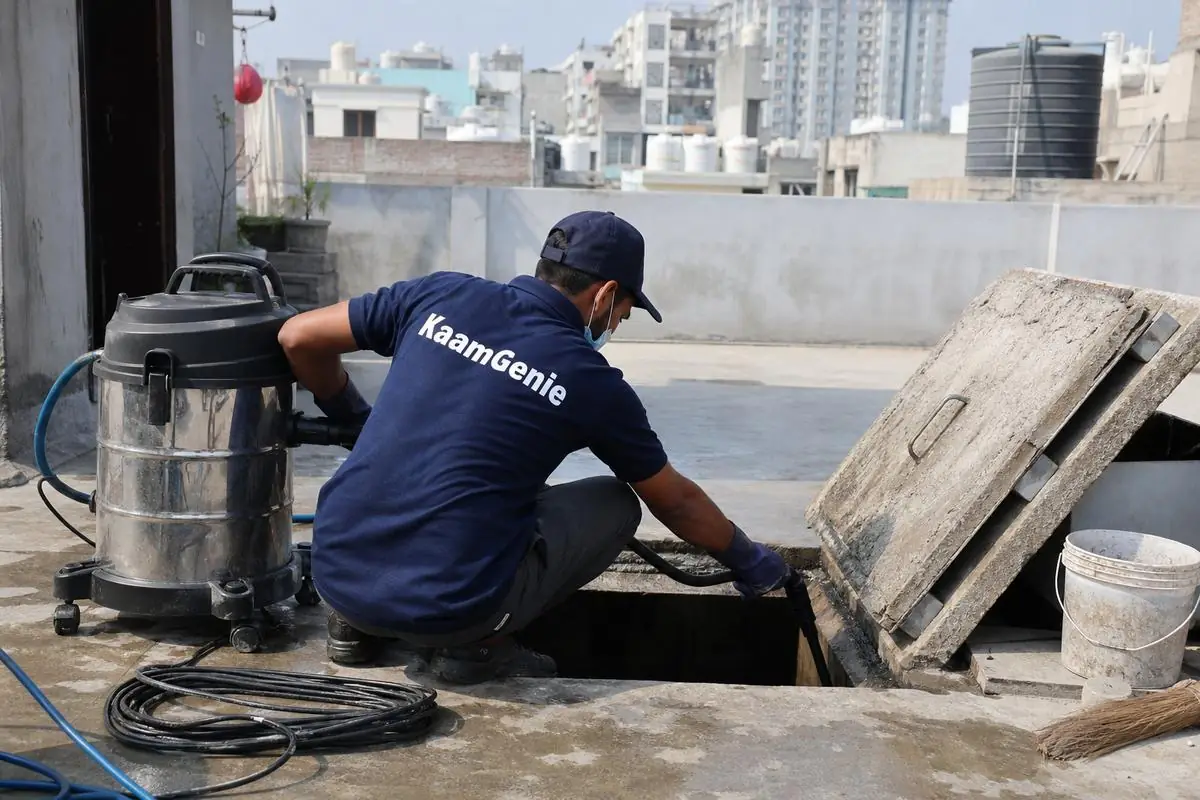
Start with the tank itself: a buried sump is a sealed, dark box that collects everything the borewell drops and then hides it. Because you cannot see inside without opening it, a sump can look after itself for years while quietly building a floor of scale and grit. The overhead tank you can peer into, so it gets attention. The one that matters most is the one you never look at, and that is exactly the sump.
The water feeding it makes the buildup fast. Shiv Vihar sits on hard borewell that carries heavy scale and grit, so each fill adds to the bed below. Then there is the density: these are tall, high-occupancy buildings where one sump serves many households, so a skipped clean affects everyone under that roof. Opening, ventilating and air-testing the cistern before a hand scrub is the only way to clear years of settled sediment properly, and it is worth doing whether or not the water has turned yet.
No travel charge anywhere in Shiv Vihar. The final price is confirmed on the call before we come — it depends only on tank size and access.
See it done in 45 seconds
Watch our web story on how a tank is really cleaned — drain, de-sludge, jet-wash, disinfect.
We reach every pocket of Shiv Vihar — and there’s no travel charge to any of them:
Every locality in Delhi stores different water, and that decides how fast a tank fouls. This is Shiv Vihar’s profile from The Delhi Water Index, built from our field observations across 250+ localities.
Indicative field characterisation, not a certified lab test. BIS IS 10500: TDS 500 mg/L acceptable, 2,000 permissible. Check any Delhi area →
“If the overhead tank looks clean, does the sump still need cleaning?” Yes, usually more so. The overhead tank only holds water the pump already lifted, while the buried sump is where scale and grit actually settle first. A clean-looking roof tank often sits above a sump with a thick sediment bed.
“Do you cover the far lanes near the Delhi-UP border?” Yes. We work across all of Shiv Vihar, from the tiraha through the phase lanes out toward the border and the Chand Bagh side. The crew comes on foot with portable equipment, so the tighter lanes are fine.
“Is entering a deep buried sump safe for your worker?” It is because we follow a confined-space routine. The sump is opened, ventilated and air-tested before anyone goes in, and only then does a trained worker enter to scrub it. We do not skip those steps to save time.
“What will the cleaning cost?” From ₹1,499 for a small sump up to roughly 1,000 litres. Most run ₹1,799 to ₹2,200 by capacity, and larger cisterns are ₹2,500 to ₹3,500. We give the exact figure once we see the tank.
“The sump has never been opened. What should I expect first time?” Expect a fair amount of settled sludge and scale on the floor, which is normal after years sealed shut. The first clean is the heaviest, and once it is done you can keep it clear with a yearly wash rather than another deep dig-out.
See our complete water tank cleaning services in Delhi NCR — pricing, process, tank types and full city coverage.
Beyond water tank cleaning, KaamGenie is rolling out a full lineup of home services across Delhi NCR — see our complete list of 12 home services we offer or will be launching through 2026. New to tank cleaning? Read our guide on how to pick the right water tank cleaning service in Delhi — what to look for, what to avoid, and the questions that separate trustworthy crews from quick-job operators.
Rooftop plastic tanks
₹699+ →Kothi sumps & underground tanks
₹1,499+ →Apartments & RWAs
Bulk pricing →FSSAI-compliant cleaning
₹2,500+ →टंकी साफ़ करने वाले
हिन्दी पढ़ें →View all water tank cleaning guides →
All pockets and lanes of Shiv Vihar covered. If your specific block or society isn’t named in the sub-areas above, just call — we almost certainly cover it.
Same crew, same 6-step process, same-day where possible. Pick any locality below for local pricing and the tanks we typically find there.
Book a slot — we can usually fit you in today or tomorrow.