
The short version
- A split system. One shared ground sump at the base feeds a common pump, which lifts water to a separate rooftop drum for each flat. You share the bottom, you own the top.
- The responsibility gap. No AOA or RWA usually exists, so the shared sump becomes “everyone’s and no one’s” job — the classic reason builder-floor sumps go years uncleaned.
- Clean the whole stack. Sump plus every rooftop drum, in one visit, so fresh water from a clean sump fills already-clean drums and nothing gets recontaminated.
- Fair cost split. Shared sump and pump divided across floors; each floor pays for its own drum. One itemised quote settles the who-pays argument.
- Noida water. Hard borewell groundwater and tanker top-ups in Greater Noida West drop scale and silt fast — aim for every 3–4 months.
- Pricing. Single drum fixed from ₹699 onwards; shared sump quoted separately; whole-building booking is cheapest per floor.
If your building has a different owner on each floor, a sump at the bottom and drums on the roof, this is you — and the sump is almost certainly overdue.
| What differs | Builder floor | High-rise society | Plotted house |
|---|---|---|---|
| Water system | Shared ground sump + common pump + a separate rooftop drum per flat | Large UGR + overhead tanks on each tower | One or two terrace tanks; sometimes a small sump |
| Who organises it | Nobody by default — floors must agree between themselves | AOA / RWA / facility agency | The single owner |
| Tanks per visit | Sump + 3–4 rooftop drums (whole G+3/G+4 stack) | Many — UGR compartments + every tower tank | Usually one or two |
| Who pays | Sump split across floors; each floor pays its own drum | Common maintenance budget | The owner alone |
| Typical Noida areas | Sector 44, Sector 50, Greater Noida West (Noida Extension) | Sector 137, 150, Expressway corridor | Established sectors 14–62 |
| Cost | Drum from ₹699; sump quoted; cheapest booked together | Custom per-tank quote | Fixed from ₹699 onwards |
Book the whole builder-floor stack at once
Shared sump plus every floor’s rooftop drum in one coordinated visit — food-grade disinfectant, photos and a per-tank certificate. Residential drums ₹699 onwards; sump quoted separately.
The builder-floor water system: shared at the bottom, separate at the top
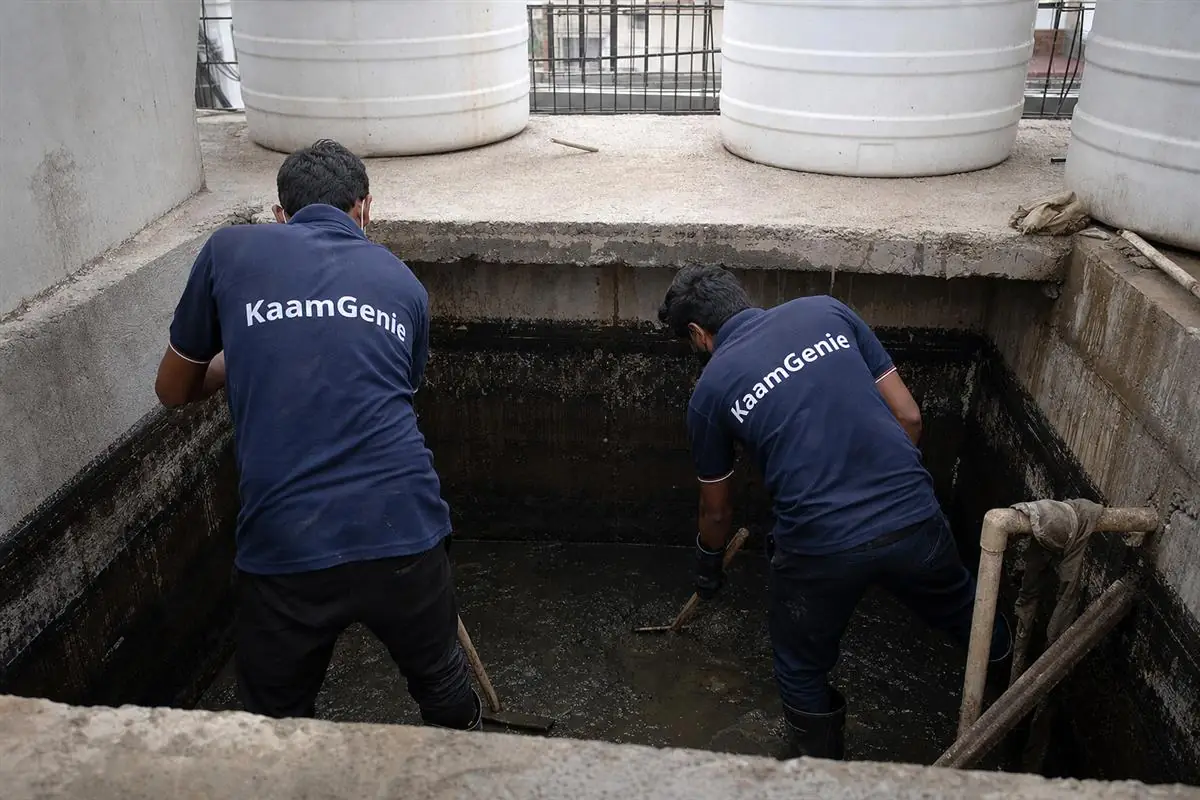
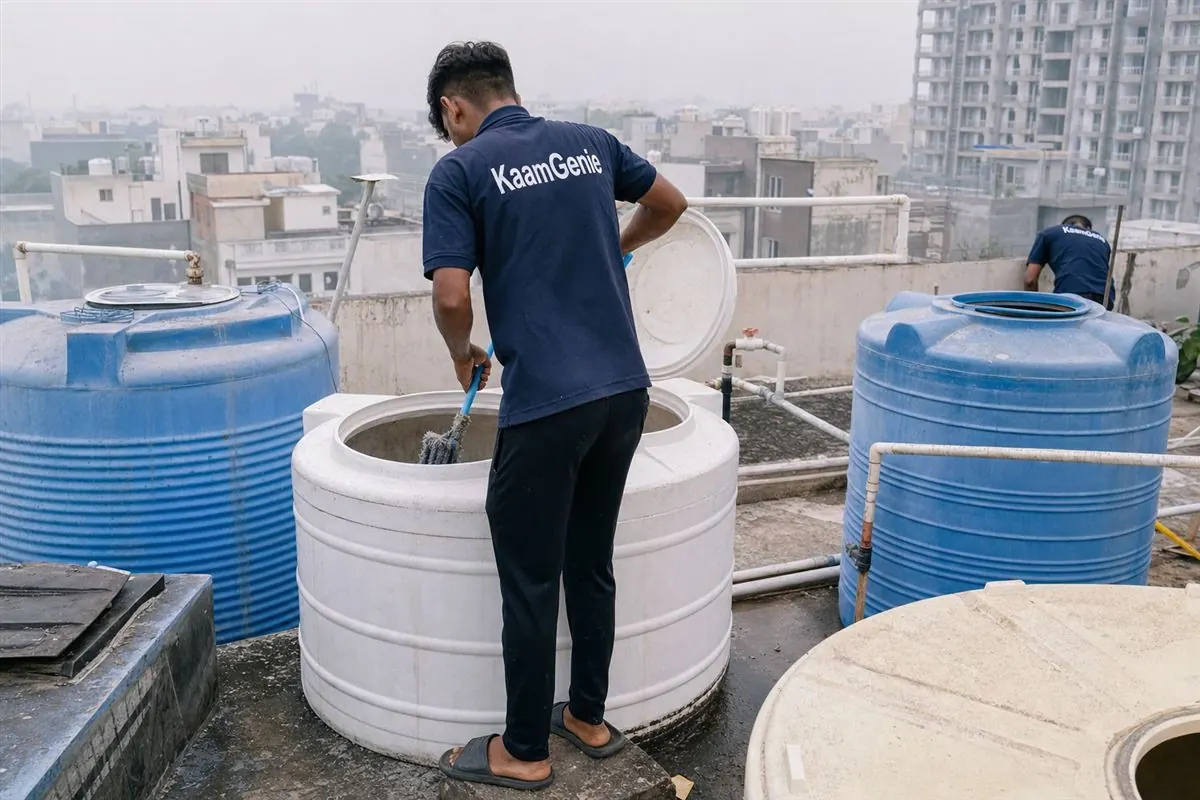
An independent builder floor — the G+3 and G+4 buildings that fill sectors like 44 and 50 and stretch right across Greater Noida West (Noida Extension) — runs a system that is half plotted house, half society. At the base sits one shared ground-level sump that collects whatever the building is supplied: Noida Authority piped water where it reaches, hard borewell groundwater, or tanker top-ups during shortfalls. A single common pump lifts that water up, and at the top each flat usually has its own rooftop drum or plastic tank — one per floor, lined up on the terrace.
That split is the whole story. The bottom of the system is shared by everyone; the top is owned by each flat separately. Water reaching a kitchen tap on the second floor has passed through the common sump and that flat’s own drum, so contamination at either point ends up in the glass. It is a genuinely different setup from the two clean cases — the shared UGR-plus-tower model and the single-owner plotted tank — which we lay out side by side in our guide to how tank cleaning differs for high-rise versus plotted homes in Noida.
The responsibility gap — why builder-floor sumps go years uncleaned
Here is the problem nobody warns new builder-floor buyers about. A high-rise has an AOA, an RWA or a builder’s facility agency whose literal job is to clean the shared tanks. A plotted house has one owner who knows the buck stops with them. A builder floor has neither. Three or four separate owners, often with one or two of the floors rented out, and no committee, no maintenance fund, no agreed schedule.
So the shared sump becomes everyone’s problem and therefore no one’s. The ground-floor owner assumes the people upstairs should sort it; the top-floor tenant has never even seen the sump and doesn’t know it exists; the investor who owns the first floor lives in another city. Months turn into years, and the sump — the part where the heaviest sediment collects — quietly turns into the dirtiest tank in the building while everyone drinks from it. We see the same pattern with rented units generally, which is why we wrote a separate piece on who is responsible for tank cleaning when you rent in Noida.
The fix isn’t complicated, it just needs one person to start it: the floors agree, once a year, to split a single sump clean the same way they’d split a shared motor repair or a common-staircase paint job. One neutral, itemised quote in a WhatsApp group does more to settle this than another round of “someone should really do something about the sump.”
Why the rooftop drums matter just as much
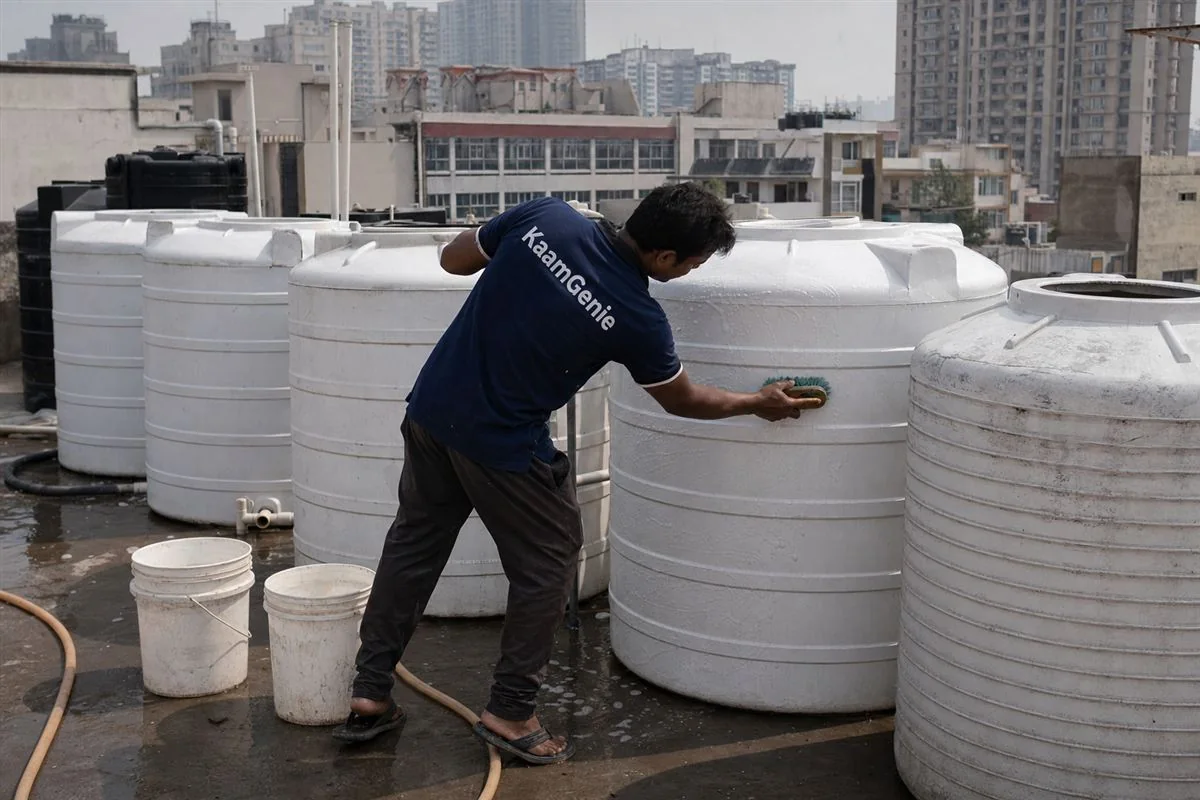
It would be a mistake to fix the sump and forget the drums. Each rooftop drum is the last point of storage before water reaches that flat’s taps, so even a spotless sump can’t save a flat whose own drum is full of algae and sediment. And rooftop drums on a builder floor have a specific weakness: they’re usually thin plastic, often uncovered or loosely lidded, sitting in direct Noida sun on an open terrace. Heat plus light is exactly what algae needs, so a neglected drum can turn green inside within weeks of a summer.
The drums are also where ownership is cleanest — a third-floor drum serves only the third floor, so that owner can and should book their own drum without waiting on anyone. The material of those drums affects how they’re cleaned, too: most are Sintex-style plastic, which we handle differently from concrete, as explained in our breakdown of Sintex versus concrete tank cleaning in Noida. The smart move is to combine the two: an individual owner books their drum, and the building books the shared sump, ideally on the same day.
Doing the whole stack in one visit
This is the part that genuinely saves a builder floor money and hassle. When you book the whole stack in a single coordinated visit, the crew arrives once and works the system top-to-tail in the right order:
- Shared ground sump first — drained, de-sludged and treated as confined-space work, with ventilation and a standby person, because the silt layer at the bottom is the dirtiest part of the building.
- Each rooftop drum in turn — the crew works up the floors, draining, scrubbing, jet-washing and vacuuming every flat’s drum.
- Disinfection and refill of the whole chain — so the freshly cleaned sump pumps clean water up into already-clean drums.
Sequence matters. If you clean the drums first and the sump last, the dirty sump immediately pumps sediment back up into your spotless drums — you’ve undone the work. Doing it as one chain avoids that recontamination entirely. It’s also where the cost drops: one call-out, one set-up of the pump, jet-wash and wet-vacuum, shared across the sump and three or four drums, instead of four separate visits on four different days.
Cost per floor — booking separately vs the whole stack together
Illustrative: a G+3 builder floor (shared sump + 4 rooftop drums)
Illustrative relative cost per floor, not a price list. The saving comes from sharing one call-out, pump, jet-wash and wet-vacuum across every tank instead of repeating the set-up on separate days. Actual pricing depends on tank sizes and sump capacity.
Who pays — a split that actually holds up
Money is where builder floors stall, so keep the rule simple and visible. The shared sump and common pump serve every floor, so their cleaning is divided equally across the floors that draw from them. Each floor’s own rooftop drum is paid for by that floor alone. That’s it — usage-based, the same logic everyone already accepts for the shared motor or the common water connection.
On the paperwork side, we can do whichever your building prefers: one combined invoice with the sump-and-pump line split across floors, or separate per-floor invoices each carrying that floor’s drum plus its share of the sump. Either way every owner can see exactly what they’re paying for. For a full sense of what drives any of these numbers — tank size, sump capacity, access — our water tank cleaning cost guide for Noida breaks down how a quote is built.
Noida’s water makes this non-optional
Builder floors don’t get to treat cleaning as a someday job, because of what’s coming through the pipes. Most of Noida and Greater Noida West draws on hard borewell groundwater, heavy with calcium and iron, which drops chalky scale and rust-coloured staining onto tank walls far faster than soft municipal water would. On top of that, a large share of Greater Noida West towers and builder floors rely on tanker water during supply shortfalls, and tanker water often carries fine suspended sediment that settles straight into the bottom of the shared sump.
Put together, that means the sump is usually the single dirtiest tank in the building, and the rooftop drums scale and grow algae quickly in the heat. The realistic schedule for a Noida builder floor is every three to four months, with twice a year as the absolute minimum that BIS IS 10500 and CPHEEO guidance support for stored drinking water. Don’t wait for yellow water or a smell — by the time the water looks wrong, the sediment has been there a while.
Where we clean builder floors across Noida
We run builder-floor cleaning as part of one water tank cleaning in Noida service, and it’s the same trained crew and food-grade method whether it’s a single drum or a full stack. We cover the established builder-floor belts like Sector 44 and Sector 50, and the newer townships of Greater Noida West (Noida Extension) where builder floors and low-rise blocks sit alongside the towers. It’s the same core 8-step cleaning we provide through our wider water tank cleaning services across NCR — just coordinated for a building with shared and separate tanks at once.
To book, call +91 95603 66362 or use the form on this site — tell us the number of floors, roughly the drum sizes, and whether the shared sump is included, and we’ll come back with a clear per-floor and shared-sump split before we arrive.
Sort the sump and every drum in one morning
One visit, the whole builder-floor stack cleaned in the right order, before/after photos and a certificate per tank. Residential drums ₹699 onwards; shared sump custom-quoted.
Get your builder floor on a schedule
The hardest part of a builder floor isn’t the cleaning — it’s getting the floors to agree to do it. Once you’ve had the whole stack cleaned and seen the difference, putting it on a quarterly rhythm is easy. Browse the wider water tank cleaning in Noida hub for area pages and related guides, and when you’re ready, book the sump and every drum together so your building starts fresh from the bottom up.
Frequently asked questions
What exactly is a builder floor, and why is its water system different?
A builder floor is an independent flat on its own floor of a low-rise building — typically G+3 or G+4 in Noida sectors like 44 and 50 and across Greater Noida West (Noida Extension), with a different owner or tenant on each floor. The water system is a hybrid: one shared ground-level sump at the base collects the supply (municipal, borewell or tanker), a common pump lifts it up, and each floor usually has its own separate rooftop drum or plastic tank. So you share the dirty bottom of the system but own the top of it — which is exactly why the cleaning gets neglected.
Who is responsible for cleaning the shared ground sump in a builder floor?
On paper, everyone who draws from it; in practice, often nobody. Unlike a high-rise there is usually no AOA, RWA or maintenance agency for an independent builder floor, so the shared sump falls into a responsibility gap — each owner assumes another floor will deal with it. That is the single most common reason builder-floor sumps in Noida go years without a proper clean. The honest fix is for the floors to agree once a year to split the sump clean, the same way they would split a shared motor repair.
We have a separate rooftop drum per flat — do they all need cleaning?
Yes, every one of them. Each rooftop drum is the last stop before the water reaches that flat’s taps, so a dirty drum on the third floor contaminates only that home — but it contaminates it completely. Plastic drums sitting in direct Noida sun also warm up and grow algae faster than a shaded tank. Cleaning only the sump and skipping the drums (or vice versa) leaves half the contamination in place, which is why we recommend doing the whole stack together.
Can you clean the whole builder-floor stack — shared sump and all rooftop drums — in one visit?
Yes, and it is the most sensible way to do it. The crew arrives once, drains and cleans the shared ground sump as confined-space work, then works up the building cleaning each floor’s rooftop drum in turn, finishing with disinfection and refill of the whole chain. Doing it in one coordinated visit means the sump’s fresh water fills already-clean drums — so no recontamination — and the cost per floor drops because the crew, equipment and call-out are shared across all the tanks.
Who pays for the shared sump when the floor owners do not agree?
The fair and standard split is by usage: the shared sump and common pump are divided equally among the floors that draw from them, while each floor pays for its own rooftop drum. We can issue a single combined invoice with the sump and pump line split across floors, or separate invoices per floor with a shared-sump share on each — whichever your building prefers. Having one neutral itemised quote in front of everyone usually settles the who-pays argument faster than another WhatsApp-group debate.
How much does builder-floor water tank cleaning cost in Noida?
A single rooftop drum or terrace tank is fixed residential pricing — ₹699 onwards, scaling with tank size. The shared ground sump is quoted separately by capacity and access because it is confined-space work. The cheapest route for a builder floor is to book the whole building at once: when the sump and three or four rooftop drums are done in one visit, the shared call-out and equipment are spread across every floor, so the per-flat cost is well below booking each tank as a separate job on a different day.
How often should a Noida or Greater Noida West builder floor clean its tanks?
Every three to four months for the rooftop drums, and at minimum twice a year per BIS IS 10500 and CPHEEO guidance for stored drinking water. Two local factors push builder floors toward the shorter end: most sit on hard borewell groundwater that drops calcium and iron scale quickly, and many Greater Noida West buildings rely partly on tanker water that carries its own sediment. A small plastic drum baking in summer sun can also grow algae within weeks, so do not wait for the water to look or smell wrong.
Does tanker water and hard borewell water change how the cleaning is done?
It changes how often, and how much sediment we expect to pull out. Hard borewell groundwater common across Noida leaves chalky calcium scale and rust-coloured iron staining on tank walls that needs proper scrubbing, not just a rinse. Tanker water — relied on heavily in newer Greater Noida West towers and builder floors during shortfalls — often arrives with fine suspended sediment that settles as a silt layer in the shared sump. Both mean the bottom of the sump is usually the dirtiest part of the whole system, which is why de-sludging it matters most.
My builder floor is in Greater Noida West (Noida Extension) — do you cover it?
Yes. We clean builder floors, plotted houses and societies right across Noida and Greater Noida West (Noida Extension), including the established plotted-and-builder-floor belts in sectors like 44 and 50 and the newer townships of Noida Extension. Book the whole stack — shared sump plus every floor’s rooftop drum — and we coordinate it as one visit. Tell us the number of floors and roughly the tank sizes when you book and we will give you a clear per-floor and shared-sump split before we arrive.
Do you give a certificate for each flat’s drum and the shared sump?
Yes. Every tank we clean gets before/after photos and a cleaning record listing the date, tank type and capacity, chemicals used and crew. For a builder floor that means a separate record per rooftop drum plus one for the shared sump, so each owner has proof their own tank was done and the building has proof the shared sump was covered. Those records are genuinely useful for a builder floor at resale or when handing a rented unit to a new tenant.
Sources & references
- Bureau of Indian Standards (BIS) — IS 10500:2012 is the canonical Indian Standard for drinking water specification, defining acceptable limits for physical, chemical, and biological parameters.
- WHO Guidelines for Drinking-water Quality, 4th edition — the global reference for water quality standards, including guidance on storage and disinfection.
- Food Safety and Standards Authority of India (FSSAI) — defines water quality requirements for food businesses, including hygiene standards for stored water and acceptable disinfection chemicals.
- WHO Fact Sheet on Drinking Water — overview of safe drinking water requirements and contamination risks.
- CPHEEO — Manual on Water Supply and Treatment — the Government of India’s engineering manual covering tank design, cleaning protocols, and disinfection practices.
Last verified: 30 June 2026. If you find any of these links broken, please let us know.