
Key takeaways
- DJB delivers treated water, but tank hygiene between fills is your responsibility
- Intermittent supply and long standing times drive sediment and biofilm buildup
- Clean DJB-fed tanks every 3–6 months; quarterly for high-use buildings
- Always clean the sump too — it collects the heaviest silt
- Mixed DJB-borewell supply fouls faster; clean toward the shorter interval
- KaamGenie: tanks from ₹699, sumps ₹1,500–2,500, AMC 15–25% off
We will walk through why DJB’s intermittent supply makes tanks riskier than continuous systems, what a defensible cleaning routine looks like, how often to clean, and what records help you show diligence if a resident or inspector ever asks. This is practical guidance for Delhi conditions — not a substitute for a specific legal opinion — and it reflects how careful buildings actually keep their water safe rather than any invented clause number.
How DJB supply behaviour affects your tank
Delhi Jal Board typically supplies water for limited hours, so buildings store large volumes in underground sumps and overhead tanks between fills. That storage gap is exactly where problems start. When a tank sits half-full for hours, sediment settles, residual chlorine dissipates, and biofilm forms on walls and corners. Old or cracked pipelines and shared boundary walls can also let contamination seep in during low-pressure periods, when the network draws in whatever surrounds it. The treated water DJB sends is only as clean as the tank it lands in. That is why cleaning is not optional maintenance — it is the step that protects the quality DJB already paid to deliver. A neglected tank can undo good source water within a single storage cycle, so the tank, not the connection, is where most Delhi water-quality problems are really created.
What a defensible cleaning routine looks like
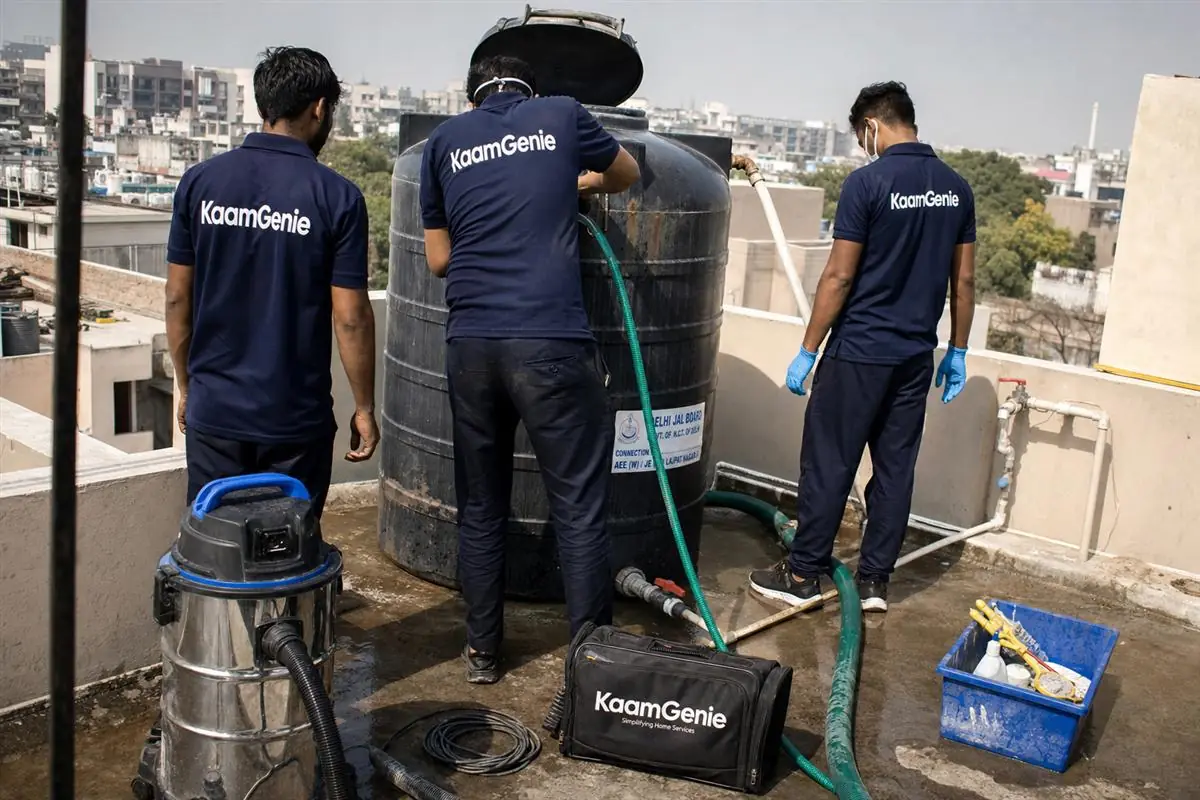
A credible tank-cleaning routine has clear, repeatable steps: full draining, manual scrubbing of walls and floor, sludge and sediment removal, an anti-bacterial wash, and thorough rinsing before refilling. Vacuum extraction of settled silt matters most in Delhi because DJB water often carries fine sediment that piles up on the tank floor. Our teams follow this on every job — see our water-tank cleaning service for the full method. The point is consistency: a tank cleaned to the same standard every time is far easier to defend than an occasional rushed rinse over standing water.
- Drain fully — never clean over standing water
- Scrub walls, floor and corners by hand
- Vacuum out silt and settled sludge
- Anti-bacterial wash, then a clean-water rinse
Recommended cleaning frequency in Delhi
For most Delhi homes and DDA flats on DJB supply, cleaning every three to six months keeps tanks safe. Buildings with heavy use, mixed borewell and DJB feed, or visible sediment should lean toward the shorter end of that range. Societies and commercial buildings with large populations often clean quarterly, because a single dirty tank affects far more families at once. After any supply disruption, pipeline repair, or waterlogging near the sump, an extra clean is sensible even if the schedule does not call for one — those events are exactly when contamination gets in. Read our guide on how often you should clean by law and practice for a fuller breakdown by building type. The simple rule of thumb: if you cannot remember the last clean, you are already overdue and should book one now.
Book your water tank cleaning
Trained crew, food-grade process, before/after photos and a service record every job. ₹699 onwards, same-day where possible across Delhi NCR.
Underground sumps versus overhead tanks
Delhi buildings almost always run two-stage storage — an underground sump that DJB fills, and overhead tanks pumped up from it. Both need cleaning, but sumps carry the bigger risk. Being below ground, they collect the heaviest silt, are prone to seepage during monsoon, and are easy to ignore because you rarely see inside them. Overhead tanks are more exposed to sun and airborne dust but are simpler to reach and inspect. A complete job covers both: cleaning only the overhead tank while a dirty sump keeps feeding it just recycles the problem straight back up. In older kothis and independent houses the sump is often the most neglected part of the whole water system. Sump cleaning is priced separately with us, typically ₹1,500–2,500 depending on size and access, and it is money well spent on the tank that fouls fastest.
Hard water, TDS and DJB-borewell mixing
Many Delhi buildings supplement DJB with a borewell during shortages, and the two sources behave very differently inside a tank. Borewell water in Delhi is frequently hard and high in TDS, so it leaves scale on tank walls and heavier mineral sediment on the floor than DJB water alone. When the two mix in the same sump, you get both the fine DJB silt and the borewell’s mineral load building up together, which fouls the tank faster. If your building runs a mixed supply, treat it as a higher-frequency case and clean toward the three-month end. Cleaning does not soften your water — that is a separate treatment question — but it does remove the scale and sludge that harbour bacteria and make water look and smell off. Knowing your source mix is the first step to setting the right schedule.
Keeping records that show diligence
Whether you are an RWA office-bearer, a facility manager, or a homeowner, simple records protect you. After each clean, keep the date, who did the work, tank capacity, and a couple of before-and-after photos. If a resident raises a water-quality concern, or you need to reassure buyers or tenants at sale or handover, that paper trail shows you acted responsibly rather than reactively. We provide a service record on request that slots straight into a society register or a facility file. You do not need elaborate paperwork — a shared folder or a note in the maintenance log is enough. The goal is to demonstrate a consistent, reasonable cleaning practice over time, so that if anyone ever asks “when was this last done?” you have an instant, credible answer instead of reconstructing memory after a complaint has already landed.
Booking a DJB-supply tank clean with KaamGenie
KaamGenie cleans DJB-fed tanks across Delhi, from single DDA flats to large societies with multiple towers. Domestic overhead tanks start from ₹699, sumps run ₹1,500–2,500, and society or commercial buildings are quoted after a quick site check based on tank number, size and access. Annual maintenance contracts run 15–25% below per-visit pricing and keep your schedule on track automatically, so cleaning never slips through the cracks. We work around your DJB supply timing so tanks are drained, cleaned and refilled with minimal disruption to residents. Call or WhatsApp 95603 66362 to book, or visit our Delhi water-tank cleaning page for coverage details. If you are unsure how often your building needs servicing, we are happy to advise based on your supply source and usage during the site visit.
Frequently asked questions
Does Delhi Jal Board clean my building’s tank?
No. DJB treats and supplies water up to your connection, but cleaning the underground sump and overhead tanks inside your premises is the owner’s or society’s responsibility. Once treated water sits in a dirty tank, its quality drops quickly, so regular in-premises cleaning is what actually protects what DJB delivers to your inlet.
How often should a DJB-supplied tank be cleaned?
For most Delhi homes and DDA flats, every three to six months is sensible. High-occupancy societies and commercial buildings often clean quarterly. Clean sooner if you see sediment, notice odour or discolouration, or after any supply disruption, pipeline repair, or waterlogging near the sump, since those are exactly when contamination gets in.
Why does DJB water leave sediment in my tank?
DJB supply is often intermittent and can carry fine sediment picked up from ageing distribution pipelines. When water sits in your tank between fills, that sediment settles as silt on the floor. Delhi’s dust and long standing times make buildup faster, which is why vacuum silt removal is a core part of a proper clean.
Is there a legal rule forcing tank cleaning in Delhi?
Rather than one simple universal clause, water-safety expectations come from a mix of public-health and building-maintenance responsibilities that fall on owners and societies. The practical takeaway is that keeping stored water safe is your duty, so a documented, regular cleaning routine is the reasonable and defensible standard to follow.
Do I really need to clean the sump as well?
Yes. The underground sump collects the heaviest silt and is most exposed to monsoon seepage, yet it is easy to overlook because you rarely see inside it. Cleaning only the overhead tank while a dirty sump keeps pumping water up simply recycles the contamination, so a complete clean always covers both stages of storage.
My DJB supply is only a few hours a day — when should I book the clean?
Book on a day when the tank can stay low or empty, ideally just before a supply slot so we drain, scrub and refill in one go. Our crew usually finishes an overhead tank in 60–90 minutes, so you rarely lose a full day of water. Call 95603 66362 and we’ll match the timing to your DJB hours.
Is the water safe to drink right after a KaamGenie clean?
Yes. We use a food-grade process and rinse out all cleaning residue, so once the tank refills with fresh DJB supply the water is ready for normal use. If you run an RO or filter, its life actually improves because far less sediment reaches it. We share before and after photos so you can see the finished tank.
Does the cleaning waste a lot of water?
No. We drain only what is already sitting in the tank plus a short rinse, and we plan the visit when the tank is naturally low. With DJB supply being precious in Delhi, our crew keeps rinsing tight and refills from your next normal slot rather than running taps needlessly.
I get mixed DJB and borewell water — does that change the cleaning?
It can. Borewell mixing usually means higher TDS and more mineral scale on the walls, so we scrub harder on deposits and check the inlet and outlet for build-up. The process stays food-grade, but a mixed-supply tank often benefits from a slightly shorter cleaning interval, which we’ll suggest after inspecting it.
How do I book a DJB-supply tank clean and what does it cost?
Call or WhatsApp 95603 66362 with your area and rough tank size and we confirm a slot, often same day. Home tank cleaning starts from ₹699, and the final price depends on tank capacity and whether a sump is included. You get before and after photos plus a service record on completion.
Sources & references
- Bureau of Indian Standards (BIS) — IS 10500:2012 is the canonical Indian Standard for drinking water specification, defining acceptable limits for physical, chemical and biological parameters.
- WHO Guidelines for Drinking-water Quality, 4th edition — the global reference for water quality standards, including guidance on safe storage and disinfection.
- Food Safety and Standards Authority of India (FSSAI) — defines water quality requirements for food businesses, including hygiene standards for stored water and acceptable disinfection chemicals.
- WHO Fact Sheet on Drinking Water — overview of safe drinking water requirements and contamination risks.
- CPHEEO — Manual on Water Supply and Treatment — the Government of India’s engineering manual covering tank design, cleaning protocols and disinfection practices.
Last verified: 6 July 2026. If you find any of these links broken, please let us know.