
Key takeaways
- Hospital tanks are a patient-safety asset — clean, disinfect, test and record.
- Clean general storage every 3 months; critical-care storage every 1–2 months.
- Follow mechanical scrubbing first, then food-grade disinfection with proper contact time.
- Keep per-tank records with dates, dose, technicians and before/after photos.
- Rotate or phase cleaning so wards and critical areas never lose water.
- Society/commercial cleaning is site-quoted; an AMC saves 15–25% — call 95603 66362.
We cover the right cleaning frequency for a healthcare setting, the step-by-step disinfection protocol, the paperwork infection-control committees actually ask for, and how to schedule cleaning without interrupting patient care. You will also see where a professional service like KaamGenie fits in — mechanised scrubbing, food-grade disinfection and after-photos — and roughly what it costs. The aim is simple: water that is demonstrably safe at every tap, backed by evidence you can produce on demand.
Why hospital tanks need stricter standards
A home can tolerate a slightly delayed clean; a hospital cannot. Immunocompromised patients, neonates and post-surgical wards are vulnerable to waterborne organisms that a healthy adult would shrug off. Stagnant zones in an under-used tank let biofilm and, in warm months, Legionella-type risks build up on walls and around outlets. Delhi’s intermittent supply makes this worse — tanks sit part-full for hours, sediment settles, and warm rooftop temperatures accelerate microbial growth. For healthcare, the standard is not “looks clean” but “is disinfected, tested and recorded.” That means treating the overhead tanks, underground sumps and any storage feeding critical areas as controlled assets with a written cleaning schedule and named responsibility.
How often should hospital tanks be cleaned
For general water safety a household clean every three to six months is fine, but hospitals should be more conservative. A practical cadence for Delhi facilities looks like this:
- Overhead and sump tanks feeding wards, kitchens and general use — every 3 months.
- Storage feeding dialysis, ICU, OT and pharmacy — every 1 to 2 months, plus water testing.
- Any tank — immediately after a contamination scare, visible turbidity, or post-monsoon silt ingress.
The disinfection protocol we follow
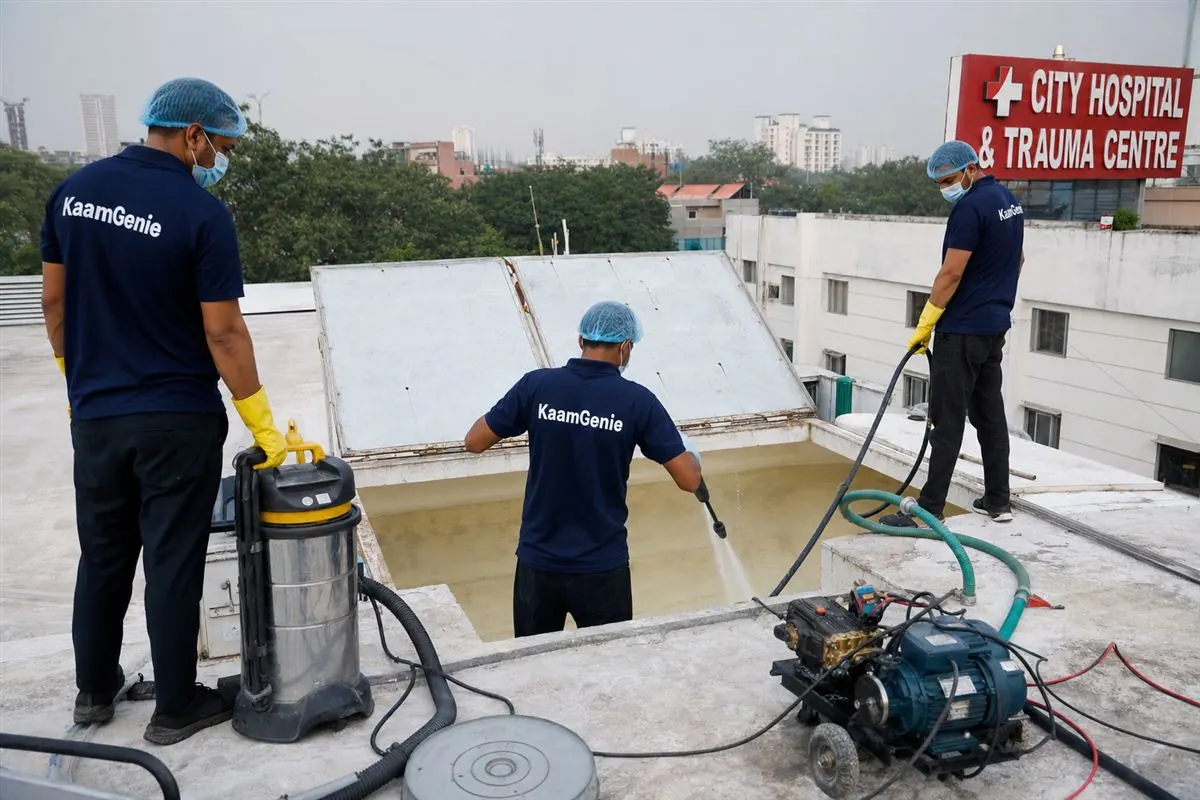
A defensible hospital clean is mechanical first, then chemical. The sequence: drain the tank fully and capture residual sludge; scrub every wall, floor and corner to lift biofilm rather than just rinsing; vacuum out loosened silt; high-pressure wash; then apply a food-grade disinfectant at the correct contact time before a final rinse. For healthcare storage we recommend a measured chlorine dose and a documented contact period, not a splash-and-go. Anti-bacterial treatment of internal surfaces and inspection of the inlet, outlet and overflow for cross-contamination points complete the job. Crucially, technicians should be healthy, gloved and using clean equipment — the cleaning crew must not become the contamination source in a clinical environment.
Book your water tank cleaning
Trained crew, food-grade process, before/after photos and a service record every job. ₹699 onwards, same-day where possible across Delhi NCR.
Documentation infection-control teams expect
In a hospital the paperwork is as important as the scrub. Your infection-control or facilities committee will typically want a per-tank record showing date cleaned, method used, disinfectant and dose, technician names, and before-and-after photographs. Where a tank feeds critical care, add a water test result — at minimum a check for coliforms and residual chlorine. Keep these records in a simple register or shared folder so they can be produced during an accreditation visit or an internal audit without a scramble. KaamGenie provides dated after-photos for every tank as standard; ask for a signed job sheet if your accreditation body needs a named sign-off against each cleaning event.
Scheduling around patient care
The operational challenge is doing this without cutting water to a live ward. The answer is sequencing. Where a building has multiple tanks, we clean them in rotation so at least one storage line stays charged. For single-tank blocks we work in a low-demand window — early morning before OT lists and outpatient rush — and coordinate with the maintenance team to isolate and refill quickly. Larger campuses are best handled as a phased plan across a week, ward by ward. Share your tank map and critical-area list in advance and the crew can plan valve isolation so dialysis, ICU and theatres never run dry mid-procedure.
What hospital tank cleaning costs in Delhi
Healthcare cleaning is quoted on capacity, number of tanks and access rather than a flat rate, because a multi-block hospital is a different job from a single nursing home. As a reference, KaamGenie residential cleaning starts from ₹699, underground sumps run ₹1,500–2,500, and society or commercial installations — which is where most hospitals sit — are quoted after a site view. For a facility running a fixed quarterly or bi-monthly schedule, an annual maintenance contract (AMC) typically saves 15–25% versus ad-hoc calls and locks in your dates. To arrange a walkthrough and a written quote, call KaamGenie on 95603 66362 or see our Delhi tank-cleaning page.
Frequently asked questions
How often should a Delhi hospital clean its water tanks?
Clean overhead and sump tanks that feed wards, kitchens and general use every three months. Storage feeding dialysis, ICU, operating theatres and pharmacy should be cleaned every one to two months with water testing. Add an extra clean after the monsoon, when Delhi roof runoff and dust often push silt into rooftop tanks.
What documentation should we keep for each cleaning?
Maintain a per-tank record showing the date cleaned, method, disinfectant and dose, technician names, and before-and-after photographs. For critical-care storage, add a coliform and residual-chlorine test result. Store everything in a register or shared folder so it can be produced instantly during an accreditation visit or internal infection-control audit.
Can cleaning be done without stopping water to wards?
Yes. Where a building has several tanks we clean them in rotation so one storage line stays charged. Single-tank blocks are done in a low-demand early-morning window with quick isolation and refill. Large campuses are phased ward by ward. Share your tank map and critical-area list so valve isolation is planned in advance.
Is chlorine safe to use in hospital water tanks?
Yes, when dosed correctly. We use a food-grade disinfectant at a measured chlorine level and a documented contact time, followed by a thorough final rinse so no chemical taste or residue reaches taps. This is standard practice for making stored water microbiologically safe and is far safer than leaving biofilm and bacteria in place.
What does hospital tank cleaning cost, and do you offer contracts?
Healthcare jobs are quoted after a site view because capacity, tank count and access vary widely. For reference, KaamGenie residential cleaning starts from ₹699 and sumps run ₹1,500–2,500. A quarterly or bi-monthly maintenance contract typically saves 15–25% over ad-hoc calls. Call 95603 66362 to arrange a walkthrough and written quote.
Are your crew police-verified before entering a hospital campus?
Yes. Every technician we send is trained and police-verified, and we can share ID details in advance so your security desk clears them at the gate. For sensitive zones like ICUs or operation theatres, we brief the team on your access rules first and work under your infection-control staff’s supervision throughout.
Do you clean the underground sump as well as the overhead tanks?
We clean the full chain — underground sump, transfer lines and every overhead tank — because contamination in one point spreads through the whole supply. For large hospital sumps we use confined-space precautions, a standby technician and proper lighting, then dose and flush so the entire system reads clean, not just one tank.
Can you test water quality after cleaning for our records?
We hand over before-and-after photos and a signed service record for each tank. For lab parameters like coliform or residual chlorine, we recommend sending a post-cleaning sample to an accredited water lab; we time the cleaning so your team can collect samples the same day and file the report.
How do you avoid disrupting a 24x7 hospital that never fully shuts water?
We plan tank by tank so at least one line stays live while another is isolated, and we schedule the noisiest steps for low-demand windows overnight or early morning. Your maintenance staff switches valves with our crew, so wards, theatres and dialysis units keep running water throughout the job.
Which disinfectant do you use, and is it safe once wards resume supply?
We use food-grade chlorine at controlled contact time, then flush thoroughly until residual levels are within safe drinking limits before reconnecting. Nothing corrosive to your plumbing is left behind. If your pharmacy or lab needs a specific residual range, tell us and we set the flush accordingly and record the final reading.
Sources & references
- Bureau of Indian Standards (BIS) — IS 10500:2012 is the canonical Indian Standard for drinking water specification, defining acceptable limits for physical, chemical and biological parameters.
- WHO Guidelines for Drinking-water Quality, 4th edition — the global reference for water quality standards, including guidance on safe storage and disinfection.
- Food Safety and Standards Authority of India (FSSAI) — defines water quality requirements for food businesses, including hygiene standards for stored water and acceptable disinfection chemicals.
- WHO Fact Sheet on Drinking Water — overview of safe drinking water requirements and contamination risks.
- CPHEEO — Manual on Water Supply and Treatment — the Government of India’s engineering manual covering tank design, cleaning protocols and disinfection practices.
Last verified: 6 July 2026. If you find any of these links broken, please let us know.