
Key takeaways
- High occupancy stirs up sediment — PGs need cleaning more often, not less.
- Clean standard PGs every 2–3 months; borewell-fed or packed buildings every 6–8 weeks.
- Hard borewell water leaves scale that traps bacteria — a proper scrub removes it.
- Do sump and overhead tanks together so you don’t recontaminate clean storage.
- Book early-morning weekday slots so residents barely notice the water going off.
- Cleaning starts from ₹699; an AMC saves 15–25% — call 95603 66362.
This guide is written for owners and managers of paying-guest accommodation and hostels across areas like Laxmi Nagar, Mukherjee Nagar, Karol Bagh, Kotla and the DDA-flat belts. We cover how often high-occupancy tanks really need cleaning, the hard-water and borewell issues common in these buildings, how to keep residents supplied during a clean, what it costs, and how a simple maintenance contract takes the whole headache off your plate. The goal: reliable, safe water your tenants never have to think about.
Why high occupancy changes the maths
A family of four and a 40-bed PG can use the same tank very differently. Heavy, constant draw keeps water moving but also keeps stirring settled silt back into suspension, so residents sometimes drink the sediment a low-use tank would leave at the bottom. High footfall also means more organic load — and in Delhi’s warm months, a busy, part-full rooftop tank is a comfortable home for bacteria and algae. On top of that, many PGs run on a mix of DJB supply and borewell water with tanker top-ups, each adding its own sediment and hardness. The practical takeaway: high-occupancy buildings need cleaning more often than the standard household advice suggests, not less.
How often to clean a PG or hostel tank
For an ordinary home, every three to six months is fine. For a PG or hostel, be stricter:
- Standard PG or hostel — every 2 to 3 months.
- Very high occupancy or borewell-fed buildings — every 6 to 8 weeks.
- Underground sump plus overhead tank — do both together so you are not recontaminating a clean overhead from a dirty sump.
Hard water, borewell and Delhi’s tank problems
Many Delhi PGs, especially in outer and unauthorised colonies, lean on borewell water that is hard and high in dissolved solids. Over time this leaves scale and mineral crust on tank walls and around outlets, which traps sediment and shelters bacteria. You will see the signs at the tap: cloudy water, a metallic or earthy smell, faster geyser scaling and residents complaining their soap won’t lather. Cleaning alone won’t soften the water, but a proper scrub removes the scale-and-biofilm layer that makes stored borewell water taste and smell worse than it needs to. If hardness is severe, pair regular cleaning with filtration at critical points like the kitchen and drinking-water outlet.
Book your water tank cleaning
Trained crew, food-grade process, before/after photos and a service record every job. ₹699 onwards, same-day where possible across Delhi NCR.
The cleaning process, step by step
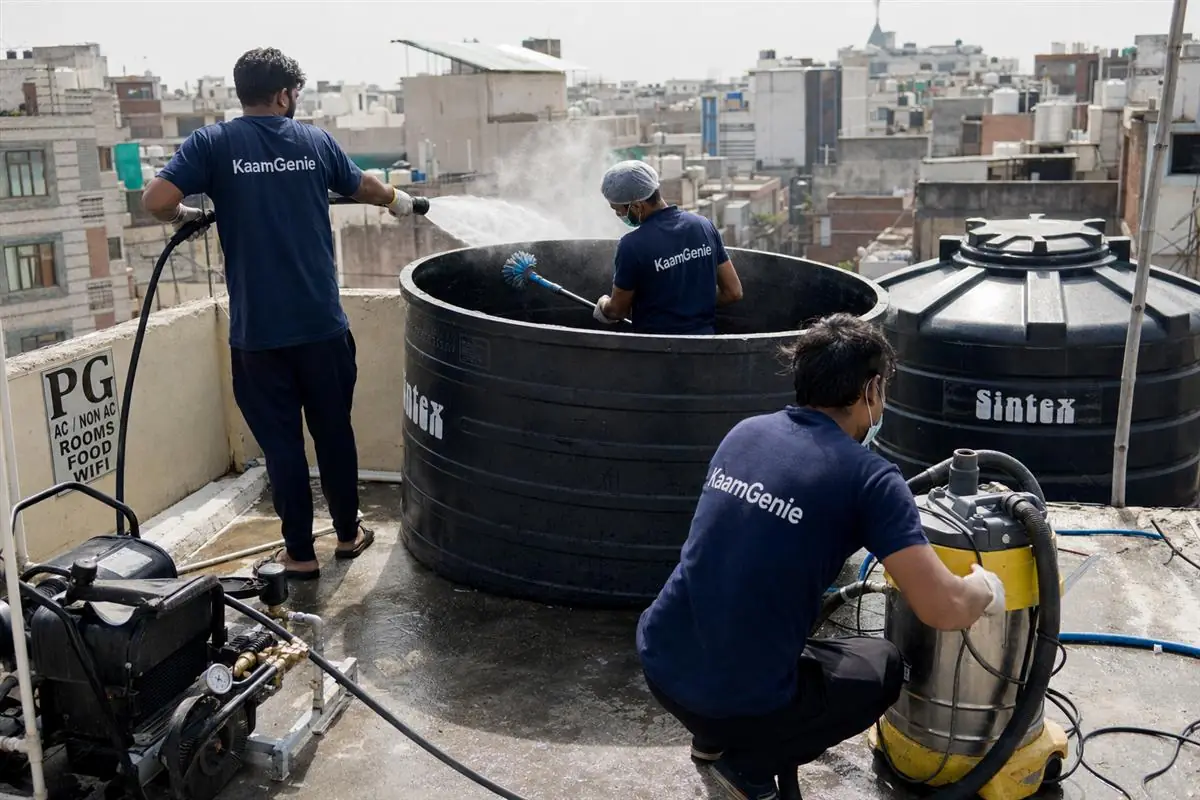
A professional clean is not just draining and rinsing. The crew drains the tank fully, removes the residual sludge, then scrubs every wall, floor and corner by hand or machine to lift biofilm and scale rather than smearing it around. Loosened silt is vacuumed out, the tank is high-pressure washed, and a food-grade disinfectant is applied and rinsed so no chemical taste is left behind. The inlet, outlet and overflow are checked for entry points where dust and pests get in — a missing tank lid is one of the most common causes of dirty PG water in Delhi. You get before-and-after photos so you can see the difference and reassure tenants.
Keeping residents supplied during cleaning
The fear for every owner is a building full of residents with no water. In practice a single overhead tank is drained, cleaned and refilled within a few hours, so booking an early-morning or mid-morning weekday slot — when most residents are at work or college — keeps disruption minimal. If your building has a sump plus overhead tank, we can keep one charged while cleaning the other. Give residents a day’s notice, ask them to store a bucket for the window, and time the refill for before the evening rush. Handled this way, a clean is a non-event most tenants barely notice.
Costs and the easy AMC option
KaamGenie pricing is transparent: standard tank cleaning starts from ₹699, and underground sumps — common under larger PGs — run ₹1,500–2,500 depending on size and access. Buildings with several tanks are quoted together after a quick look. For a PG or hostel the smart move is an annual maintenance contract: you lock in cleaning every 6 to 8 weeks, never have to remember to book, and typically save 15–25% versus one-off calls. That works out to very little per resident per month for water they can trust. To set up a schedule, call KaamGenie on 95603 66362 or visit our Delhi page.
Frequently asked questions
How often should a PG or hostel in Delhi clean its water tank?
More often than a home. A standard PG or hostel should clean every two to three months, and very high-occupancy or borewell-fed buildings every six to eight weeks. Always add a clean right after the monsoon. Heavy daily draw keeps stirring up settled sediment, so busy tanks actually need attention sooner than low-use household tanks.
Will residents lose water while the tank is cleaned?
Only briefly. A single overhead tank is drained, cleaned and refilled within a few hours, so an early or mid-morning weekday slot — when most residents are out — keeps disruption minimal. If you have a sump plus overhead tank, we keep one charged while cleaning the other. Give a day’s notice and time the refill before the evening rush.
My PG runs on hard borewell water — does cleaning help?
Yes, though it won’t soften the water. Hard borewell water leaves scale on tank walls that traps sediment and shelters bacteria, making stored water smell and taste worse. A proper scrub removes that scale-and-biofilm layer. For severe hardness, pair regular cleaning with filtration at the kitchen and drinking-water outlets for the best result.
What does PG or hostel tank cleaning cost in Delhi?
Standard tank cleaning starts from ₹699, and underground sumps common under larger PGs run ₹1,500–2,500 depending on size and access. Buildings with several tanks are quoted together after a quick site view. Spread across your residents, safe water costs very little per head per month. Call 95603 66362 for a quote.
Is a maintenance contract worth it for a hostel?
For most PG and hostel owners, yes. An annual maintenance contract locks in cleaning every six to eight weeks so you never have to remember to book, and it typically saves 15–25% versus one-off calls. It also gives you dated after-photos for every visit — useful proof of clean water if a tenant ever raises a concern.
Can you clean our PG tank on a Sunday when most residents are out?
Yes, weekend and early-morning slots are the easiest for occupied buildings, and we book them often. Fewer people drawing water means we can isolate the tank faster and finish before the evening rush. Just tell us your quietest window when you call 95603 66362 and we will try to match it.
Do I need to inform residents before the cleaning day?
A one-day notice on the notice board or WhatsApp group helps — ask residents to store a bucket of water and avoid the tank during the isolated hours. We reconnect supply the same day, so it is usually just a short interruption rather than a full day without water.
Is the process safe if students keep using bathrooms nearby?
Yes. We cordon the tank area, keep hoses and equipment tidy, and our crew works cleanly so corridors stay usable. The food-grade chlorine we dose is flushed out before supply resumes, so once we reconnect there is nothing harmful in the water students draw for washing or drinking.
As a tenant running a PG on a rented building, can I still book?
Absolutely. You do not need to own the building to arrange cleaning — you just need access to the tank. Many PG operators book on their own and simply inform the landlord. We give you a dated service record and photos, which is handy proof of upkeep for your rental agreement.
Will you also clean the RO or water-cooler storage that residents drink from?
The main overhead and underground tanks are our core job. If your PG has a separate drinking-water storage drum feeding coolers or RO points, tell us and we will clean and disinfect that too in the same visit. Keeping the drinking store clean matters as much as the rooftop tank.
Sources & references
- Bureau of Indian Standards (BIS) — IS 10500:2012 is the canonical Indian Standard for drinking water specification, defining acceptable limits for physical, chemical and biological parameters.
- WHO Guidelines for Drinking-water Quality, 4th edition — the global reference for water quality standards, including guidance on safe storage and disinfection.
- Food Safety and Standards Authority of India (FSSAI) — defines water quality requirements for food businesses, including hygiene standards for stored water and acceptable disinfection chemicals.
- WHO Fact Sheet on Drinking Water — overview of safe drinking water requirements and contamination risks.
- CPHEEO — Manual on Water Supply and Treatment — the Government of India’s engineering manual covering tank design, cleaning protocols and disinfection practices.
Last verified: 6 July 2026. If you find any of these links broken, please let us know.