
Key takeaways
- South Delhi’s mix of intermittent DJB supply and hard borewell water makes tanks foul and scale fast.
- A real clean is a 7-step mechanised, drained and sanitised job — not a hose rinse.
- Kothis, DDA flats and societies each need a different scheduling approach.
- Home overhead tanks from ₹699; sumps ₹1,500–2,500; societies quoted on site; AMC saves 15–25%.
- Clean every 3–4 months on borewell supply, and always once after the monsoon.
This guide is written specifically for South Delhi homes, kothis and RWAs. We cover why tanks here foul faster, how borewell hardness and DJB storage change the cleaning job, what a proper mechanised clean actually involves, realistic pricing, and how societies in Saket, Malviya Nagar or CR Park should structure an annual contract. Wherever it helps, we link the local water tank cleaning pages so you can book for your own colony.
Why South Delhi tanks foul faster than you think
Two things stack up here. First, DJB supply is intermittent, so almost every home stores water in an underground sump and pumps it to an overhead tank — water then sits for hours in warm rooftop plastic. Second, large parts of the zone still draw borewell water that is high in dissolved salts. The result is a chalky scale on tank walls plus a slick biofilm layer that ordinary rinsing never removes. In leafy colonies like Greater Kailash and Defence Colony, overhanging trees add leaf litter and bird droppings through poorly sealed lids. Left alone, that sludge harbours E. coli and gives water a musty smell and off taste long before you can see anything wrong.
Hard water, TDS and what it does to your sump
Borewell-fed homes across Saket, Chattarpur and Sangam Vihar often see high TDS, and hardness is the silent tank-killer. Calcium and magnesium precipitate out as a crust that coats walls, pump inlets and float valves, then traps organic matter against the surface. You cannot scrub that off with a bucket and cloth — it needs mechanical agitation and a food-safe descaling wash. A few pointers:
- If your bathing water leaves white marks on taps and tiles, your tank is scaling too.
- Get a simple TDS reading before and after cleaning to see the difference.
- Pair tank cleaning with a plumber-checked inlet filter so grit stops entering the sump.
What a proper mechanised cleaning looks like
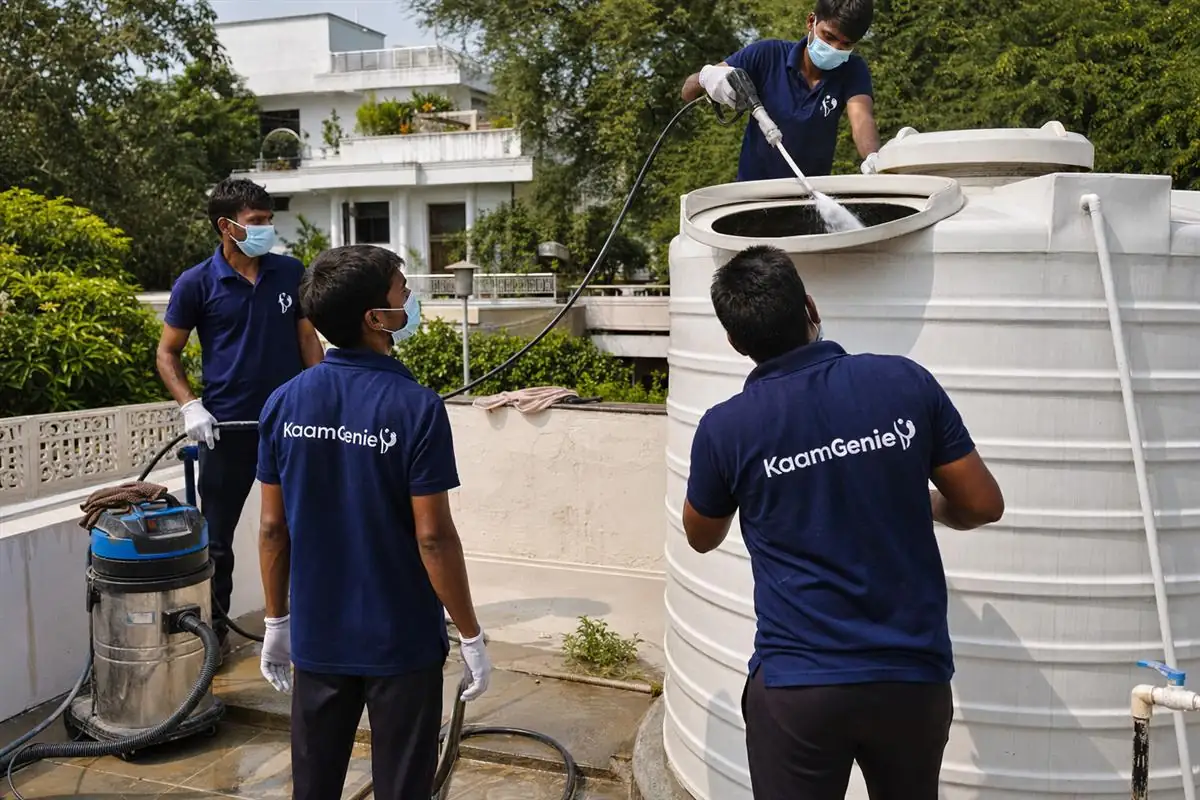
A real clean is a seven-step job, not a hose-down. Our South Delhi crews drain the tank, remove residual sludge, then use a submersible dewatering pump and vacuum to clear the last inch of slurry. Walls, floor and baffles are scrubbed mechanically, treated with a food-grade anti-bacterial and anti-fungal solution, high-pressure rinsed, then UV or fog sanitised before refilling. The whole cycle takes 45–90 minutes for a typical 1,000–2,000 litre home tank. Crucially, no worker enters a confined sump without ventilation checks. You should always be shown before-and-after photos and the drained sludge — if a vendor skips that, they skipped the job.
Book your water tank cleaning
Trained crew, food-grade process, before/after photos and a service record every job. ₹699 onwards, same-day where possible across Delhi NCR.
Kothis vs DDA flats vs societies
The right approach depends on your building. Independent kothis in Vasant Vihar or Hauz Khas usually have one large sump plus multiple floor-wise overhead tanks, so plan for a half-day and clean every tank in one visit. DDA and builder flats in Saket or Malviya Nagar often share a common terrace tank per block — here the RWA should coordinate a single scheduled clean rather than owners going solo. Group housing in CR Park and Alaknanda benefits most from a fixed annual calendar so no tank is ever missed. Match the plan to the plumbing and you avoid paying twice.
What it costs in South Delhi
Pricing is driven by tank size, access and how much sludge has built up. As a guide, a single overhead home tank starts from ₹699, an underground sump runs ₹1,500–2,500 depending on capacity, and society or commercial jobs are quoted after a quick site look because of shared risers and multiple tanks. If you sign an annual maintenance contract, expect 15–25% off per visit versus one-off calls. Beware suspiciously cheap quotes — they usually mean a rinse, not a mechanised sanitised clean, and you will be rebooking within weeks. For a fair quote in your colony, call 95603 66362.
How often, and booking for your colony
For South Delhi we recommend cleaning every three to four months for borewell-fed homes and twice a year minimum for DJB-only supply. Do an extra clean right after the monsoon, when rooftop grit and silt wash into loosely sealed tanks. Families with infants, elderly members or anyone recovering from a stomach illness should lean toward the shorter cycle. Booking is simple: pick your area page — for example Saket, Kalkaji or Lajpat Nagar — or call and we will slot a crew into a supply-off window so your tank is empty and ready.
Frequently asked questions
How often should I clean my water tank in South Delhi?
Every three to four months if your home runs on borewell water, and at least twice a year on DJB-only supply. Add one clean straight after the monsoon, when rooftop silt washes in. Homes with infants, elderly members or anyone with a recent stomach illness should stick to the shorter cycle to be safe.
Does hard borewell water damage my tank?
Yes. High TDS borewell water in areas like Chattarpur and Sangam Vihar leaves a calcium scale that coats walls, pump inlets and float valves, and traps bacteria against the surface. Ordinary scrubbing cannot shift it — you need mechanical agitation plus a food-safe descaling wash, which is part of our standard South Delhi cleaning.
What does water tank cleaning cost in South Delhi?
A single home overhead tank starts from ₹699. An underground sump runs ₹1,500–2,500 depending on capacity, and society or commercial buildings are quoted after a short site visit. Annual maintenance contracts cut 15–25% off each visit. Call 95603 66362 for an exact figure for your colony.
Do you clean both the overhead tank and the sump?
Yes. Most South Delhi kothis and flats store water in an underground sump and pump it up, so both need cleaning. We drain, de-sludge, scrub, sanitise and rinse each tank in the same visit, and follow confined-space safety checks before anyone enters a sump. You get before-and-after photos of every tank.
How long does the cleaning take and can I use water after?
A typical 1,000–2,000 litre home tank takes 45–90 minutes; a full kothi with several tanks may take half a day. Once refilled after sanitising, the water is safe to use immediately. We time visits to a supply-off window so the tank is already low, which speeds up the whole job.
I live in a DDA flat in Saket — who books the shared tank cleaning?
In DDA flats the overhead tank is usually shared by the block, so the RWA or the flat owners jointly arrange it and split the cost. If you have your own individual tank, you can book directly. Tell us your setup on 95603 66362 and we will guide who should organise it.
Can you reach rooftop tanks in older South Delhi kothis with tight access?
Yes. Our crew regularly handles kothi terraces with narrow stairs, parapets and awkwardly placed tanks. We carry portable pumps and hoses that fit tight spaces, so we rarely need special equipment. If access is unusually difficult, mention it when booking and we plan the right approach beforehand.
Does a South Delhi RWA get a better rate for cleaning the whole colony?
Usually yes. When several blocks or houses book together, or a society signs an annual contract, we can offer better per-tank pricing than one-off visits. It also keeps everyone on the same six-monthly schedule. Ask about an AMC when you call and we will quote for your colony’s tank count.
Is the food-grade chlorine safe for homes with young kids and pets?
Yes. We dose food-grade chlorine at a controlled level and flush it out thoroughly before handing the tank back, so the water your children and pets use afterwards is within safe limits. Nothing harsh or industrial is left behind — it is the same class of disinfection used for drinking-water storage.
How much water is wasted during a South Delhi tank clean?
Only the dirty residue and rinse water goes to the drain — we do not empty a full tank needlessly. We drain what is left, scrub, and use measured rinses rather than continuous flooding. Given how much sediment hard borewell water leaves, the small amount used is well worth the clean supply you get.
Sources & references
- Bureau of Indian Standards (BIS) — IS 10500:2012 is the canonical Indian Standard for drinking water specification, defining acceptable limits for physical, chemical and biological parameters.
- WHO Guidelines for Drinking-water Quality, 4th edition — the global reference for water quality standards, including guidance on safe storage and disinfection.
- Food Safety and Standards Authority of India (FSSAI) — defines water quality requirements for food businesses, including hygiene standards for stored water and acceptable disinfection chemicals.
- WHO Fact Sheet on Drinking Water — overview of safe drinking water requirements and contamination risks.
- CPHEEO — Manual on Water Supply and Treatment — the Government of India’s engineering manual covering tank design, cleaning protocols and disinfection practices.
Last verified: 6 July 2026. If you find any of these links broken, please let us know.