
The short version, by area
- Old plotted sectors (15–19, 25–37): one or two rooftop tanks, small sumps, hard borewell scale — quick self-contained jobs.
- Expressway high-rise belt (75, 137, 150, 168): big underground reservoirs feeding rooftop tower tanks — society-arranged, half-day jobs.
- Greater Noida West / Noida Extension: heavily tanker-fed towers — more sediment, shorter cleaning cycle.
- IT & office belt (62, 125–135): mixed corporate, institutional and residential — documentation matters, after-hours work common.
Same trained crew and the same ₹699-onwards residential price across every sector — what changes is the tank setup, not the standard.
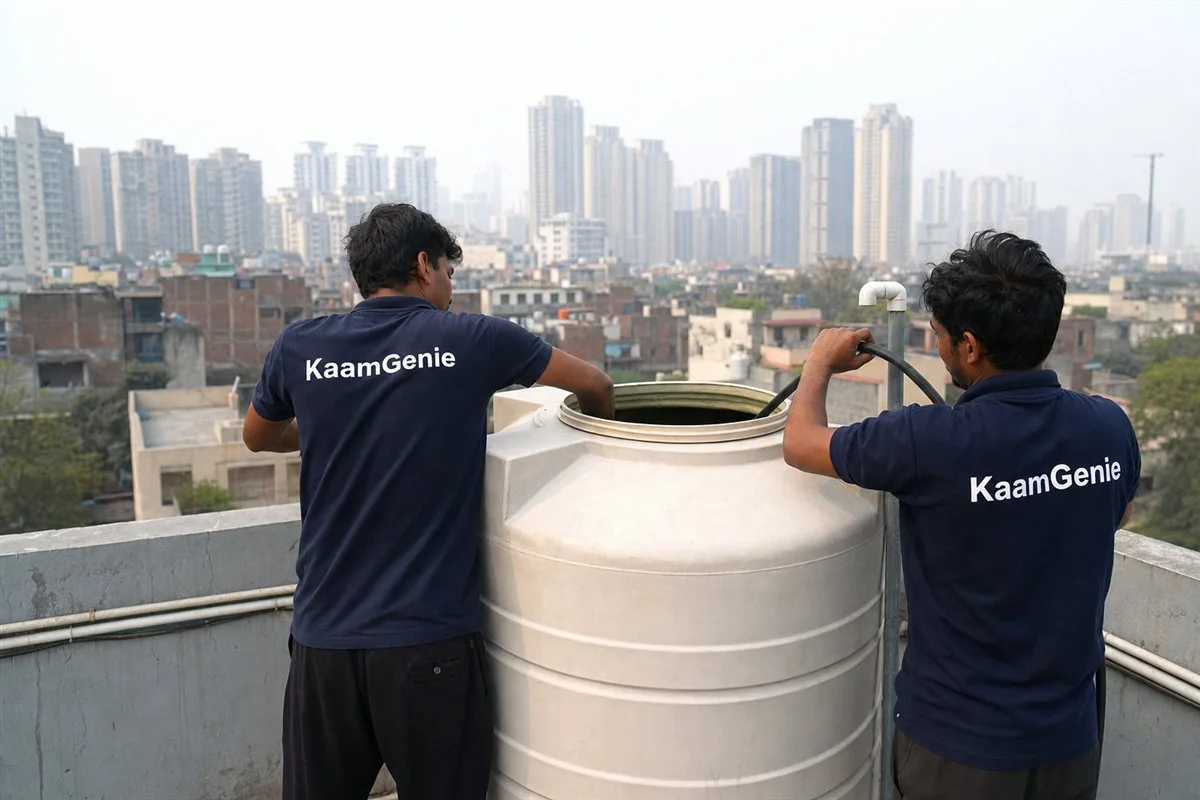
Most “water tank cleaning” advice treats a city as one uniform place. Noida doesn’t work like that. The Authority planned it in waves, and you can read those waves in the water infrastructure: the squat plotted houses of the original sectors, the glass towers along the Noida–Greater Noida Expressway, the still-filling townships of Noida Extension, and the corporate campuses of the IT belt. The tank that sits on each of those buildings is plumbed differently, fed differently, and dirties at a different rate.
This guide walks Noida area by area so you can see where your home or building fits, and book the right kind of water tank cleaning in Noida rather than a generic one. If you just want the overall how-and-why first, our complete Noida water tank cleaning guide covers the basics; this piece is specifically about how needs differ by area.
| Zone | Typical setup | Main water source | What we watch for |
|---|---|---|---|
| Old plotted sectors (15–19, 25–37) | 1–2 rooftop tanks, small sump | Piped Ganga Jal + borewell | Hard-water scale, neglected old RCC sumps |
| Expressway high-rise belt (75, 137, 150, 168) | Large UGR → rooftop tower tanks | Piped supply, pumped up | Reservoir sludge, full chain cleaning |
| Greater Noida West / Noida Extension | Tanker-fed UGR + tower tanks | Tankers (heavily), part-piped | Heavy suspended sediment, shorter cycle |
| IT & office belt (62, 125–135) | Mixed: offices, institutes, builder floors | Piped + borewell | Documentation, after-hours access |
Not sure which kind your building is?
Tell us your sector and tank setup — we’ll tell you exactly what the job involves. Residential cleaning ₹699 onwards, fixed across every Noida sector.
The old plotted sectors — 15–19 and 25–37
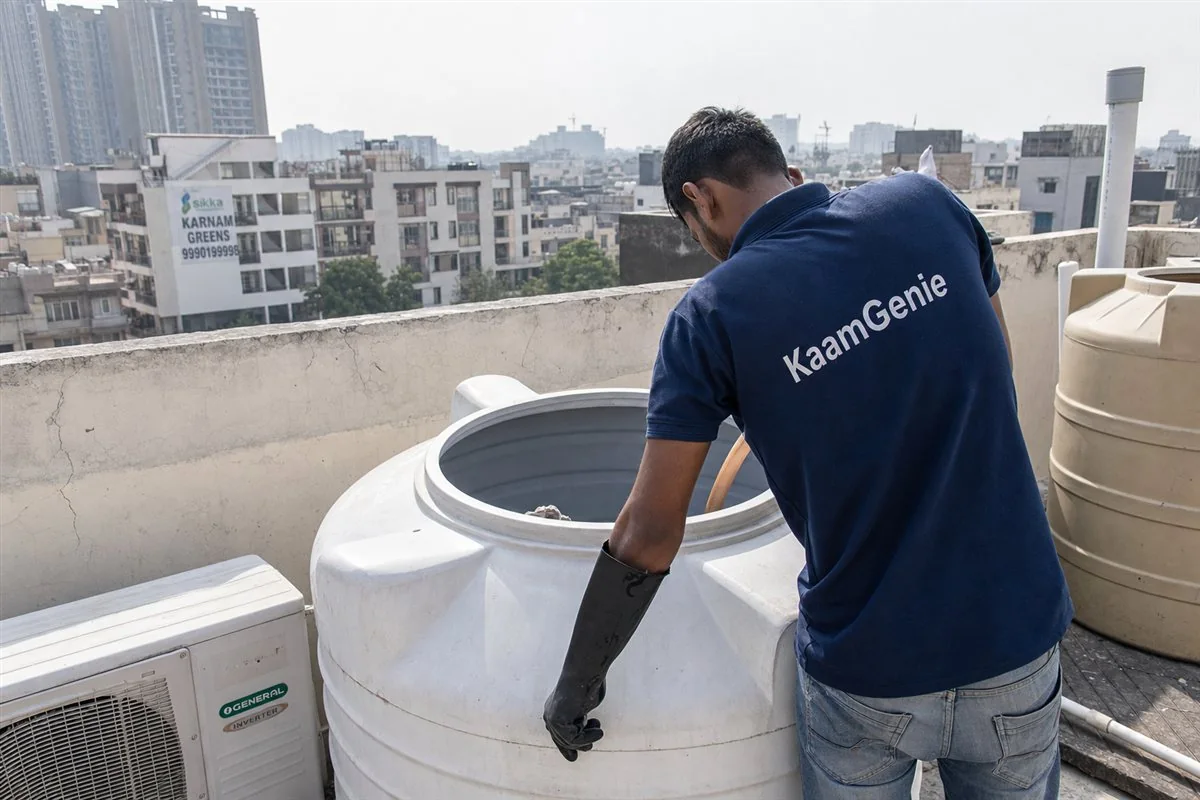
This is original Noida: the Authority-allotted plots of Sector 15, Sector 18 (and its market spine), Sector 19, and the leafy residential blocks of Sector 25, Sector 27 and Sector 37. Most homes here are independent houses or 3–4 storey builder floors, each with its own one or two rooftop tanks and sometimes a modest underground sump.
Two things define cleaning in these sectors. First, scale. A lot of the old core runs on hard borewell groundwater, often blended with piped Ganga Jal, and hard water leaves a chalky calcium crust on tank walls and around the inlet and outlet that only manual scrubbing plus a jet wash will lift. If your tank has never been properly scrubbed, that’s usually the bulk of what we remove. Second, neglected sumps. Plotted houses frequently have an underground sump that nobody has opened in years because it’s out of sight — and that’s exactly where the worst sludge collects.
The upside: these are quick, self-contained jobs. A single rooftop tank is a 75–90 minute visit at ₹699 onwards, sump quoted on size. Because the tank serves one household, you can book it yourself without coordinating a whole society.
The Expressway high-rise belt — 75, 137, 150, 168
Run down the Noida–Greater Noida Expressway and the skyline changes completely: 20- to 30-storey condominium towers in Sector 75, the residential clusters of Sector 137, the premium towers of Sector 150, and Sector 168. Here the plumbing is fundamentally different from a plotted house.
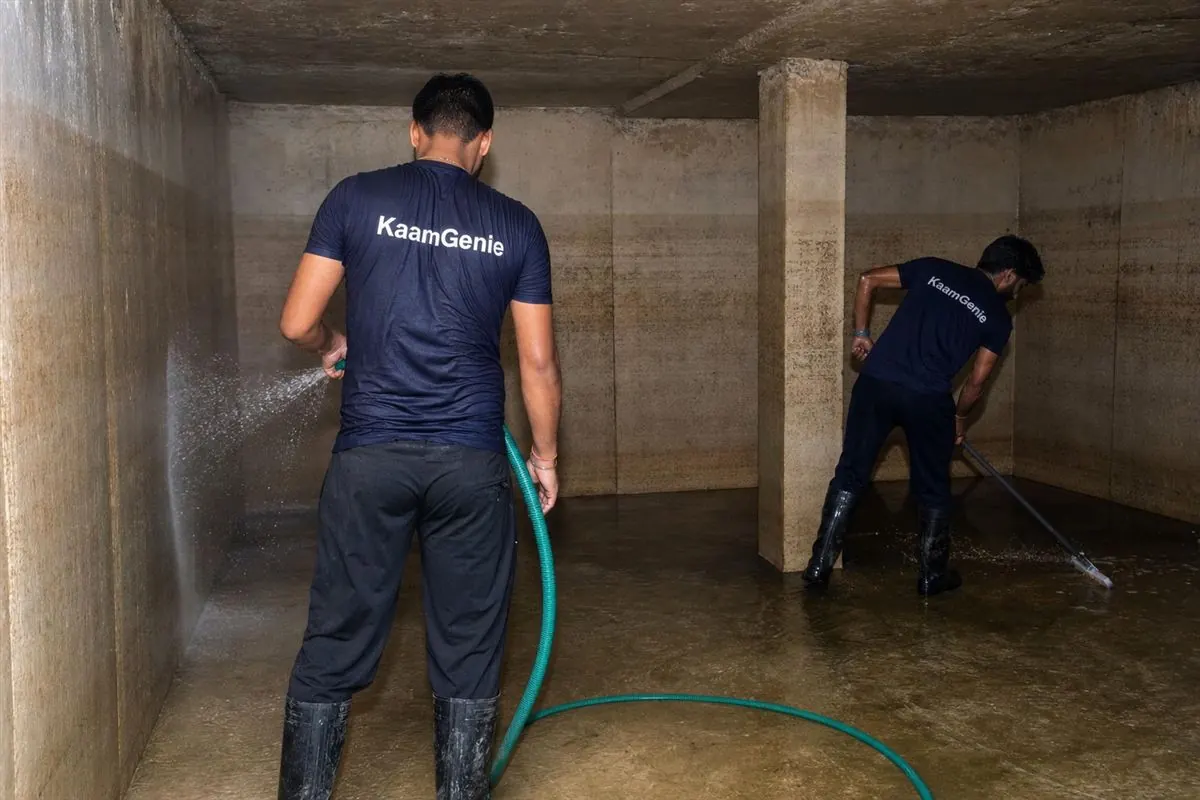
A high-rise almost always works on a two-stage system: municipal supply fills one or more large underground reservoirs (UGRs) at the base of the tower, and pumps lift that water to rooftop tower tanks that gravity-feed the flats. That means a real cleaning has to cover the whole chain — the UGR and the rooftop tanks — in one coordinated visit. Clean only the rooftop tanks and they get refilled from a dirty reservoir within hours; clean only the UGR and the rooftop scale stays put. We do both together for exactly this reason.
Because these tanks serve every flat, the booking sits with the society, AOA or facility manager, not the individual resident. It’s a half-day job, sometimes a full day with two crews for the bigger reservoirs, and it’s priced on capacity rather than the flat ₹699 residential rate. If you’re weighing up how a tower job differs from a plotted one, we go deeper in our piece on high-rise vs plotted water tank cleaning in Noida.
Greater Noida West / Noida Extension — the tanker-fed towers
The townships of Greater Noida West / Noida Extension are their own category. Many are large gated societies built fast, and a good number still depend heavily on water tankers because full piped supply hasn’t reached every pocket. That single fact changes the cleaning maths.
Tanker water carries more suspended solids than treated piped supply — fine silt and sediment that drops to the bottom of the reservoir and the rooftop tanks far quicker than piped water does. So even a society that cleaned six months ago can show a real sediment layer by month four. For genuinely tanker-dependent towers here we usually recommend a tighter cycle — around every four months rather than the standard six — and we make a point of scooping and vacuuming the reservoir floor thoroughly, because that’s where the tanker silt ends up. There’s more on this water-source angle in our note on water tank cleaning cost in Noida, which breaks down how tank type and access affect a society quote.
The IT & office belt — 62 and 125–135
Then there’s working Noida: Sector 62 with its IT parks, corporate offices, colleges and hospitals, and the office-and-institutional spine of Sector 125 through Sector 128 and the 130s, home to universities, BPOs and headquarters buildings. This belt mixes commercial, institutional and residential in one stretch.
Two practical things stand out here. First, documentation. Offices, food canteens, hospitals and colleges have hygiene obligations, so the cleaning record — date, tank capacity, chemicals used, crew, before/after photos — matters as much as the cleaning itself; it’s what gets shown at an audit or an FSSAI inspection. Second, access. Commercial tanks usually have to be done after hours or over a weekend so they don’t interrupt operations, which we schedule around. For any of this corporate, campus or restaurant work, the wider NCR pillar page on water tank cleaning services lays out how the commercial side is handled.
Roughly how often we suggest cleaning, by Noida zone
Driven mostly by water source and how many people share the tank
General guidance, not a hard rule — a tank on hard borewell water or one that’s been neglected for years may need attention sooner. BIS IS 10500 and FSSAI cover the water-quality side; the interval is about keeping you inside it.
Book the right job for your sector
Plotted home, Expressway tower, Noida Extension society or office — we send the crew and kit that fits. ₹699 onwards for residential; societies and commercial quoted on capacity.
Find your sector and book the right cleaning
Wherever you sit in Noida — an old plotted home in Sector 27, a tower on the Expressway in Sector 150, a society in Noida Extension, or an office in Sector 62 — the standard is the same: full manual scrubbing, jet wash, food-grade disinfection, before/after photos and a cleaning record. What changes is the tank setup and the schedule, and that’s exactly what an area-wise approach is for. Pick your area on the Noida water tank cleaning hub, or just tell us your sector when you book and we’ll send the nearest crew with the right kit.
Frequently asked questions
Does my Noida sector actually change how often I should clean my tank?
Yes, indirectly. Your sector decides your water source, your tank setup, and how many people share the supply — and those three things decide the cleaning interval. A plotted house in Sector 27 on a single rooftop drum is different from a 25-storey tower in Sector 150 on a deep underground reservoir, which is different again from a tanker-fed society in Noida Extension. We recommend every 6 months as a baseline, more often for tanker-fed towers and hard-borewell areas.
Why do Greater Noida West / Noida Extension towers need cleaning more often?
Much of Greater Noida West and Noida Extension is heavily tanker-fed, especially newer townships still waiting on full piped supply. Tanker water carries more suspended sediment than treated piped water, so it settles faster at the bottom of the underground reservoir and rooftop tanks. That sediment load is why we usually suggest a 4-month cycle for tanker-dependent societies instead of the standard 6 months.
We live in an old plotted house in Sector 27 — is our cleaning different from a high-rise?
Yes. Old plotted Authority homes in sectors like 15, 19, 25, 27 and 37 usually have one or two rooftop tanks (Sintex or RCC) and sometimes a small underground sump — a quick, self-contained job, around 75–90 minutes, ₹699 onwards. A high-rise involves a large common underground reservoir plus rooftop tower tanks feeding many flats, which is a half-day society job priced separately.
How does Noida’s hard borewell water change the cleaning?
Large parts of Noida and Greater Noida still draw on hard borewell groundwater alongside Ganga Jal piped supply. Hard water leaves calcium and mineral scale on tank walls and around fittings that ordinary rinsing won’t remove — it needs proper manual scrubbing plus a jet wash. Sectors that lean on borewell water tend to show heavier scale, so the scrubbing phase takes longer there.
Who arranges cleaning for a high-rise on the Noida Expressway — the resident or the society?
For the shared underground reservoir and the common rooftop tower tanks, the society / AOA or facility manager arranges it, because those serve every flat. If your individual flat has its own dedicated loft or terrace tank, you can book that yourself. In the Expressway belt (Sectors 75, 137, 150, 168) most towers run on the shared-reservoir model, so it’s usually a society booking.
Is the underground reservoir (UGR) cleaned at the same time as the rooftop tanks?
Ideally yes. In most Noida high-rises water flows from the municipal/tanker inlet into a large underground reservoir, then gets pumped up to rooftop tower tanks. If you clean only the rooftop tanks but leave the UGR, the freshly cleaned tanks get refilled from a dirty reservoir. We clean both in one coordinated visit so the whole chain is hygienic, not just the last link.
How much does water tank cleaning cost across Noida sectors?
Residential cleaning starts at ₹699 onwards for a standard rooftop tank, and that price is the same whether you’re in Sector 18, Sector 62 or Noida Extension — we don’t charge more for one sector over another. Underground sumps, society reservoirs and commercial tanks are quoted on capacity and access. There’s a full area-wise cost breakdown in our Noida cost guide.
Do you cover both Noida and Greater Noida West?
Yes — we cover Noida sectors end to end, from the old core (15–37) through the Expressway belt and the IT/office sectors, plus Greater Noida West and Noida Extension. You can pick your area from the Noida hub page or just tell us your sector when you book and we’ll send the nearest crew.
How long does a typical Noida tank cleaning take?
A single residential rooftop tank in a plotted house or builder floor takes about 75–90 minutes. An underground sump runs 2–2.5 hours. A high-rise underground reservoir plus the rooftop tower tanks is a 3–5 hour society job, sometimes a half-day with two crews for the larger Expressway and Greater Noida West towers.
Sources & references
- Bureau of Indian Standards (BIS) — IS 10500:2012 is the canonical Indian Standard for drinking water specification, defining acceptable limits for physical, chemical, and biological parameters.
- WHO Guidelines for Drinking-water Quality, 4th edition — the global reference for water quality standards, including guidance on storage and disinfection.
- Food Safety and Standards Authority of India (FSSAI) — defines water quality requirements for food businesses, including hygiene standards for stored water and acceptable disinfection chemicals.
- WHO Fact Sheet on Drinking Water — overview of safe drinking water requirements and contamination risks.
- CPHEEO — Manual on Water Supply and Treatment — the Government of India’s engineering manual covering tank design, cleaning protocols, and disinfection practices.
Last verified: 30 June 2026. If you find any of these links broken, please let us know.