
Quick answer
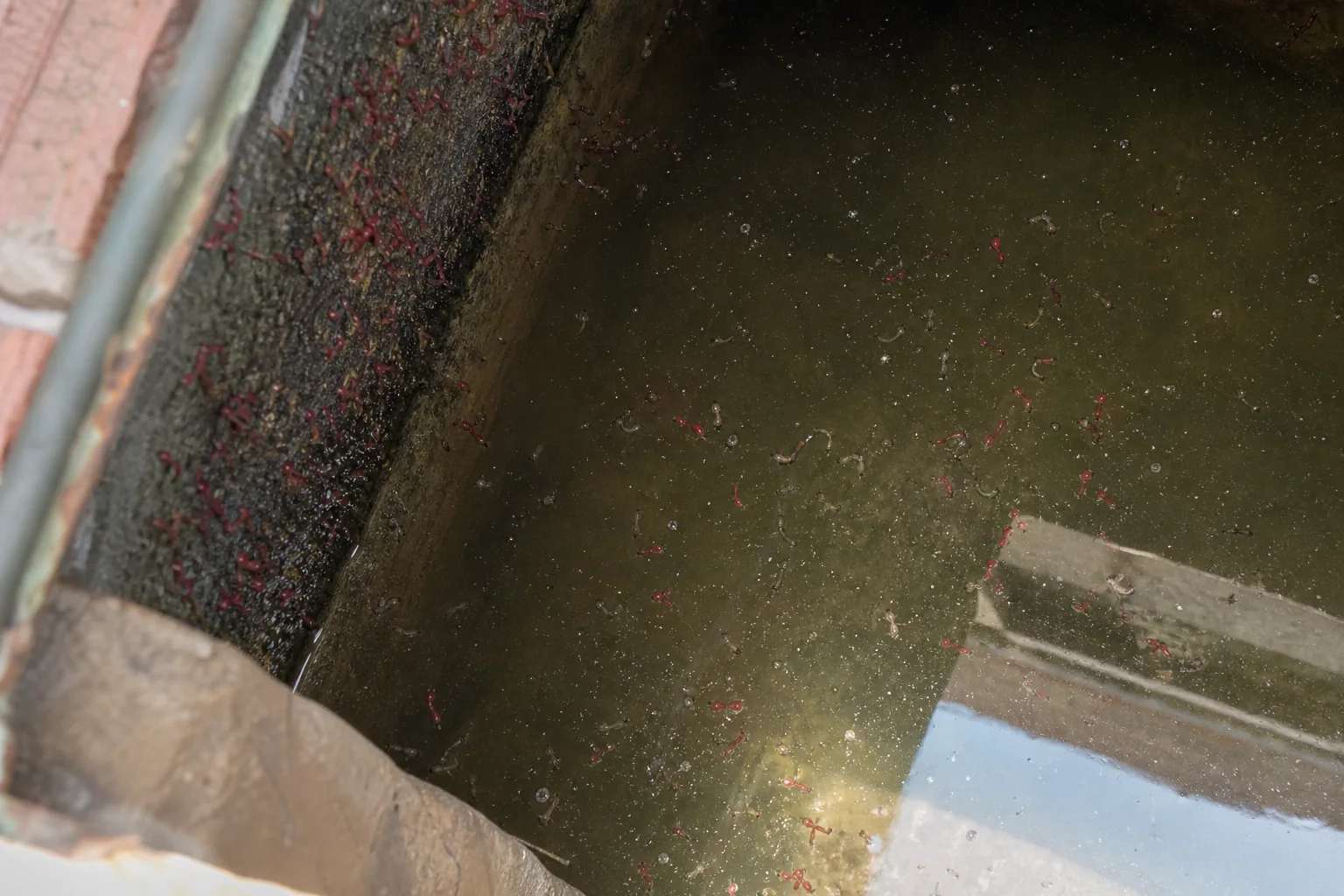
Red worms in a water tank are usually bloodworms, the larvae of non-biting midge flies (chironomids), or mosquito larvae. They breed in an uncovered or dirty tank where water stands over a layer of sediment. Water in that state is not safe to drink. The fix is to drain the tank, remove the sludge, scrub and disinfect the walls and floor, refit a tight lid and a mesh over the vent and overflow, and repeat the clean every 3 to 6 months.
- Red worms are typically bloodworms (midge larvae); thinner ones that surface for air are mosquito larvae.
- They are not poisonous, but they signal a contaminated tank, so stop drinking and cooking with the water.
- Cause: a loose or missing lid, no vent mesh, warmth, sunlight and organic sediment at the bottom.
- Fix: drain, de-sludge, scrub, disinfect, rinse and flush the taps until clear.
- Prevent: seal the lid, mesh every opening and clean every 3 to 6 months, especially after the monsoon.
Finding worms in a water tank is alarming, but the good news is that it is a solvable problem with a clear cause. Below we identify exactly what those red worms are, explain the real health risk (which is not the worms themselves but what they represent), walk through why Delhi tanks are so prone to them, and lay out the step-by-step method that actually clears the breeding source rather than just masking it for a week.
What those red worms actually are
The bright red, thread-thin worms most people find are bloodworms. Despite the name they are not worms at all: they are the larvae of non-biting midge flies, a family of insects called chironomids. They look red because their bodies contain a haemoglobin-like pigment that lets them survive in low-oxygen, sediment-rich water, which is exactly the environment at the bottom of a neglected tank. They are typically a centimetre or less long and wriggle in a distinctive figure-of-eight motion.
Two other common finds are worth telling apart. Mosquito larvae, often called wrigglers, are usually greyish or pale, hang head-down just under the water surface, and dart down when disturbed because they breathe air through a tube at their tail. If your "worms" keep coming up to the surface for air, they are mosquito larvae, not bloodworms, and that matters for the health risk below. The third find is tubifex or sludge worms, which are reddish and cluster in the muck at the very bottom; they are a sign of heavy organic sludge. In practice, most Delhi tank sightings are bloodworms, some are mosquito larvae, and a quick look at whether they live on the surface or in the sediment tells you which one you are dealing with.
Are red worms in your water tank dangerous?
Bloodworms are not directly poisonous. They do not bite, they do not carry a specific disease you catch just by touching them, and swallowing one by accident will not usually harm a healthy adult. So in the narrow sense, the worms themselves are not the danger. The real problem is what their presence proves: your tank has enough organic sediment, biofilm and stagnation for insects to breed in it, and that same environment shelters bacteria. Water drawn from such a tank can cause stomach upsets and diarrhoea, not because of the worm but because of the contamination it grew in.
Mosquito larvae are a more serious signal. If your tank is hatching mosquitoes, it is functioning as a breeding site for the species that spread dengue, chikungunya and malaria, all of which are a real concern across Delhi in and after the monsoon. That is a public-health risk for your whole household and your neighbours, not just a water-quality issue. Either way, the safe rule is simple: once you see worms or larvae, do not drink or cook with that water, and do not give it to children, until the tank has been fully drained, cleaned and disinfected. Use stored or RO water in the meantime and get the tank sorted quickly.
Book your water tank cleaning
Trained crew, food-grade process, before/after photos and a service record every job. ₹699 onwards, same-day where possible across Delhi NCR.
Why worms and insects appear in a water tank
Insects do not spawn out of nowhere. An adult midge or mosquito flies in, lands on standing water and lays its eggs, and those eggs hatch into the larvae you find. Everything that lets that happen comes down to a handful of avoidable conditions, and Delhi tanks tend to have all of them at once.
The single biggest cause is a loose, cracked or missing lid. Even a finger-width gap is an open door for an egg-laying insect. Next is a cracked or absent vent and overflow mesh: the overflow pipe and the breather vent are the two openings people forget, and an unscreened overflow is a direct route in. Add warmth and sunlight, which speed up both algae and larvae, and translucent rooftop tanks in Delhi supply plenty of both. At the bottom sits the real fuel: organic sediment and sludge, made of settled dust, dead algae and biofilm, which is exactly what bloodworms feed on. Finally, water that stands for days without turnover gives the larvae the calm, still surface they need. The monsoon makes every one of these worse, and borewell water tends to carry more nutrients than treated municipal supply, feeding the whole cycle. Remove the lid gap, the open mesh and the sediment, and you remove the three things insects rely on.
How to get rid of worms in your water tank, step by step
Clearing worms properly means removing the sediment they breed in, not just killing what you can see today. Here is the method our crews follow, and the same sequence you can run at home for a small tank.
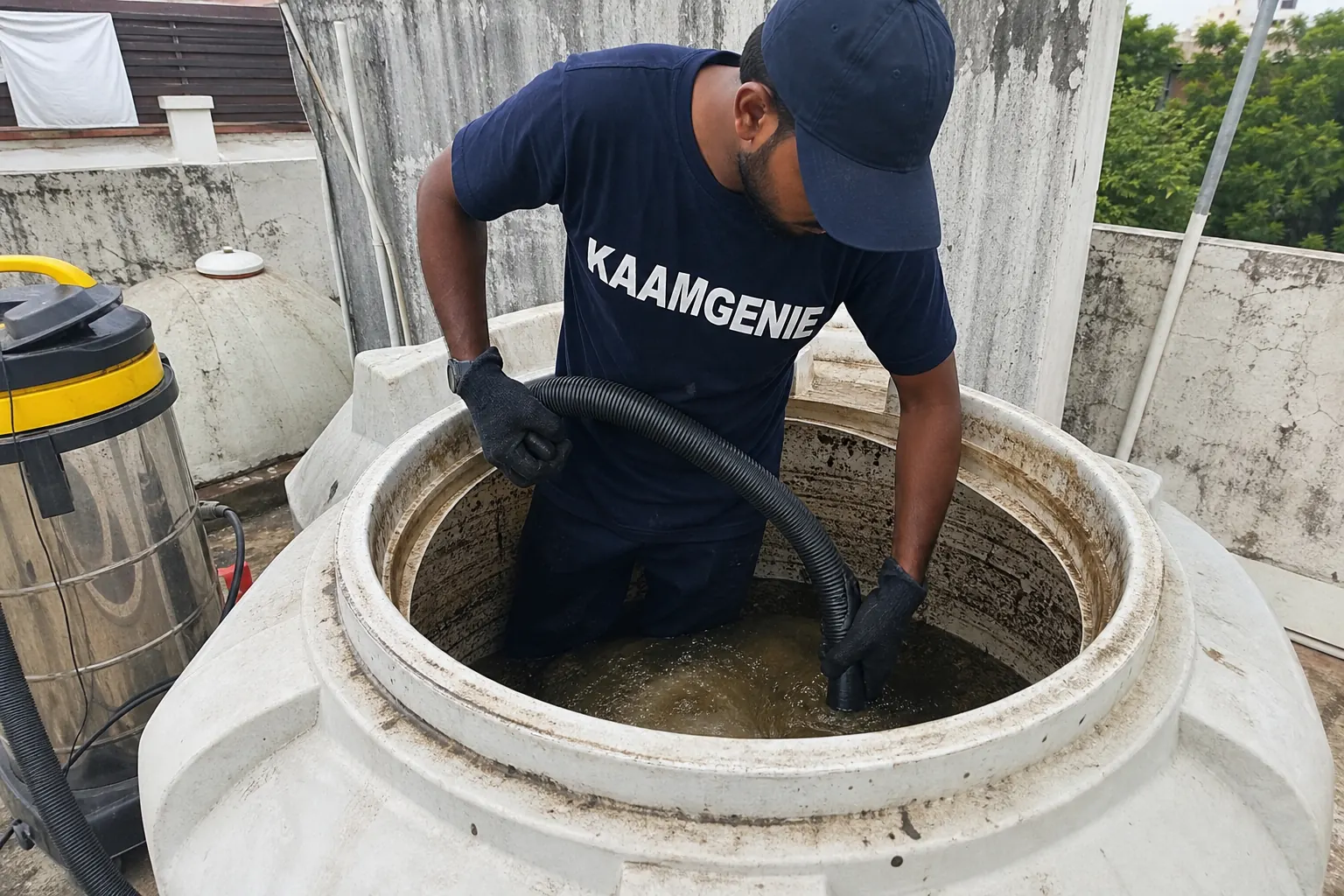
- Empty the tank completely. Drain it out through the outlet or bail it down; do not just top it up, because that leaves the sediment and larvae in place.
- Scoop and vacuum the sludge. Remove the layer of muck, dead algae and dead larvae from the floor and corners with a scoop or wet vacuum. This is the step that actually starves the problem.
- Scrub the walls and floor. Hand-scrub every internal surface with a food-safe brush to lift the biofilm the worms live in. The slimy film on the walls is their food source, so it has to physically come off.
- Disinfect and let it sit. Apply a food-safe chlorine solution across all surfaces and let it stand so it kills bacteria and any remaining eggs.
- Rinse thoroughly. Rinse the tank out fully so no chlorine residue or loosened sludge is left behind before you refill.
- Flush the pipes and taps. Run every tap and outlet until the water is clear, so no larvae or sediment are sitting in the lines feeding your household.
- Refit a tight lid and mesh. Close the tank with a properly fitting lid and fix a fine mesh over the vent and overflow so nothing can get back in.
One warning worth repeating: a partial "just add bleach" fix does not work. Chlorine may kill the larvae you can see, but it does nothing about the sediment and biofilm at the bottom, so a fresh batch hatches within days. Removing the sludge is non-negotiable. For a heavily fouled overhead tank or an underground sump, this is a job that needs draining and physical de-sludging, which is why so many people book it out rather than do it by hand.
How to stop worms and insects coming back
Once the tank is clean, keeping it clear is mostly about sealing the openings and not letting sediment build up again. First, fit a tight, properly seating lid so no insect can get in to lay eggs, and check it actually closes flush rather than resting loose. Second, put a fine mesh on the overflow and vent pipes, the two openings people always miss; a cheap stainless or nylon mesh cable-tied in place is enough. Third, clean the tank every 3 to 6 months so sediment never gets deep enough to sustain larvae, and always check again right after the monsoon, when breeding peaks across Delhi. Finally, keep the surroundings clear: remove any standing water, leaf litter or debris near the tank and terrace, because that is where the adult insects gather before they find your tank. These are small, cheap habits, but together they break the breeding cycle for good instead of fighting it every few weeks.
When to call a professional
You can manage a small, lightly affected tank yourself, but a genuinely worm-infested tank, an underground sump, or a large society tank needs a proper drain, de-sludge, scrub and disinfection to clear the breeding source completely. That full process is what actually removes the sediment layer the larvae depend on, and it is difficult to do thoroughly by hand from the top of a tank. This is exactly what a professional water tank cleaning visit is built to do. KaamGenie does it across Delhi NCR from ₹699, with before and after photos and a GST invoice, so you can see the sludge come out and know the job was done. For underground tanks, which trap sediment worst of all and are the hardest to clear of larvae, see our dedicated underground sump tank cleaning service. If you have found worms or insects in your tank, do not keep drinking the water: call KaamGenie on 95603 66362, or book online, and we will usually clear it in a single same-day visit.
Areas we serve across Delhi
Our crews cover water tank cleaning right across Delhi NCR, so a worm or insect problem can usually be sorted the same day close to you. We regularly work in South Delhi, West Delhi, East Delhi, North Delhi, Dwarka, Rohini, Saket, Vasant Kunj, Lajpat Nagar, Janakpuri, Rajouri Garden, Mayur Vihar, Preet Vihar, Pitampura, Model Town, Karol Bagh and across the wider NCR including Noida, Gurgaon, Faridabad and Ghaziabad. Wherever you are, the process is the same: drain, de-sludge, scrub, disinfect and seal, with photos and an invoice for your record. Call 95603 66362 to check availability in your area today.
Frequently asked questions
What are the tiny red worms in my water tank?
They are almost always bloodworms, the larvae of non-biting midge flies (chironomids), which are bright red because of a haemoglobin-like pigment. If the worms are thinner, wriggle to the surface for air and hang head-down, they are mosquito larvae instead. Either way, an adult insect laid eggs in your open or dirty tank and they hatched in the still water.
Are red worms in a water tank dangerous?
The bloodworms themselves are not poisonous and will not bite, but they are a clear sign the tank is contaminated with sludge and biofilm where bacteria thrive, so the water can cause stomach upsets. Mosquito larvae are worse, because they mean your tank is breeding dengue or malaria mosquitoes. Do not drink or cook with the water until the tank has been drained, cleaned and disinfected.
How do I get rid of worms in my drinking water tank?
Empty the tank fully, scoop or vacuum out the sludge and dead larvae, scrub the walls and floor to remove the biofilm they feed on, disinfect with a food-safe chlorine solution and let it sit, then rinse thoroughly and flush the taps until the water runs clear. Finish by fitting a tight lid and a fine mesh on the vent and overflow. Just adding bleach does not work, because it leaves the sediment they breed in.
Why do worms and insects keep appearing in my tank?
Because the tank gives insects an easy nursery: a loose or missing lid, a cracked or absent vent mesh, warmth and sunlight, organic sediment at the bottom, and water that stands for days. Monsoon makes it worse, and borewell water carries more nutrients than treated supply. Seal the lid, mesh every opening and clean out the sediment and the breeding stops.
How can I stop worms coming back after cleaning the tank?
Fit a tight-fitting lid so no insect can get in to lay eggs, put a fine mesh on the overflow and vent pipes, and clean the tank every 3 to 6 months, checking again right after the monsoon. Keep the area around the tank clear of stagnant water and debris. Removing the sediment at each clean is what really starves any future larvae.
Sources & references
- Bureau of Indian Standards (BIS) — IS 10500:2012 is the canonical Indian Standard for drinking water specification, defining acceptable limits for physical, chemical and biological parameters.
- WHO Guidelines for Drinking-water Quality, 4th edition — the global reference for water quality standards, including guidance on safe storage and disinfection.
- National Center for Vector Borne Diseases Control (NCVBDC) — India’s programme on dengue and malaria control, including guidance on eliminating standing-water mosquito breeding sites.
- WHO Fact Sheet on Drinking Water — overview of safe drinking water requirements and contamination risks.
- CPHEEO — Manual on Water Supply and Treatment — the Government of India’s engineering manual covering tank design, cleaning protocols and disinfection practices.
Last verified: 17 August 2026. If you find any of these links broken, please let us know.