
Quick answer
- Red worms that sink and loop at the bottom: midge larvae, often called bloodworms. They live in the sludge layer of a tank that has gaps and has not been cleaned for a while.
- Pale wrigglers at the surface that dive when disturbed: mosquito larvae. Most hang angled down from the surface; malaria (Anopheles) larvae lie flat just under it. Act the same day, because some of the mosquitoes that spread dengue and malaria breed in clean stored water.
- Tiny commas that tumble and rise: mosquito pupae, adults are only days away.
- How they got in: an open or cracked lid, an overflow pipe without mesh, a vent, or the gap where a pipe enters the tank.
- The fix: a full drain and clean to remove larvae and sludge, then sealing every opening so insects cannot reach the water.
Do not drink the tank water until it has been cleaned. Straining it through cloth does not make it safe.
Seen larvae in your tank? Get it cleaned
Larvae removal from an overhead tank is a fixed ₹699. We drain to waste, take out the larvae with the sludge they feed on, and you pay only after the before and after photos reach you. No chemicals unless you ask.
Worms and larvae in Gurgaon tanks are most likely between the pre-monsoon heat and the end of the rains, when warm water and insect activity line up, but they can turn up at any time of year in a tank that is left open. The cause is almost never the supply itself. Insects lay eggs on water they can reach, so a creature in your tank is proof that your tank has an opening. That is good news, because openings can be found and closed. For the wider set of warning signs, see signs your Gurgaon tank needs cleaning; for larvae cleared on site, book our Gurgaon water tank cleaning crew.
The jar test: identify what is in your water
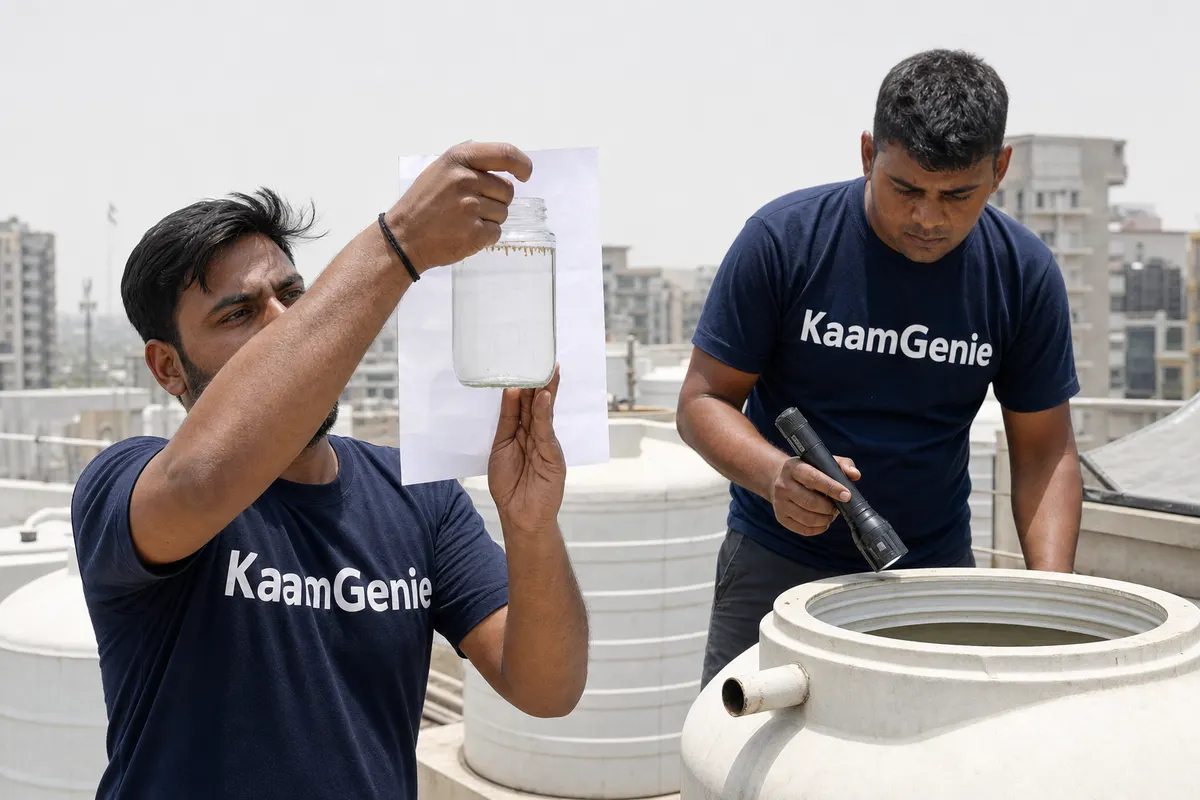
You need one clear glass jar or bottle with a wide mouth, a sheet of white paper and a dark cloth. Collect water from the tank itself if you can reach the lid safely, scooping from the top layer with a clean mug. If you cannot, run the nearest tank-fed tap into the jar for a minute; larvae often come through when the tank is low.
- Let it stand for two minutes. Put the jar down on a flat surface out of direct sun and do not touch it. Anything alive will settle into its natural position.
- Look at the surface first. Hold the white paper behind the jar and look at the top centimetre of water. Most mosquito larvae, such as Culex and the dengue mosquito Aedes, hang there angled down from the surface, breathing through a tube at their tail end. Anopheles larvae, the malaria mosquito, are different: they lie flat and parallel just under the surface, so look for short still lines as well as hanging ones.
- Then look at the bottom. Move the paper lower. Midge larvae stay low and move in loops, bending into an S or figure-of-eight.
- Tap the jar once. Mosquito larvae jerk downwards in a wriggling dive, then drift back up to the surface within seconds. Midge larvae simply keep looping where they are.
- Check against the dark cloth. Pale or translucent larvae are much easier to see against a dark background. This is how most people miss early mosquito larvae: against a white tank wall they are nearly invisible.
Do this twice, once in the morning and once in the evening, if the first jar shows nothing but you are still seeing things in buckets. Larvae move around the tank and one sample can miss them.
What you saw: the larvae decision table
| What you see in the jar | What it is | What it tells you about the tank | Act |
|---|---|---|---|
| Red, thread-like, 1–2 cm, sinks and loops at the bottom | Midge larvae (bloodworms) | A soft sludge layer to live in, and a gap that let adult midges reach the water | Book a clean this week |
| Pale or brownish, hangs angled from the surface or lies flat just under it, dives when tapped | Mosquito larvae (wrigglers) | Open water surface: loose lid, unmeshed overflow or vent | Same day: stop use, seal, clean |
| Comma-shaped, tumbles when tapped, rests at the surface | Mosquito pupae | Larvae have been there long enough to mature | Same day: adults are close |
| Very thin pale threads, slow-moving | Other small worms or fly larvae | Organic debris in the tank, sometimes a decaying leaf mat | Inspect with a torch; clean |
| Tiny black specks that jump on the surface | Springtails or similar small insects | Damp debris near the lid or a gap at the rim | Clean and seal the rim |
| Bits that do not move at all | Bio-film flakes, dust or rust | Not alive, but the tank still needs attention | Clean; see our colour guide |
If what you found does not move, the problem is debris rather than larvae, and our guide to yellow or brown tank water in Gurgaon is the better place to start.
Red worms: why midge larvae love neglected tanks
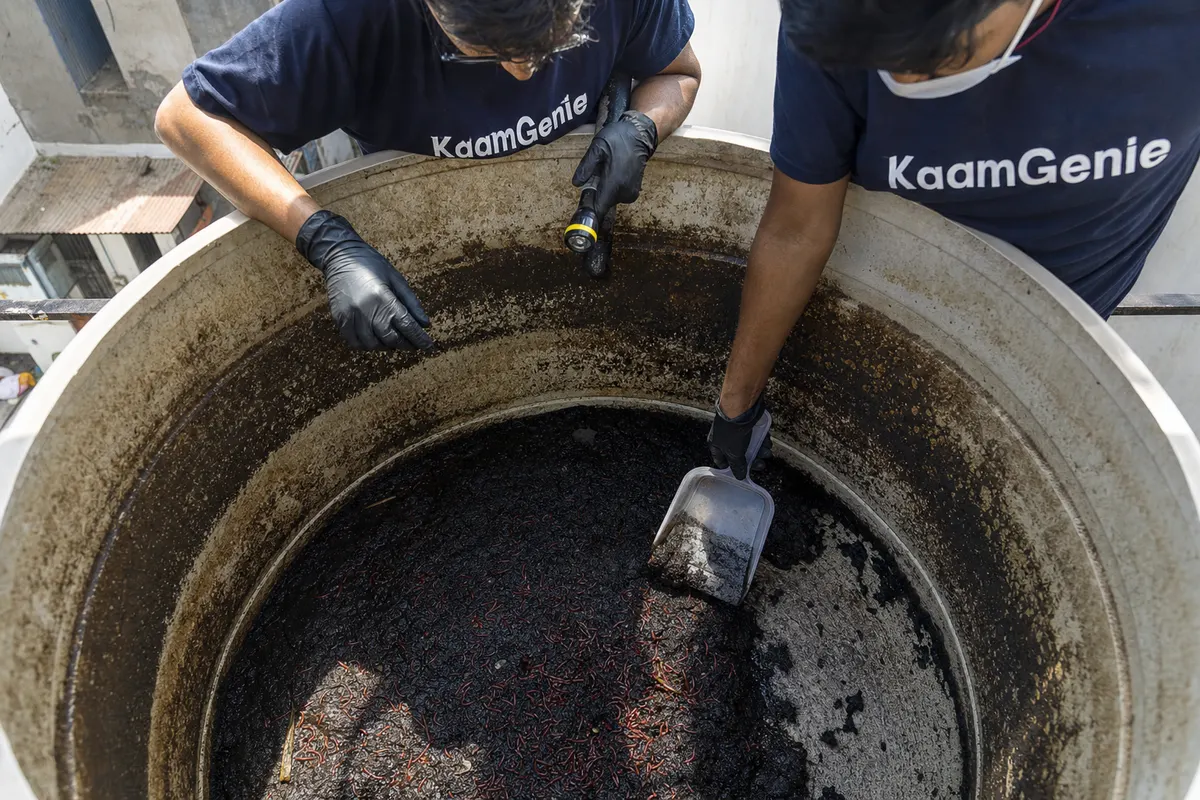
Bloodworms are the larvae of small, non-biting midges that look a lot like mosquitoes. Their red colour comes from haemoglobin, which lets them survive in water with little oxygen, such as the bottom of a tank full of soft sludge. The adult midge only needs a small gap to slip in and lay eggs on the water. In Gurgaon, the sludge they feed in builds up from summer dust, tanker silt and leaves, so a tank that sits under trees fills up faster. Our crews often find bloodworms in rooftop tanks among the old trees of colonies such as DLF Phase 1, where leaf litter keeps settling into that soft floor. If the larvae came with a damp, musty smell, the walls may also carry algae; our post on green water and algae in Gurgaon tanks covers that side.
Midge larvae are not known to spread disease the way mosquitoes do, but they are a clear sign of two things you do not want in a drinking-water tank: a layer of organic sludge, and an opening that insects use. Draining and de-sludging removes the larvae and their food in one go. Closing the gap stops the next generation.
Mosquito larvae: why this one is urgent
Most people expect mosquitoes to breed in dirty drains, and some do. But the mosquitoes behind dengue and urban malaria are known to prefer clean, still, stored water, and an overhead tank with a gap in the lid is exactly that. The National Centre for Vector Borne Diseases Control and the National Centre for Disease Control both list covering overhead tanks and stored-water containers among the basic steps to prevent mosquito breeding around homes.
In warm weather, mosquitoes can go from egg to flying adult in around a week, so a tank with wrigglers today can be releasing mosquitoes into your building soon after. That is why larvae call for same-day action. If anyone at home develops a fever, especially during or after the monsoon, see a doctor promptly rather than waiting it out; do not self-diagnose. Our post on waterborne diseases and tank hygiene in Gurgaon covers the other health side of a dirty tank.
While you wait for the clean: stop drinking the tank water, close the lid as tightly as you can, and tie a piece of fine cloth or mesh over the overflow pipe outlet. Do not pour kerosene, oil or insecticide into a drinking-water tank; those are meant for drains and unused containers, not water your family uses. For mosquitoes already flying around the house, our pest control service in Gurgaon handles that separately.
How they get in: five openings to check
Every tank with larvae has a way in. On Gurgaon rooftops, these five are the usual suspects, and you can check most of them yourself from the terrace with a torch:
- The lid. Plastic lids warp in the summer sun and stop sitting flat. Screw lids lose their thread. Many lids are simply left resting on top, or replaced with a plate or a piece of tin after the original broke.
- The overflow pipe. This is the most overlooked entry. It is an open pipe leading straight to the water surface, and mosquitoes find it easily. Many rooftop overflow pipes have no mesh at all.
- Vent openings. Some tanks have small vents near the top. Without a mesh cap they are another direct route in.
- Pipe entry points. Where the inlet pipe or a float-valve rod passes through the tank wall or lid, the hole is often cut larger than the pipe, leaving a ring-shaped gap.
- Cracks. Old plastic tanks crack near the top rim from heat and age. A crack that does not leak water still lets insects in.
The same overflow and lid gaps that let in mosquitoes are also how birds and rats end up in tanks, which is a far worse problem; our post on a dead bird or rat in your water tank covers that case.
Shared tank or your own? It decides how fast this gets fixed
With larvae, the building type matters for one reason: whose tank it is. If the larvae came from a shared tower tank or a society reservoir, every flat on that supply is exposed, and mosquitoes from one open tank fly into the whole building. Send the maintenance office or facility team your jar video and the date, and ask them to check the overflow and vent mesh on every rooftop tank, not just the one that was reported. Several complaints from the same tower move it up the list faster than one.
If the tank is your own, as on most builder floors and plotted houses, you can act the same day without waiting for anyone. Plotted houses have one more place to look: the underground sump, whose manhole cover is often loose or cracked and sits at ground level, close to drains where mosquitoes are already breeding. In older plotted sectors such as Sector 23, our crews regularly see ground-level manhole lids that have cracked or warped with age. In a new tower handed over recently, it is worth asking whether overflow mesh was ever fitted at all. For how each property type is cleaned overall, see the complete guide to water tank cleaning in Gurgaon.
Send us a video of your jar
A ten-second WhatsApp video of the jar test is usually enough for us to tell you what it is and how urgent it is, with a fixed price if the tank needs a clean.
How KaamGenie clears and seals the tank
Larvae cannot be strained or filtered out of a tank in any reliable way. Eggs and tiny larvae stick to walls and hide in sludge, so the dependable fix is to empty the tank and clean it properly. The whole sequence is in our Gurgaon cleaning process guide. For larvae, three parts of it matter most:
- Draining to waste, not to the taps. With the inlet shut, the water is pumped out to a drain point on the roof, so larvae are never sent down into your pipes and geyser.
- Taking the sludge out. The floor layer where bloodworms live is scooped and wet-vacuumed out and carried away, so their food goes with them.
- Scrubbing the old waterline. Mosquito eggs are laid at the water’s edge and stick to the wall there. A scrub of that band, the corners and the lid underside removes them before the fresh-water rinse.
Larvae need no chemicals once the tank is emptied and scrubbed, so none go in by default. Should you want a tank that held wrigglers disinfected too, that is added on request. You get before and after photos on WhatsApp, and you can ask the crew to show you any open gaps they spot.
Sealing it afterwards
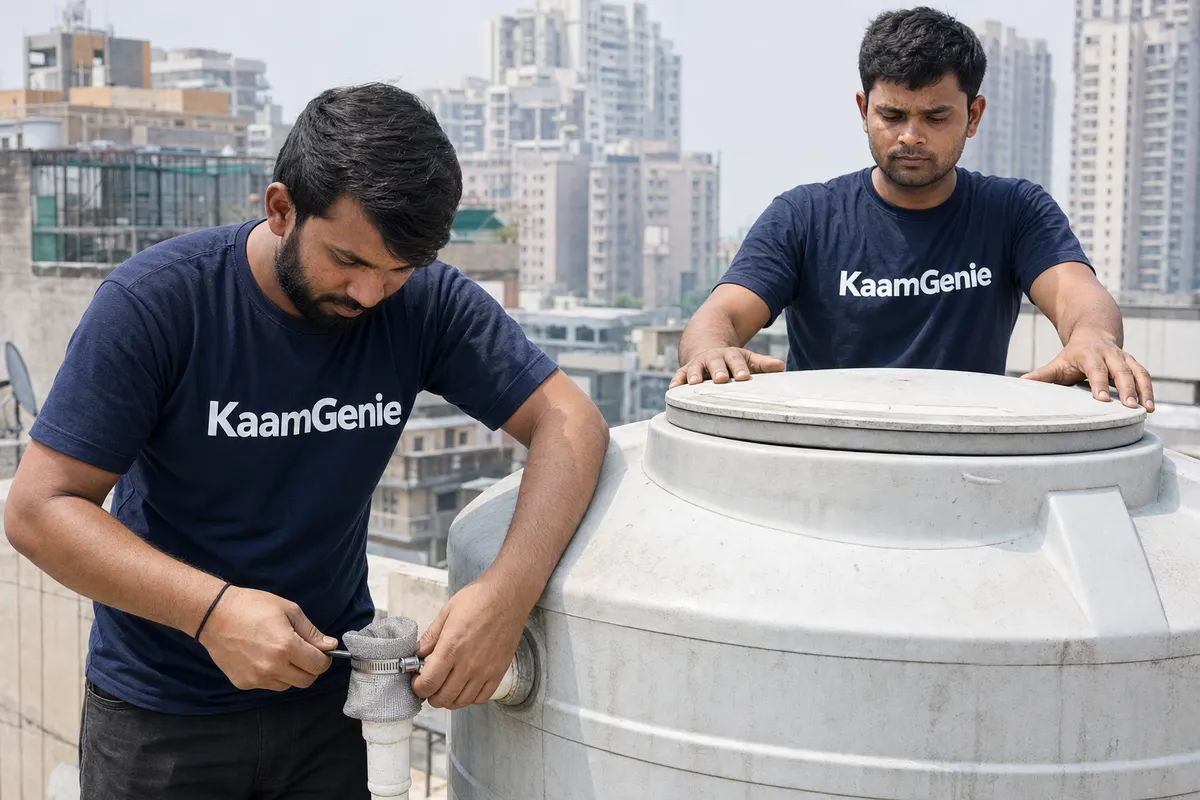
- Overflow pipe: fine stainless-steel or nylon mesh fixed over the outlet with a clamp, so it cannot fall off in the wind.
- Vents: a mesh cap on each one.
- Lid: one that sits flat and is clamped, strapped or locked down. Never rely on a brick or a weight on top; wind and tanker hoses shift them. If yours is warped, replacing it costs far less than another infestation.
- Pipe entries: the ring gap around inlet pipes closed with a rubber grommet or a sealant rated safe for potable water, not ordinary silicone or putty, which is not made for contact with drinking water.
- Sump manholes: a tight-fitting cover, kept closed.
Check the lid and mesh before each monsoon and after any rooftop work such as dish antenna or solar panel installation, when lids are often disturbed. Our monsoon tank care guide covers the rest of the rainy-season routine.
What not to do
- Do not put kerosene, oil, larvicide or insecticide in a drinking-water tank yourself. They may kill larvae, but they contaminate the water you bathe in and cook with.
- Do not add bleach and keep using the water. Dead larvae and sludge stay in the tank, and a DIY dose is easy to get wrong.
- Do not just strain the tap water through cloth. It catches big larvae but leaves eggs and small larvae in the tank to keep breeding.
- Do not drain the tank through the house taps. That pushes larvae and sludge into your pipes and geyser.
- Do not clean the tank and leave the overflow open. Without mesh, larvae are usually back within the season.
Found wrigglers? Here is how to get the tank done
Send us the jar video on WhatsApp or call, and we will tell you whether it can wait a few days (bloodworms) or should be done today (mosquito larvae or pupae). Same-day visits are possible where our schedule allows. Larvae removal from an overhead tank starts at ₹699 and from an underground sump at ₹1,499, a fixed price agreed before work starts and paid after the job, once you have seen the photos; mesh or a new lid are quoted separately. Larvae call-outs cover Sohna Road, Palam Vihar and New Gurgaon; see the rest on our Gurgaon water tank cleaning page, or call +91 95603 66362. Prefer Hindi? Read tanki me keede kaise hataye.
Frequently asked questions
What are the small red worms in my water tank?
They are almost always midge larvae, often called bloodworms. Adult midges are small, non-biting insects that look like mosquitoes and lay eggs on any water they can reach. The larvae are red because they carry haemoglobin, which helps them live in the low-oxygen sludge on a tank floor. Seeing them means the tank has both a sludge layer and an opening that needs closing.
Are red worms in tank water dangerous?
Midge larvae are not known to transmit disease the way some mosquitoes do, but you still should not drink water from a tank that has them. They live in sludge that can also hold bacteria, and their presence shows insects can reach your water. Use other drinking water until the tank has been drained, de-sludged and scrubbed, and the gap they came through has been sealed.
How do I know if they are mosquito larvae?
Put tank water in a clear jar and leave it still for two minutes. Most mosquito larvae hang from the surface at an angle, breathing through a tube at their tail, while malaria (Anopheles) larvae lie flat just under the surface. Tap the jar and they dive in a jerky wriggle, then float back up within seconds. Comma-shaped ones that tumble are pupae, which means adults are close. Midge larvae, by contrast, stay at the bottom and loop.
Can mosquitoes really breed in an overhead tank?
Yes. The mosquitoes associated with dengue and urban malaria are known to breed in clean, still, stored water, and an overhead tank with a loose lid or an unmeshed overflow pipe gives them exactly that. National vector-control guidance lists covering overhead tanks among the basic steps for homes. A properly closed tank with mesh on every opening gives them nowhere to lay eggs.
Can I just add kerosene or a larvicide to the tank?
Not to a tank your household drinks, cooks and bathes from. Kerosene and oil are used on drains and unused containers precisely because nobody uses that water. In a drinking-water tank they contaminate everything that comes out of the taps. The safe route is to drain the tank to waste, clean it properly and seal the openings, so no treatment is needed afterwards.
Why do larvae keep coming back after cleaning?
Because the opening is still there. Cleaning removes larvae, eggs and sludge, but if the overflow pipe has no mesh, the lid is warped or a pipe entry has a gap, insects return and lay eggs again. Check the lid, overflow, vents and pipe entries yourself, or ask the crew to point out any gaps during the clean. Fix those with mesh, a clamped lid and a potable-safe sealant, and the problem usually stops.
Is it the society or me who should fix larvae in the tank?
If it is a shared tower tank or reservoir, the society or facility team is responsible, and larvae are a reason to escalate quickly because mosquitoes affect the whole building. Share a photo or video of the jar test with the maintenance office. If it is your own floor’s tank in a builder floor, it is yours or your landlord’s to arrange.
How much does it cost to clean a tank with worms in Gurgaon?
Worm and larvae removal is priced from ₹699 for an overhead tank and from ₹1,499 for an underground sump, fixed before anyone climbs in. That figure covers draining, de-sludging, scrubbing, rinsing and the before and after photos, with no surprise extras for the cleaning itself, and you pay only once the job is finished and the photos are with you. Mesh or a new lid is quoted separately. A larvae clean uses no chemicals by default; disinfection is added only on request.
Sources & references
- National Centre for Vector Borne Diseases Control (NVBDCP): national programme for dengue, malaria and other vector-borne diseases, with guidance on preventing mosquito breeding in stored water.
- National Centre for Disease Control (NCDC): public health guidance on communicable and vector-borne diseases in India.
- WHO Guidelines for Drinking-water Quality, 4th edition: covers invertebrate animals in drinking-water storage and how to keep them out.
- CPHEEO Manual on Water Supply and Treatment: engineering guidance on storage tanks, covers, vents and overflow arrangements.
Last verified: 22 November 2026. If you find any of these links broken, please let us know.