
Key takeaways
- Kitchen water counts as an ingredient — a dirty storage tank is a food-safety and compliance failure, not just maintenance.
- Clean a Delhi restaurant tank quarterly; high-volume or borewell-fed kitchens may need it more often.
- Keep a dated cleaning log with invoices and before-and-after photos ready for FSSAI and hygiene audits.
- Demand a full mechanised clean with a potable-water-safe disinfectant for both the tank and any sump.
- A commercial AMC (15–25% off) fixes the annual cost and guarantees the scheduled cleans and records auditors want.
This guide is for food-business owners and kitchen managers running restaurants across Delhi. It covers why tank cleaning is a food-safety issue and not just maintenance, how often a commercial kitchen tank must be cleaned, the records you need ready for an FSSAI or hygiene audit, what a proper commercial clean includes, and what it realistically costs. The aim: safe water on every plate and a clean sheet at inspection time.
Water tank cleaning is a food-safety issue
Under food-hygiene norms, water used in a kitchen is treated as an ingredient — it must be potable, the same standard as drinking water. That means the storage tank feeding your restaurant is part of your food-safety chain, not a background utility. Sediment, biofilm and bacterial growth in a neglected tank contaminate everything downstream: washed salad, cooked rice, ice, and the glass of water on the table. For a licensed food business, a dirty tank isn’t just unhygienic — it’s a compliance failure that an auditor can cite. Treating tank cleaning as a scheduled part of your hygiene programme, on par with pest control and kitchen deep-cleaning, is what separates a professional kitchen from a risky one.
How often a Delhi kitchen tank needs cleaning
A commercial kitchen tank needs cleaning far more often than a home’s because throughput is higher and the stakes are higher. For a Delhi restaurant, quarterly cleaning — every three months — is the sensible standard, and high-volume kitchens or those on tanker and borewell supply should consider it more frequently. Delhi conditions push the frequency up:
- Intermittent DJB supply leaves tanks stagnant between fills.
- Hard borewell water in many areas leaves scale and deposits.
- Monsoon silt and dust enter through poorly sealed lids.
- Summer heat accelerates bacterial growth in stored water.
Records auditors want to see
At a hygiene inspection, saying “we clean it regularly” means nothing without proof. Auditors look for documentation, so maintain a simple water-tank cleaning log alongside your other food-safety records. For each clean, record the date, who performed it, the tanks covered, and keep the contractor’s invoice. Before-and-after photos strengthen the file considerably. A water-quality or potability report adds another layer if your inspection demands it. The point is to produce a dated, unbroken history on request — showing that cleaning happens on a fixed schedule, not reactively. A restaurant that hands over a clean, current log at inspection signals a well-run operation and moves the audit along quickly, while a missing record invites deeper scrutiny of the whole kitchen.
Book your water tank cleaning
Trained crew, food-grade process, before/after photos and a service record every job. ₹699 onwards, same-day where possible across Delhi NCR.
What a commercial clean must include
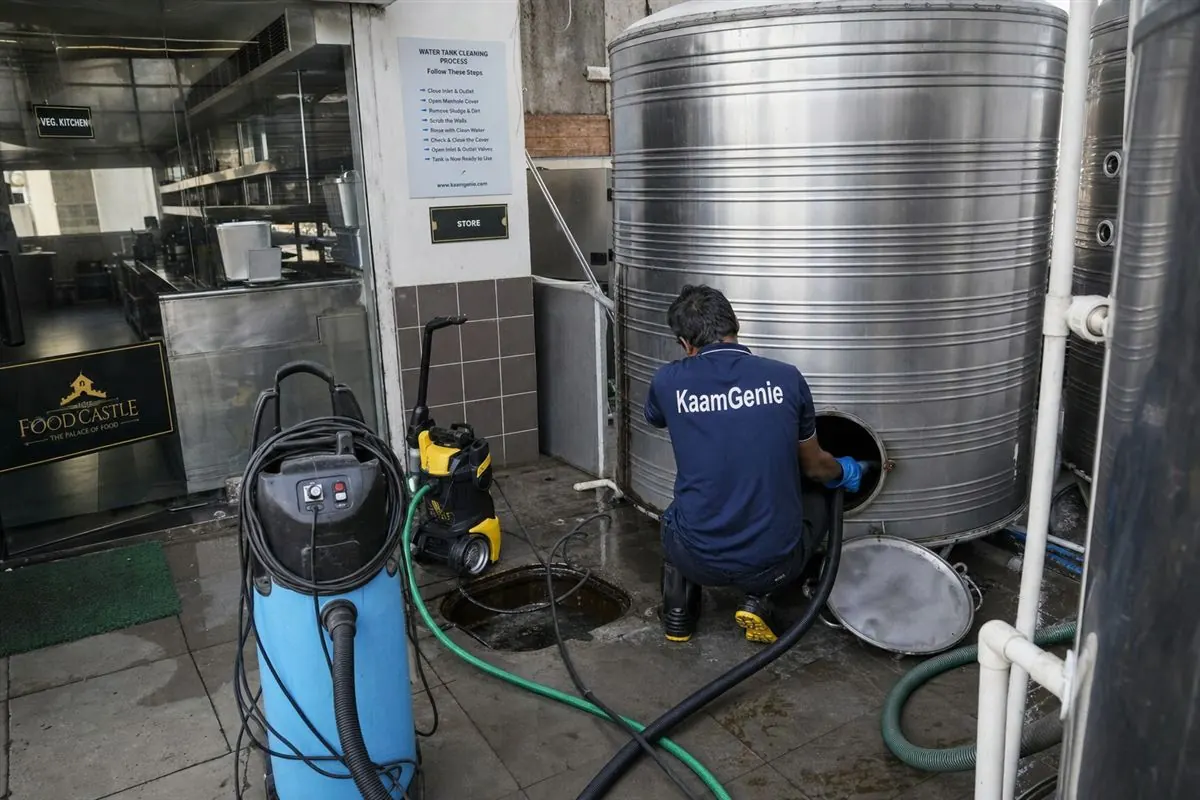
A restaurant tank clean has to be mechanised and thorough — a quick manual rinse won’t pass muster for a food business. Insist the scope covers complete draining, mechanical removal of sludge and sediment, high-pressure jet washing of every wall and the floor, vacuuming of residue, a food-safe anti-bacterial and anti-fungal treatment, and a final rinse before refilling. The disinfectant used should be safe for potable water — important when the tank feeds a kitchen. For larger underground sumps, the crew should follow confined-space safety precautions. Ask for before-and-after photos as standard; for a restaurant these aren’t a nicety but part of your audit file. Same standard applies to both the overhead tank and any underground sump feeding the kitchen line.
What it costs and the AMC advantage
Commercial tanks are quoted on inspection rather than a flat rate, since restaurant setups range from a single rooftop tank to a large underground sump. The smart route for a food business is an AMC. KaamGenie water-tank cleaning in Delhi offers commercial AMCs at 15–25% off standard rates, covering scheduled quarterly cleans on a fixed calendar — which conveniently matches the frequency a kitchen needs anyway. An AMC does two things for a restaurant: it fixes the annual cost so it sits cleanly in your operating budget, and it guarantees the cleans actually happen on schedule, generating the dated records an auditor wants. Compared with the cost of a shutdown or a food-safety complaint, scheduled tank cleaning is one of the cheapest insurance policies a kitchen can buy.
Building it into your kitchen hygiene routine
Tank cleaning shouldn’t live in someone’s memory — build it into the same system that governs pest control, kitchen deep-cleans and equipment servicing. Put the quarterly clean on the hygiene calendar, assign one manager to own it, and file the record the day it’s done. Between professional cleans, small habits protect the water: keep tank lids sealed against dust and pests, inspect after heavy monsoon rain, and flush the tank if a tanker delivered visibly cloudy water. If your restaurant already runs a pest-control schedule, book tank cleaning on a matching cadence so both stay current together. A kitchen that treats water storage as seriously as it treats its cold chain rarely gets caught out at inspection.
Frequently asked questions
How often must a restaurant clean its water tank in Delhi?
Quarterly — every three months — is the sensible standard for a Delhi restaurant, and high-volume kitchens or those on tanker and borewell supply should clean more often. Because kitchen water is treated as an ingredient, a commercial tank can’t wait for a smell or complaint the way a home might. Put it on a fixed hygiene calendar.
What records do I need for an FSSAI or hygiene audit?
Maintain a water-tank cleaning log recording the date, who cleaned it, and the tanks covered, plus the contractor’s invoice for each clean. Before-and-after photos and a water-potability report strengthen the file. Auditors want a dated, unbroken history proving cleaning happens on schedule, not reactively — a current log signals a well-run kitchen.
Is home tank cleaning good enough for a restaurant?
No. A commercial kitchen needs a mechanised clean — full draining, sludge removal, high-pressure jet washing, vacuuming, a potable-water-safe anti-bacterial treatment and a final rinse — documented with photos for your audit file. A quick manual rinse won’t meet food-safety expectations, and the frequency is higher because kitchen throughput and risk are higher.
How much does commercial tank cleaning cost in Delhi?
Commercial tanks are quoted on inspection because setups vary from a single rooftop tank to a large sump. The cost-effective route is a commercial AMC at 15–25% off, covering scheduled quarterly cleans — matching the frequency a kitchen needs. It fixes the annual cost in your budget. Call KaamGenie on 95603 66362 for a site quote.
Can dirty tank water really affect my food safety rating?
Yes. Water is used to wash produce, cook, make ice and clean utensils, so a contaminated tank puts unsafe water directly into your food. An auditor can cite a dirty tank as a compliance failure, and a resulting complaint or illness can trigger a shutdown. Scheduled cleaning with documentation is one of the cheapest protections a kitchen has.
Can you schedule the clean so my kitchen never has to close?
Yes. We work in your off-hours — late night or early morning — and go tank by tank so water is back before service. A typical overhead tank takes about 60–90 minutes. Give us your quietest window when you book on 95603 66362 and we plan around it.
Is the refilled water genuinely safe for cooking and ice after cleaning?
Yes. Our food-grade process disinfects the tank and rinses out all residue, so once it refills the water is fit for cooking, washing produce and making ice. Clean tank water also protects your downstream filters and reduces the sediment that clogs them between services.
What’s the difference between a one-off clean and an AMC for a restaurant?
A one-off resets a dirty tank; an AMC fixes a regular frequency — often quarterly for a busy kitchen — so cleaning never slips and your records stay continuous for audits. An AMC usually works out more economical per visit and means we remind you before each is due.
Do you handle the staff washroom and rooftop tanks too, not just the kitchen tank?
Yes. We can clean every tank on the premises in one visit and keep a separate record for each. The kitchen and any tank feeding food prep are the priority, but doing them all together means nothing is missed and your whole water system stays hygienic.
How do I show an inspector the cleaning was actually done properly?
Keep the dated service record, the GST invoice and the before and after photos we provide in your hygiene file. Together they give an FSSAI or municipal inspector immediate, visual proof of routine tank maintenance — far stronger than a verbal assurance that the tank is cleaned.
Sources & references
- Bureau of Indian Standards (BIS) — IS 10500:2012 is the canonical Indian Standard for drinking water specification, defining acceptable limits for physical, chemical and biological parameters.
- WHO Guidelines for Drinking-water Quality, 4th edition — the global reference for water quality standards, including guidance on safe storage and disinfection.
- Food Safety and Standards Authority of India (FSSAI) — defines water quality requirements for food businesses, including hygiene standards for stored water and acceptable disinfection chemicals.
- WHO Fact Sheet on Drinking Water — overview of safe drinking water requirements and contamination risks.
- CPHEEO — Manual on Water Supply and Treatment — the Government of India’s engineering manual covering tank design, cleaning protocols and disinfection practices.
Last verified: 6 July 2026. If you find any of these links broken, please let us know.