
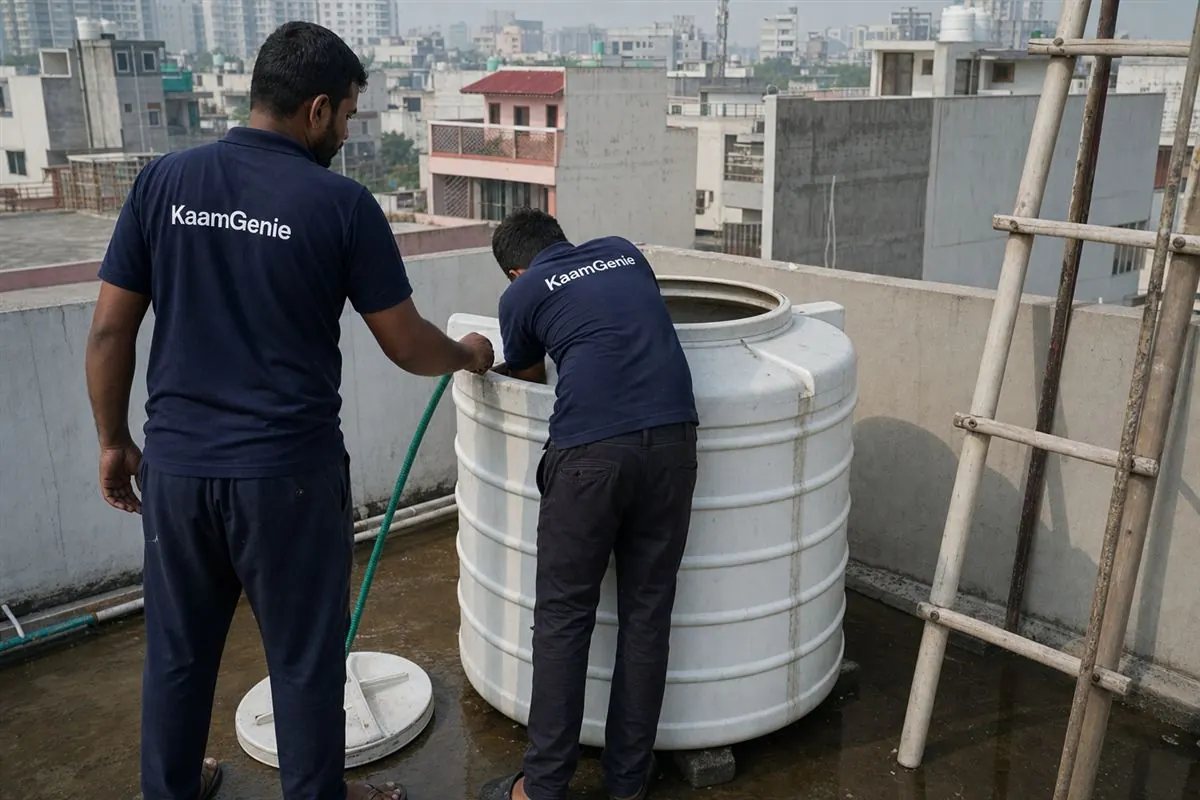
The short version for Greater Noida homes
- Greater Noida is GNIDA-planned. Plotted kothis across Alpha, Beta, Gamma and Delta; an institutional belt of universities and hospitals around Pari Chowk and Knowledge Park; and a growing ring of newer societies.
- Hard borewell groundwater dominates. High calcium and iron means scale and rust-coloured sediment build up on tank walls within months.
- Tanker reliance is real. Tanker water carries its own sediment straight into your underground reservoir — a heavier, sandier sludge layer than mains-fed tanks.
- Two tanks per home. An underground reservoir (UGR) at the base and rooftop overhead tanks above — both must be cleaned, and the UGR is the one that matters most.
- That means every three to four months, not the once-a-year clean a soft-water locality might get away with.
- Always de-sludge the UGR floor, never just rinse the walls — the sediment sits below the outlet where your filter never sees it.
If your Alpha or Beta kothi is on borewell or tanker water and the UGR hasn’t had a real food-grade clean this year, there’s almost certainly a sediment layer feeding your taps right now.
| Where you live | Typical setup | Water source | Realistic schedule |
|---|---|---|---|
| Plotted kothi (Alpha, Beta, Gamma) | UGR + 1–2 rooftop tanks | Borewell, tanker top-up | Every 3–4 months |
| Independent / builder floor | Shared sump + per-floor drums | Borewell, tanker | Every 3–4 months |
| Newer society / group housing | Split UGR + tower rooftop tanks | Borewell, supply, tanker | Quarterly |
| Institutional belt (Pari Chowk, Knowledge Park) | Large UGR + multiple rooftop tanks | Borewell, supply, tanker | Quarterly, documented |
Book a Greater Noida tank clean
UGR plus rooftop tanks, de-sludged and food-grade disinfected, with before/after photos. Residential single-tank cleaning ₹699 onwards; society/UGR custom-quoted.
What makes Greater Noida its own case
Greater Noida is not an organic city that grew street by street — it is a Greater Noida Industrial Development Authority (GNIDA) plan, laid out in lettered sectors with generous plot sizes and wide roads. The result is a city with three quite different residential characters, and each one changes how a tank should be cleaned. There are the established plotted kothis of Alpha, Beta, Gamma and Delta, mostly independent houses with their own underground reservoir and rooftop tanks. There is the institutional belt around Pari Chowk and Knowledge Park — universities, colleges, hostels and hospitals running large reservoirs for big resident and student populations. And there is the spreading ring of newer societies on the outer sectors and the Greater Noida West side.
What ties them together is the water. Much of Greater Noida runs on hard borewell groundwater rather than soft, treated mains supply, and where the piped network is still thin, homes and societies top up with water tankers. Hard water and tanker water both leave more behind in a tank than clean municipal supply does — which is the whole reason tanks here need a tighter cleaning schedule. This page is part of our wider water tank cleaning in Noida coverage, and you can see every sector we serve on the Greater Noida water tank cleaning hub. If you live in the high-rise townships on the Noida Extension side, the companion read is our Greater Noida West society guide, which deals specifically with new-tower handovers and tower-by-tower staging.
The two-tank setup in a Greater Noida kothi
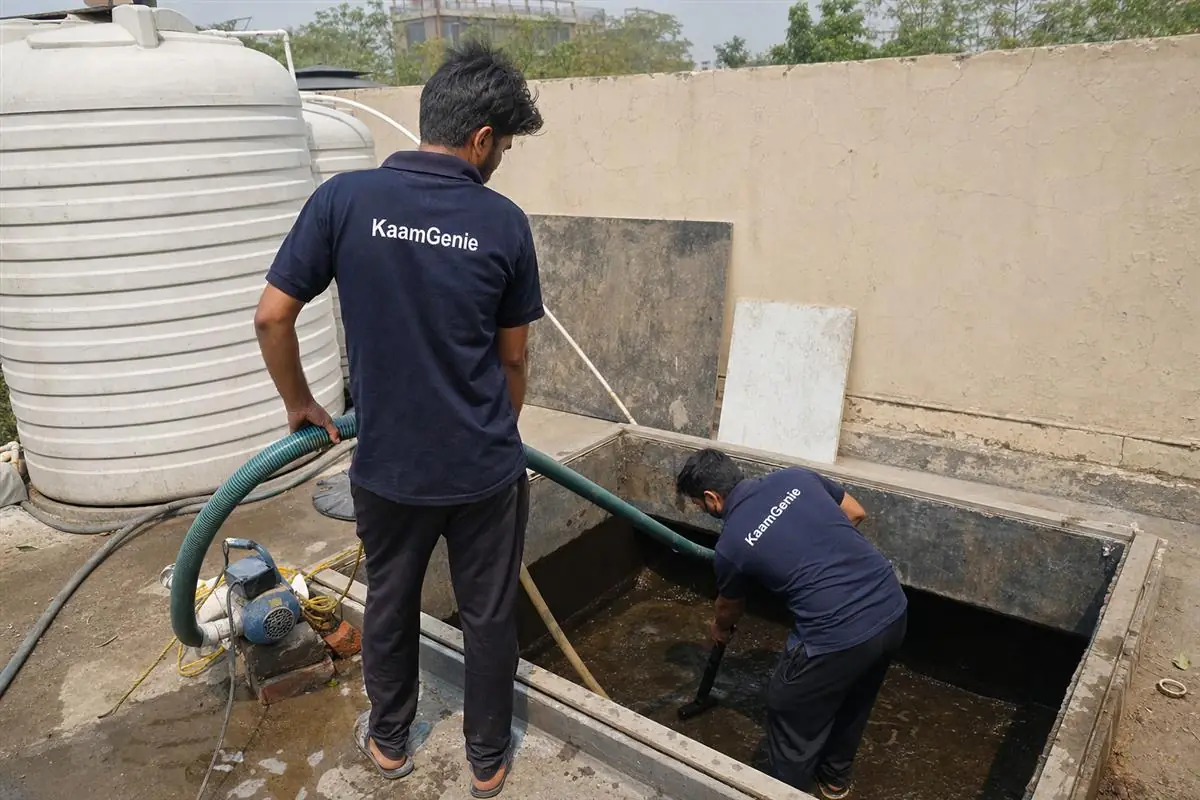
Almost every plotted home in Alpha, Beta or Gamma stores water in two stages, and a real clean has to cover both:
- The underground reservoir (UGR). A below-ground tank, often split into a domestic side and a flushing or spare side, where borewell or tanker water lands first. It is the single most important tank in the house because everything — rooftop tank, pump, every tap — draws from it.
- The pump. A pump lifts water from the UGR up to the roof.
- The rooftop overhead tanks. One or two tanks on the terrace where water sits before gravity-feeding down to the floors.
So the water in your kitchen tap passed through two tanks before it reached you. The catch is that the UGR is below ground, harder to open and needs confined-space precautions, so it is exactly the tank a cheap operator quietly skips — doing only the easy rooftop tank and calling the job done. That is backwards. The source tank is the one that silts up worst and feeds everything else, so a clean that ignores the UGR leaves the worst contamination right where your water passes through it. Our underground sump & reservoir cleaning service is built specifically for that below-ground work, and our guide to underground sump cleaning in Noida walks through how it’s done safely.
Problem one: hard borewell groundwater
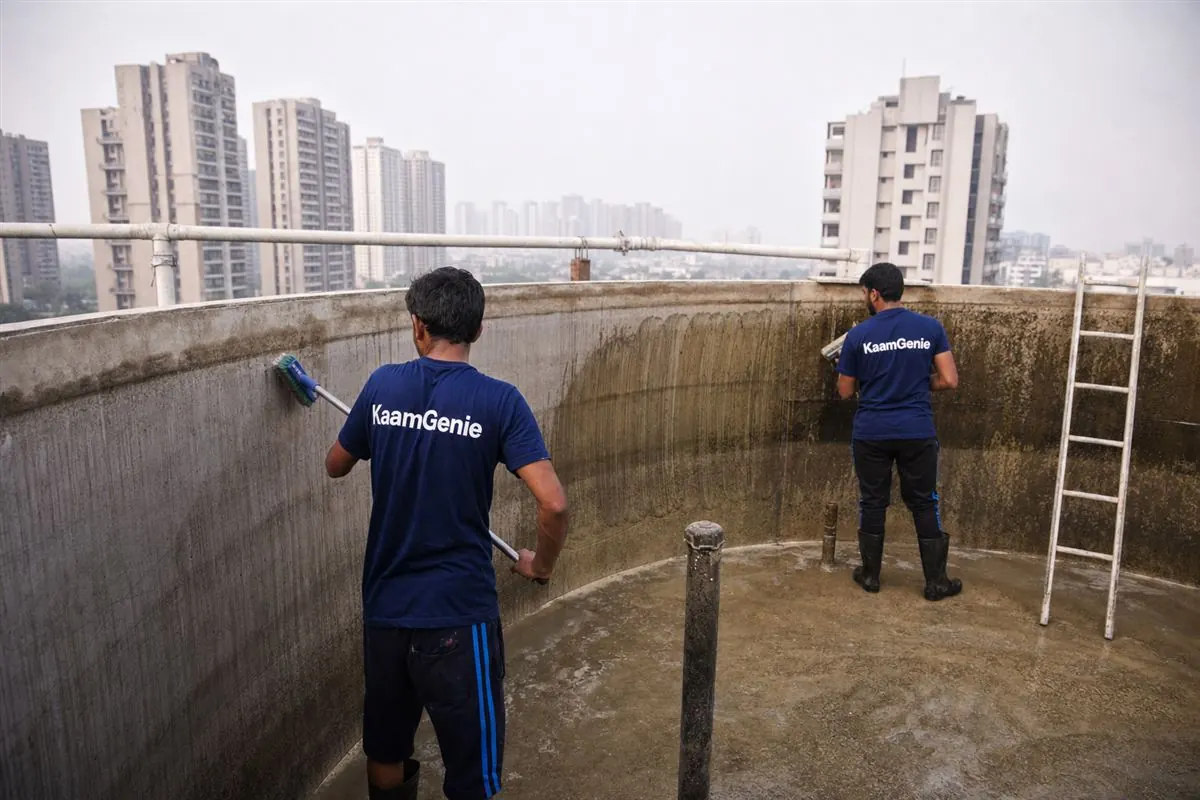
The borewell water under much of Greater Noida is genuinely hard — high in dissolved calcium and iron. In a storage tank those minerals come out of solution and settle as chalky white scale on the walls and rust-coloured sediment on the floor. You notice it as a gritty layer at the bottom of the UGR, orange staining around the outlet and on bathroom fittings, and a rough film on the rooftop tank walls that bare water never shifts.
To be clear about what cleaning does and doesn’t fix: tank cleaning does not soften your water — that needs a softener or a point-of-use RO. What it does is remove the accumulated scale and sediment that the hard water keeps depositing, so the next few months start from a clean surface instead of building on years of crust. Because the deposition never stops, the cleaning has to be repeated more often than on soft supply. This is why a six-monthly clean — fine for treated municipal water — is not enough on Greater Noida groundwater, and why we recommend every three to four months for homes and quarterly for societies and campuses. For the full chemistry of what hard water does to a stored tank, see our dedicated hard water tank cleaning guide for Noida.
Problem two: tanker reliance
The second factor specific to Greater Noida is how much of it runs on water tankers. In sectors and societies where the piped network is still being extended, tankers fill the gap — topping up the UGR through dry spells and in newer pockets that aren’t fully on supply yet. That keeps the taps running, but it has a direct effect on your tank.
Tanker water quality varies with its source, and a tanker that isn’t itself cleaned regularly carries its own sediment, which it discharges straight into your reservoir. The practical result is that tanker-fed tanks accumulate a heavier, sandier sludge layer at the bottom than mains-fed ones. That sludge sits below the outlet, so your filter and RO never see it — until the level drops far enough during a shortage that the sediment gets drawn up into the supply, and suddenly the water runs cloudy. The honest takeaway is the opposite of what people assume: tanker-reliant homes should clean more often, not less, and the job must always include a proper de-sludge of the UGR floor, never just a wall rinse.
The institutional belt: Pari Chowk and Knowledge Park
The belt around Pari Chowk and Knowledge Park is the densest concentration of large water users in Greater Noida — universities, colleges, hostels and hospitals, each running big underground reservoirs and several rooftop tanks to serve large student and resident populations. The stakes are higher here for an obvious reason: one neglected reservoir on a campus is the drinking water of hundreds or thousands of people, not one family.
Institutional cleaning is its own discipline. It needs a full tank inventory, a defined per-tank scope, food-grade disinfectant named by spec, confined-space safety on the UGR, staging so no hostel block or ward loses water, and a separate certificate per tank for audit and compliance. A hospital or a hostel mess that stores or serves water also falls under water tank cleaning services with FSSAI-grade documentation. We handle these campuses the same way we handle society contracts — surveyed, scheduled and documented tank by tank — right across the institutional sectors near Knowledge Park and Pari Chowk.
How fast a tank re-soils on different Greater Noida water
Visible sediment and scale on the tank floor between cleans — why hard and tanker water need a tighter schedule
Illustrative, from what our crews see on the ground across Greater Noida: the harder and more tanker-dependent the supply, the sooner sediment and scale return — which is why three-to-four-month (home) and quarterly (society/campus) schedules are the realistic defaults here, not the BIS minimum of twice a year.
How often, and why the BIS minimum isn’t enough here
BIS IS 10500 and CPHEEO guidance set a floor of cleaning stored drinking-water tanks at least twice a year. That floor is written for benign, treated water. On Greater Noida’s hard groundwater — and especially on tanker-fed tanks — a six-monthly clean means the tank is already re-scaling and silting well before the next visit. The realistic standards are:
- Plotted kothis and independent floors: every three to four months, both UGR and rooftop tank.
- Newer societies and group housing: quarterly, staged so no block loses supply.
- Institutional campuses around Pari Chowk and Knowledge Park: quarterly, fully documented per tank.
If you want to pin a date to the calendar, the practical advice in our guide on the best time to clean a water tank in Noida applies to Greater Noida too — just on a tighter cycle because of the water.
What a proper Greater Noida clean actually involves
A real clean — whether on a Beta kothi or a Knowledge Park campus — runs the same defined sequence on every tank: inspect and photograph, close the inlet and drain, hand-scoop and vacuum the sediment off the floor, scrub the walls and floor with food-grade brushes, high-pressure jet-wash the corners and fittings, wet-vacuum the residue, disinfect with food-grade sodium hypochlorite at the correct concentration with proper contact time, then refill and hand over before/after photos and a cleaning record. The two steps cheap operators cut — de-sludging the floor and food-grade disinfection — are exactly the two that matter most on hard, tanker-fed water. For a deeper comparison of how plotted homes and high-rise societies differ in practice, our guide to high-rise versus plotted tank cleaning in Noida breaks it down side by side, and the full step list lives in our overall Noida tank-cleaning coverage.
Kothi, floor, society or campus?
We survey your tank inventory, de-sludge the UGR, clean the rooftop tanks and certify each one. Residential ₹699 onwards; society, institutional & UGR work custom-quoted after a free survey.
Book a tank clean across Greater Noida
Whether you’re in a plotted kothi in Alpha 1 or Beta 1, an independent floor on borewell water, a newer society on the outer sectors, or a campus in the Pari Chowk institutional belt, we cover the whole GNIDA city — UGR plus rooftop tanks, de-sludged and food-grade disinfected, with before/after photos and a per-tank certificate where it matters. Start at the Greater Noida water tank cleaning hub for your sector, or at our wider water tank cleaning in Noida service for booking and area coverage.
To book, call +91 95603 66362 or use the booking form on this site — we’ll confirm shortly. Residential single-tank cleaning is ₹699 onwards; society, institutional and UGR work is custom-quoted after a free tank-inventory survey.
Frequently asked questions
What makes water tank cleaning in Greater Noida different from Noida proper?
Greater Noida is a planned GNIDA city built around plotted kothis in sectors like Alpha, Beta and Gamma, an institutional belt of universities and hospitals near Pari Chowk and Knowledge Park, and a fast-growing ring of newer societies. Most of it runs on hard borewell groundwater and a lot of it leans on water tankers, especially in pockets where the piped network is still thin. That mix — big private underground reservoirs feeding rooftop tanks, hard water, and tanker top-ups — means tanks here scale and silt up faster than on soft municipal supply, so they need a more thorough, more frequent clean than a once-a-year rinse.
Is Greater Noida tap water hard, and what does that do to my tank?
Much of Greater Noida draws on borewell groundwater that is genuinely hard — high in dissolved calcium and iron. In storage, those minerals drop out as chalky white scale and rust-coloured sediment on the floor and walls of the tank. You see it as a gritty layer at the bottom of the UGR, orange staining around the outlet, and a film on the rooftop tank walls. Hardness is not removed by tank cleaning — that needs a softener or RO at the point of use — but cleaning removes the accumulated scale and sediment that the hard water keeps depositing, which is exactly why the schedule has to be tighter here.
How often should I get my Greater Noida tank cleaned?
For a plotted kothi or independent floor on hard borewell water, every three to four months is the realistic standard. BIS IS 10500 and CPHEEO guidance set a floor of cleaning stored drinking-water tanks at least twice a year, but that minimum is written for benign, treated water. On Greater Noida’s hard groundwater — and especially on tanker-fed tanks that take in whatever sediment the tanker carries — a six-monthly clean means the tank is already re-scaling and silting before the next visit. Societies and institutional campuses around Pari Chowk and Knowledge Park should run quarterly.
We rely on water tankers in Greater Noida — does that affect the tank?
Yes, significantly. Tanker water varies in quality depending on its source, and a tanker that isn’t itself cleaned regularly carries its own sediment, which it deposits straight into your underground reservoir. Tanker-fed tanks in Greater Noida tend to accumulate a heavier, sandier sludge layer at the bottom than mains-fed ones. That is the contamination your filter and RO never see because it sits below the outlet — until the level drops and it gets drawn up into the supply. Tanker-reliant homes and societies should clean more often, not less, and always de-sludge the UGR floor properly rather than just rinsing the walls.
I have a plotted kothi in Alpha or Beta with a UGR and a rooftop tank. Do both need cleaning?
Both, every time. Almost every Greater Noida kothi stores water in two stages — an underground reservoir (UGR) at the base where borewell or tanker water lands first, and rooftop overhead tanks that the pump lifts it into for gravity supply to the floors. The UGR is the more important of the two because everything downstream draws from it, yet it’s the one cheap operators skip because it’s harder to access and needs confined-space precautions. A clean that only does the easy rooftop tank and ignores the UGR is leaving the worst sediment exactly where your water passes through it.
How much does water tank cleaning cost in Greater Noida?
Residential single-tank cleaning starts at ₹699 onwards. A typical plotted kothi with one UGR and one or two rooftop tanks is quoted per tank by capacity and access — the UGR costs more than a rooftop tank because it holds more water, needs draining and de-sludging, and requires confined-space safety gear. Society, institutional and large underground-reservoir work around Pari Chowk and Knowledge Park is custom-quoted after a free tank-inventory survey, so the whole inventory is priced transparently rather than hidden in a lump sum.
Do you cover the institutional belt around Pari Chowk and Knowledge Park?
Yes. The belt around Pari Chowk and Knowledge Park is dense with universities, colleges, hostels and hospitals, all of which run large underground reservoirs and multiple rooftop tanks serving big resident and student populations. Those campuses need a defined per-tank scope, food-grade disinfectant, confined-space safety on the UGR, staged cleaning so no block loses water, and a separate certificate per tank for audit and compliance. We handle that institutional work the same way we handle society contracts — surveyed, scheduled and documented tank by tank.
How long does a Greater Noida tank cleaning take, and will I lose water?
A single residential rooftop tank takes about 75 to 90 minutes; a kothi UGR up to roughly 5,000 litres takes two to two-and-a-half hours. For a home with both, we usually clean the rooftop tank from its stored water while the UGR is being done, so you’re out of supply only for the short refill window. For societies and institutional campuses we stage the work — one UGR compartment feeds the property while the other is cleaned, then towers in sequence — so no block loses water for more than its own refill window.
What proof do I get that the job was done properly?
Before-and-after photos of each tank and a cleaning record listing the tank type and capacity, the date, the crew, and the food-grade disinfectant used. For societies and institutions, every UGR compartment and every rooftop tank gets its own separate certificate, so the committee or facility manager can prove the whole inventory — not just the convenient tanks — was actually cleaned. That paper trail is what protects you at an AGM, in an FSSAI or campus audit, or if a water-quality complaint is ever raised.
Sources & references
- Bureau of Indian Standards (BIS) — IS 10500:2012 is the canonical Indian Standard for drinking water specification, defining acceptable limits for physical, chemical, and biological parameters including calcium and iron.
- WHO Guidelines for Drinking-water Quality, 4th edition — the global reference for water quality standards, including guidance on storage and disinfection.
- Food Safety and Standards Authority of India (FSSAI) — defines water quality requirements for food businesses, including hygiene standards for stored water and acceptable disinfection chemicals.
- WHO Fact Sheet on Drinking Water — overview of safe drinking water requirements and contamination risks.
- CPHEEO — Manual on Water Supply and Treatment — the Government of India’s engineering manual covering tank design, cleaning protocols, and disinfection practices.
Last verified: 30 June 2026. If you find any of these links broken, please let us know.