
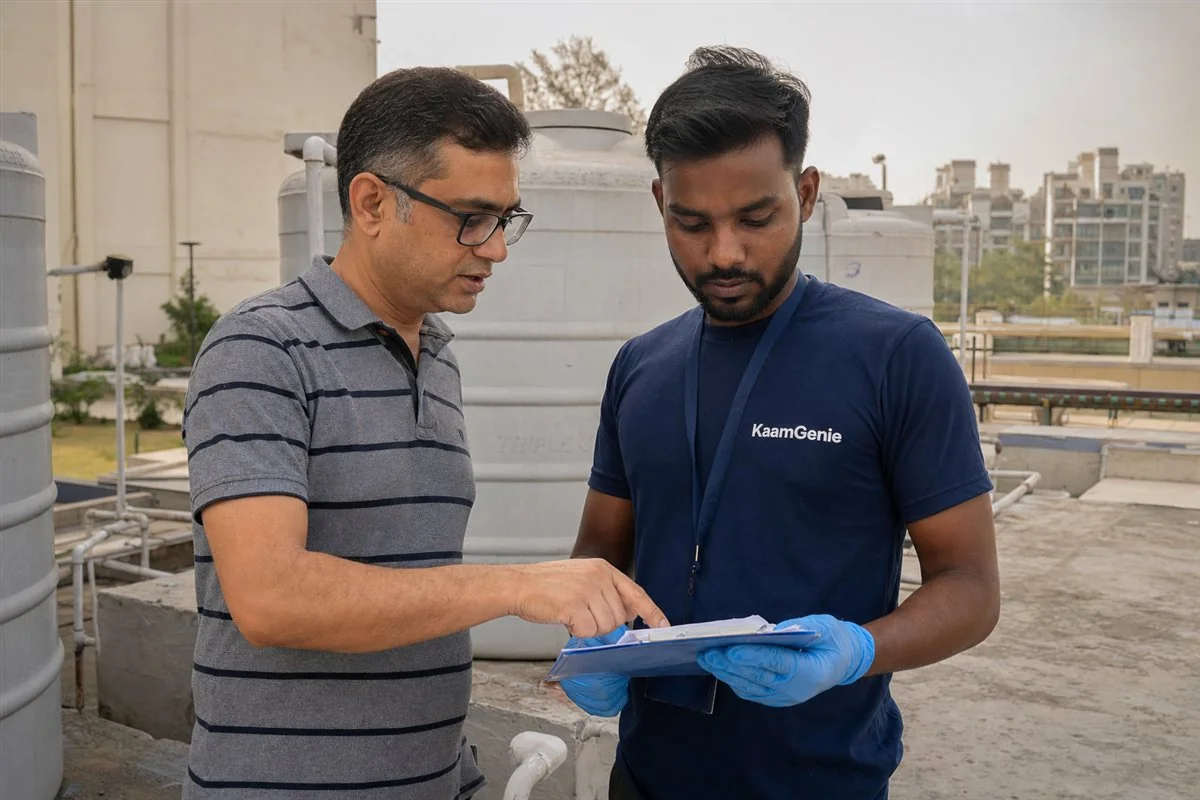
The rules in plain English
- No single statute sets a tank-cleaning calendar — the benchmark comes from standards plus AOA/RWA duties
- BIS IS 10500:2012 defines what safe drinking water must be; WHO & FSSAI add storage and disinfection guidance
- Frequency: every 3–6 months — closer to quarterly for Gurgaon reservoirs on tankers and hard borewell water
- Responsibility for shared tanks sits with the AOA/RWA managing committee, not individual tenants
- Disinfection: food-grade sodium hypochlorite, ~50–100 ppm, 20–30 min contact, then rinse
- Keep the paperwork: a dated certificate, photos, and a tank-maintenance register the committee can produce on demand
Treat tank cleaning as a documented maintenance obligation, not a favour someone does when the water smells.
Gurgaon — Gurugram — runs on stored water more than almost any city in the NCR. The DLF colonies, the high-rise condominiums along Golf Course Road and the Southern Peripheral Road, the new-tower belt off Dwarka Expressway, the corporate blocks of Cyber City and Udyog Vihar — almost all of them depend on a large underground reservoir (UGR) that is topped up by water tankers and hard borewell groundwater, then pumped to rooftop tower tanks. That storage chain is exactly where contamination accumulates, which is why the standards below matter more here than in a city on continuous piped supply.
This guide is about the rules and norms, not the scrubbing technique. If you want the step-by-step method, the cost ladder or the AOA contract structure, those live in separate guides linked through this page. Here we stay on one question: what does “compliant” tank maintenance actually look like for a Gurgaon society, and how do you write it down so it survives a change of committee?
The standards that set the benchmark
There is no Haryana law that prints a sentence like “every society shall clean its tanks every X months.” What there is, instead, is a layered set of references that together define the obligation. A good managing committee cites all of them in its maintenance policy:
| Reference | What it governs | Relevance to a Gurgaon tank |
|---|---|---|
| BIS IS 10500:2012 | Indian Standard for drinking water — acceptable & permissible limits | Defines what “clean” water in the tank must measure: turbidity, TDS, hardness, residual chlorine, coliforms |
| WHO Guidelines for Drinking-water Quality | Global water-quality and storage/disinfection guidance | The international benchmark behind IS 10500; useful when expat tenants ask |
| FSSAI requirements | Water hygiene for food businesses | Binds any restaurant, cloud kitchen, cafeteria or clubhouse pantry on the premises |
| CPHEEO manual | Govt. of India engineering manual on water supply & treatment | Reference for tank disinfection logic and chlorination dosing |
| Haryana apartment / RWA framework | Upkeep of common facilities by the AOA/RWA | Places the duty for the shared UGR and tower tanks on the managing committee |
Read together, these say something simple: the water leaving a society tank should meet IS 10500, the people legally charged with the common reservoir are the AOA or RWA, and where food is served on site FSSAI hygiene rules apply on top. Cleaning is how you keep stored water inside those limits between deliveries. None of this is invented — it is the same framework professional facility managers across Gurgaon already work to. What is often missing is writing it into a policy and following it on a schedule.
Get a documented, standards-aligned cleaning
Food-grade disinfection, before/after photos and a dated certificate for your register — residential from ₹699 onwards, society & UGR quoted on site.
How often the norm says to clean
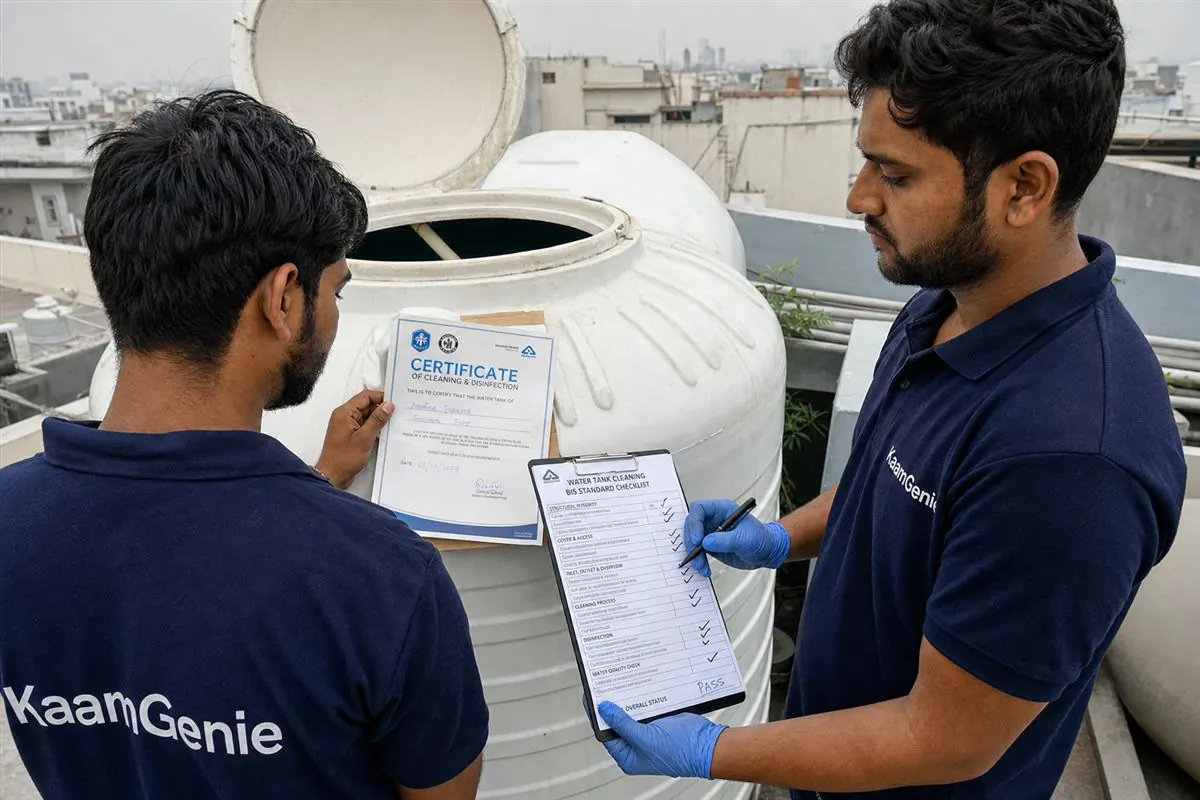
The widely accepted benchmark, echoed in public-health guidance, is to clean and disinfect stored-water tanks every three to six months. For Gurgaon we lean firmly to the shorter end of that band, and here is the reasoning rather than a slogan:
- Tanker top-ups carry sediment. Reservoirs that depend on tanker water — common across the SPR and Dwarka Expressway tower belt — receive whatever silt the source carried. It settles on the UGR floor between deliveries.
- Borewell groundwater is hard. Gurgaon’s groundwater is mineral-heavy, so calcium and iron scale forms on walls and fittings faster than in soft-water cities.
- Large UGRs sit still. A big reservoir holds a deep, undisturbed bottom layer where bio-film grows quietly even when the upper water looks fine.
So our standing recommendation: quarterly for underground reservoirs, and at least twice a year for rooftop tower tanks, with a tighter cycle through the warmer pre-monsoon months when microbial growth accelerates. If you want the full month-by-month logic and the triggers that justify an out-of-cycle clean, that is laid out in our guide on how often to clean a water tank in Gurgaon. Whatever interval you pick, the rule that matters is this: put the number in the AOA maintenance policy and keep to it on the calendar, not on complaints.
Who is responsible — the AOA/RWA duty
Under the Haryana apartment-ownership and RWA framework, the common water infrastructure is exactly that — common. The underground reservoir, the booster pumps, the shared overhead tower tanks and the riser network are the responsibility of the Association of Apartment Owners or the RWA, acting through its managing committee and facility manager. An individual flat owner is responsible only for a private tank that sits entirely within their own flat.
This matters because of how the duty is usually neglected. In many societies the tank only gets cleaned when a resident complains, and the arrangement is whatever the caretaker can find cheapest that week. That inverts the obligation. The correct ownership looks like this:
- Managing / maintenance committee — sets the policy, approves the vendor and the interval, sanctions the budget.
- Facility manager — schedules each clean, supervises it on the day, checks the confined-space safety for the UGR.
- Treasurer / office — files the certificate and photos in the tank-maintenance register and tracks the next-due date.
Tenants — and Gurgaon has a very large rental and expat population — should never be left to organise cleaning of shared tanks; that is the society’s job. For the contract structure, scope and how to split costs fairly between owners, our companion piece on society and high-rise tank cleaning in Gurgaon goes deeper, and many committees formalise the interval through an annual plan — see AMC plans for Gurgaon condo societies.
What “to standard” cleaning actually involves
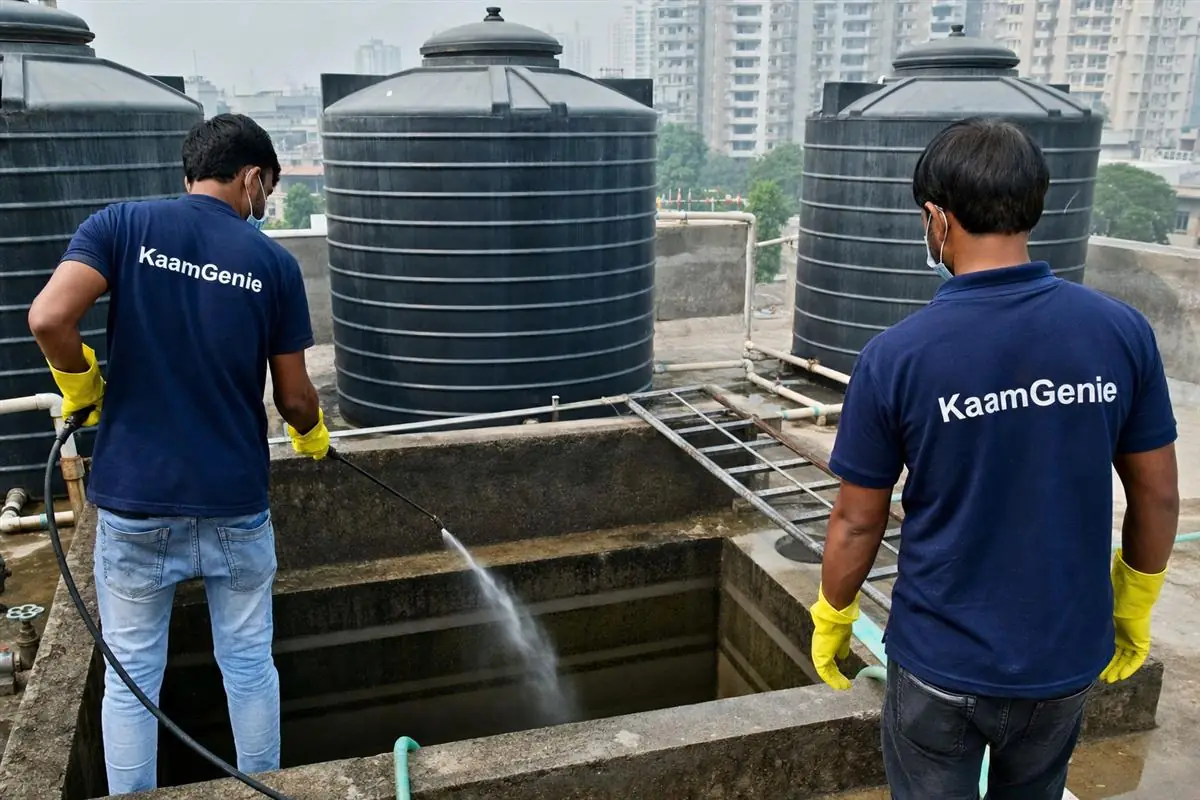
A cleaning that meets the norm is defined by its process and its disinfection, not by how shiny the tank looks afterwards. The sequence that aligns with CPHEEO and FSSAI logic is: drain the tank fully, hand-remove the settled sludge, manually scrub every wall and the floor, jet-wash the corners and fittings, vacuum out the residue, then disinfect with a food-grade chemical. For potable systems that means food-grade sodium hypochlorite at roughly 50–100 ppm with a 20–30 minute contact time before a final rinse. Industrial or pool-grade bleach fails the norm because of its additives and residue.
The point of writing the dosage and contact time into your policy is that it makes the job auditable. “They disinfected it” is unverifiable; “food-grade sodium hypochlorite at 80 ppm, 25-minute contact, rinsed” on a signed certificate is. This is also the same standard our crews follow on every job, whether it is a single rooftop tank in a builder floor off Sohna Road or a multi-tank reservoir for a tower in Sector 56. You can read the full method and equipment list in our 8-step water tank cleaning process, and book through our NCR water tank cleaning services page.
Records, certificates and audits
This is where most societies fall short, and it is the cheapest part of compliance to fix. A cleaning that leaves no paper trail did not, as far as anyone can later prove, happen. For every tank, keep:
- A dated cleaning certificate — tank ID and capacity, date, the steps performed, the disinfectant and concentration, crew names, and the next-due date.
- Before-and-after photographs attached to that certificate.
- The water-test report, where one was done, showing the IS 10500 parameters.
- A single tank-maintenance register holding all of the above, so the committee can produce the history at an AGM, for a buyer’s due diligence, or for an FSSAI inspection of any on-site kitchen.
A genuine cleaning is not the same as a lab test — the two answer different questions. The clean removes the contamination; an IS 10500 water test tells you whether the delivered water meets the standard. For a society reservoir we recommend at least an annual test covering turbidity, residual chlorine, total coliforms and E. coli, plus an extra test after any contamination scare, filed alongside the cleaning record.
A Gurgaon society’s compliance checklist — how the typical society scores
Where committees usually lose marks is paperwork, not the cleaning itself
Illustrative pattern from what our crews see across Gurgaon societies — not a formal survey. The gap is almost always documentation and schedule discipline, both free to fix.
Auditing your vendor against the norm
When a committee reviews quotes, the temptation is to compare only the per-tank price. Audit the process instead. A vendor who clears a large underground reservoir in thirty minutes and hands over nothing has not met the standard, however low the bill. Before you sign, confirm the vendor will:
- Drain the tank fully and remove sludge by hand — not rinse from the top.
- Scrub manually and jet-wash fittings, then vacuum the residue.
- Disinfect with a food-grade chemical at a stated concentration and contact time, and show its food-grade documentation.
- Carry proper confined-space safety gear for the UGR — this is non-negotiable for deep reservoirs.
- Issue a signed certificate with photographs and log the next-due date.
Run the same checklist as a spot audit on the day, and keep the completed form in the register. It takes ten minutes and it is the difference between a policy on paper and a tank that is actually safe.
Want a compliance-ready quote for your society?
We’ll survey your UGR and tower tanks, propose a schedule, and document every clean for your register. Society & commercial pricing on request.
Turn the norms into a one-page policy
The whole framework above fits on a single sheet your committee can adopt and pin in the office: clean the UGR quarterly and tower tanks at least twice a year; disinfect with food-grade sodium hypochlorite at a documented dose; file a dated certificate with photos for every tank; test reservoir water against IS 10500 annually; and review the vendor against a process checklist each cycle. Do that and your society is meeting the recognised standards — whether or not anyone ever writes a single statute that names a date.
If you want this turned into a working schedule for your buildings, or you manage a luxury condominium and need the same discipline at scale, start from our hub for water tank cleaning in Gurgaon and the detailed guide for DLF and luxury condominium tank cleaning. We’ll help you set the interval, run the cleans to standard, and keep the register your committee can stand behind.
Frequently asked questions
Is there a single law that forces a Gurgaon society to clean its water tanks?
There is no standalone statute that names a fixed tank-cleaning calendar for every Gurgaon society. What exists is a stack of standards and duties: BIS IS 10500:2012 defines what safe drinking water must be, the Haryana apartment ownership and RWA framework places the upkeep of common facilities (which includes the underground reservoir and overhead tanks) on the Association of Apartment Owners or RWA, and FSSAI rules bind any food business on the premises. Treat tank cleaning as a documented maintenance obligation flowing from those duties rather than a single line in an Act.
How often should a Gurgaon society clean its water tanks?
Best practice across the industry and public-health guidance is every three to six months. In Gurgaon we recommend the shorter end — roughly quarterly — for underground reservoirs fed by tankers and hard borewell groundwater, because sediment and scale build faster here. A twice-yearly minimum is the floor, not the target. Set the interval in the AOA maintenance policy and hold to it regardless of whether anyone has complained about the water.
What standard actually defines whether tank water is clean?
BIS IS 10500:2012, the Indian Standard for drinking water, is the reference. It sets acceptable and permissible limits for physical, chemical and biological parameters — turbidity, total dissolved solids, hardness, residual chlorine, E. coli and total coliforms. The WHO Guidelines for Drinking-water Quality cover the same ground globally. A tank cleaning does not change the source water chemistry, but it removes the sludge, bio-film and microbial load that push stored water outside these limits.
Who is responsible for tank cleaning in a Gurgaon AOA or RWA society?
The Association of Apartment Owners or the RWA, through its managing committee and facility manager, is responsible for common water infrastructure — the underground reservoir, pumps and shared overhead tanks. Individual flat owners are responsible only for any private tank inside their own demise. In practice the maintenance committee schedules the cleaning, the facility manager supervises it, and the treasurer files the record. Tenants should not be left to arrange cleaning of shared tanks.
What records should a society keep after each cleaning?
Keep a dated cleaning certificate for every tank that lists the date, tank ID and capacity, the steps performed, the disinfectant and concentration used, the crew names and the next-due date. Attach before-and-after photographs and, where done, the water-test result. File these in a single tank-maintenance register that the committee can produce at an AGM, for a prospective buyer’s due diligence, or for an FSSAI inspection of any on-site kitchen or restaurant.
Do we need a water test along with the cleaning?
A cleaning is not a lab test, and the two answer different questions. The cleaning removes contamination you can see and the bio-film you cannot; a water test against IS 10500 tells you whether the delivered water meets the standard. For societies we recommend at least an annual test of the reservoir water — turbidity, residual chlorine, total coliforms and E. coli — and an extra test after any contamination scare. Pair the report with the cleaning record.
What disinfectant and dosage meet the accepted norms?
Food-grade sodium hypochlorite is the standard choice, applied to clean tank surfaces at roughly 50-100 ppm with a contact time of 20-30 minutes before a final rinse, which mirrors the chlorination logic in the CPHEEO manual and FSSAI guidance for potable systems. Industrial or pool-grade bleach is not appropriate for drinking-water tanks because of additives and residue. The norm is the chemical being food-grade and used at a documented concentration, not a particular brand.
What should a society check when auditing a cleaning vendor?
Audit the process, not just the price. Confirm the crew drains the tank fully, removes sludge by hand, scrubs walls manually, disinfects with a food-grade chemical at a stated concentration, and issues a signed certificate with photographs. Ask for the chemical’s food-grade documentation, check confined-space safety gear for underground reservoirs, and verify the next-due date is logged. A vendor who finishes a large reservoir in thirty minutes and leaves no paperwork has not met the norm.
Does a builder floor or independent house in Gurgaon follow the same norms?
The legal AOA/RWA responsibility framework applies to multi-owner societies, but the water-quality standards — IS 10500, food-grade disinfection, the 3-6 month interval — are the same sensible benchmark for a builder floor, a kothi or a rented flat. There is no committee to file the record, so the owner or landlord should keep the certificate themselves, especially before a new tenant moves in or before selling.
Sources & references
- Bureau of Indian Standards (BIS) — IS 10500:2012 is the canonical Indian Standard for drinking water specification, defining acceptable limits for physical, chemical, and biological parameters.
- WHO Guidelines for Drinking-water Quality, 4th edition — the global reference for water quality standards, including guidance on storage and disinfection.
- Food Safety and Standards Authority of India (FSSAI) — defines water quality requirements for food businesses, including hygiene standards for stored water and acceptable disinfection chemicals.
- WHO Fact Sheet on Drinking Water — overview of safe drinking water requirements and contamination risks.
- CPHEEO — Manual on Water Supply and Treatment — the Government of India’s engineering manual covering tank design, cleaning protocols, and disinfection practices.
Last verified: 30 June 2026. If you find any of these links broken, please let us know.