
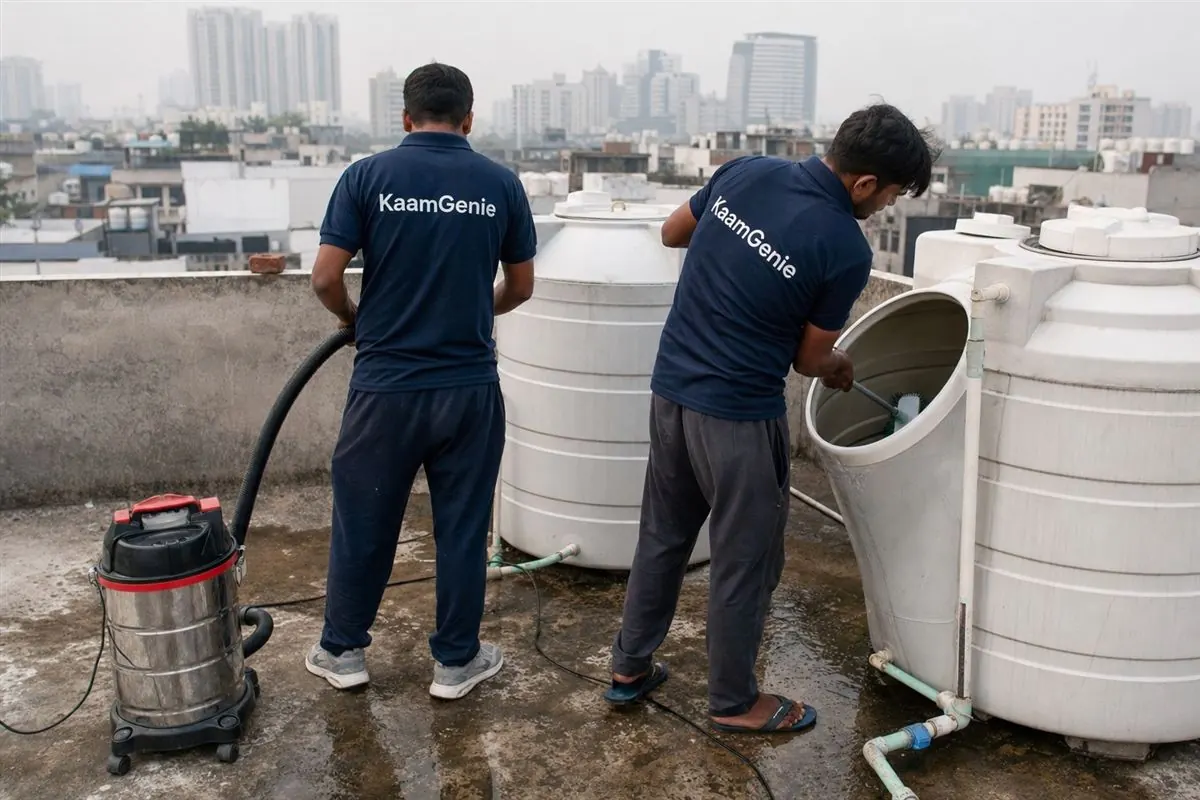
What’s included — the short version
- The cleaning steps: drain → de-sludge → scrub → jet wash → vacuum → disinfect → rinse & refill
- The deliverables: before/after photos, a dated cleaning certificate, and a proper GST bill
- The chemicals: food-grade detergent and food-grade chlorine — FSSAI-acceptable, no hardware-shop bleach
- Usually extra: the underground sump, additional tower tanks, heavy hard-water descaling, and any repairs
- Confirm before booking: how many tanks the price covers, sump included or not, descaling extra or not, and whether the fixed price holds after the crew sees the tank
Residential standard cleaning starts at ₹699 onwards. Society reservoirs, builder-floor blocks and commercial jobs are quoted on site.
Gurgaon — Gurugram — runs on stored water more than almost any city in the NCR. Across DLF colonies, the Golf Course Road and Sohna Road high-rises, the Dwarka Expressway towers and the independent builder floors of the older sectors, most homes draw hard borewell groundwater or rely on private water tankers, hold it in a big underground reservoir, and pump it up to rooftop tower tanks. That is a lot of storage between the source and your tap, and every litre of it sits in a tank that needs cleaning. So when you book water tank cleaning in Gurgaon, it is worth knowing precisely what your money buys.
| Item | In the standard price? | Notes for Gurgaon homes |
|---|---|---|
| Drain old water + shut inlet | Included | Usable water saved to a drum for non-drinking use |
| Sludge & sediment removal | Included | Iron/sand-heavy in borewell-fed tanks |
| Manual scrub + jet wash + vacuum | Included | Food-grade brushes; 100–150 PSI jet |
| Disinfection (food-grade chlorine) | Included | 50–100 PPM, FSSAI-acceptable |
| Before/after photos + certificate + GST bill | Included | Certificate accepted by AOAs/RWAs |
| Underground sump (UGR) | Usually extra | Larger volume, confined-space work |
| Each additional tower tank | Usually extra | Entry price covers one overhead tank |
| Heavy hard-water descaling | Extra | Acid wash for thick calcium/iron scale |
| Repairs (lid, gasket, valve) | Extra (flagged free) | Quoted before any work is done |
Book a real cleaning in Gurgaon
Every step documented, before/after photos, certificate and GST bill — at a fixed price. ₹699 onwards.
The cleaning steps that are always included
The core of any honest service is the physical cleaning. These seven steps are non-negotiable — they are what you are actually paying for, and they are the same whether the crew is on a Sushant Lok rooftop or in a high-rise basement reservoir off Sohna Road.
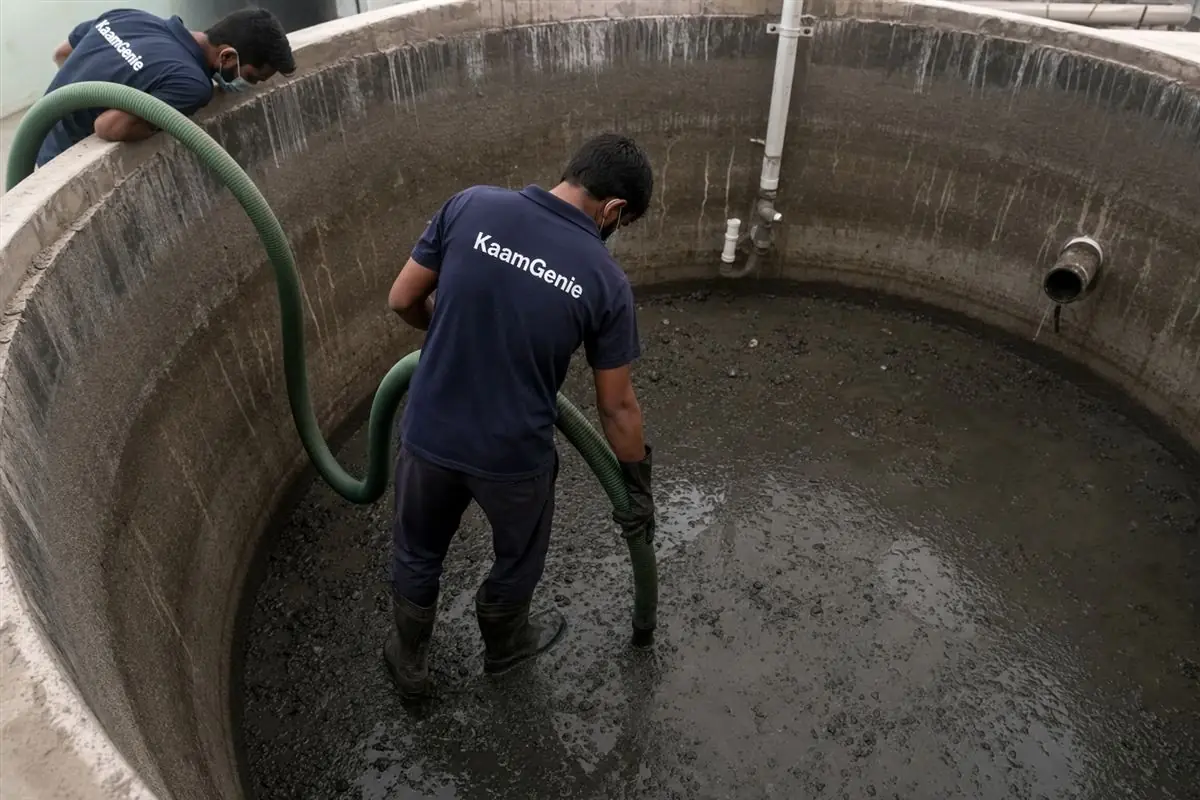
- Drain the old water. The inlet is shut so no fresh water enters mid-job, then the tank is drained. Any clean, usable water is saved into a drum for non-drinking use rather than wasted — which matters in a tanker-dependent city.
- De-sludge the floor by hand. Once empty, the layer of settled sediment at the bottom — sand, iron particles, dead insects, calcium grit — is scooped out into a sealed bucket and carried away. Borewell-fed Gurgaon tanks build this faster than most.
- Manual scrubbing. Every wall, the floor, the corners, the seams and the underside of the lid are scrubbed with food-grade nylon brushes and food-grade detergent. This is the longest step and the one that separates a real cleaning from a rinse.
- High-pressure jet wash. A 100–150 PSI jet blasts bio-film and scale out of corners, behind fittings and into lid threads where brushes cannot reach.
- Wet vacuum. An industrial wet vacuum removes the dirty residue and loosened scale so it does not redistribute into your fresh water on refill.
- Disinfection. Food-grade sodium hypochlorite (50–100 PPM) is applied to every surface and left for its contact time to kill bacteria and remaining bio-film.
- Rinse and refill. The tank is rinsed, vacuumed once more, then refilled with fresh water for a final check.
If you want the full mechanics of each step — equipment, timings and the science of the contact time — our step-by-step process guide walks through all of it. The point here is simpler: all seven steps are included in the standard price. None of them is an upsell.
The deliverables — what you receive on paper
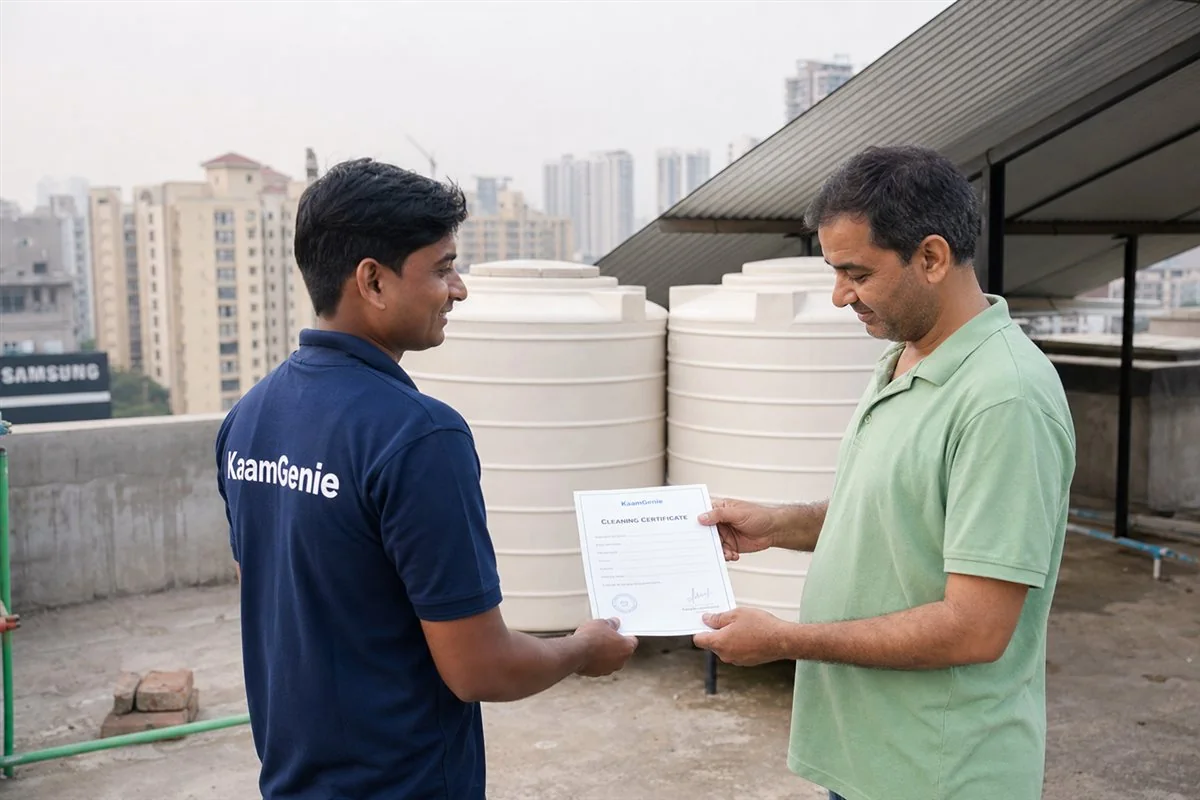
The work is only half of it. A professional service leaves behind a record. Three deliverables come included with every KaamGenie job — none of them is a separate charge:
- Before and after photos. Four to six of each, sent on WhatsApp. The before shots show the inside condition when the lid first comes off; the after shots use the same angles so the difference is obvious. For tenants and owners who are not home during the job, this is the proof the work was actually done.
- A cleaning certificate. A dated record listing tank type and capacity, chemicals used, crew names and the service date. In Gurgaon’s AOA and RWA condominiums — the DLF towers, the Golf Course Road high-rises — this is exactly what the management committee asks flat owners to produce as evidence the tank is on a maintenance schedule.
- A proper GST tax invoice. Not a handwritten slip. A GST bill matters for society accounts, for office and rental reimbursements, and as a basic sign you are dealing with a registered business rather than a one-day operator.
If a quote is cheap because it quietly drops the certificate and the bill, you are not saving money — you are losing the two documents that make the cleaning count.
The extras — what usually costs more (and why)
Honesty about extras is what separates a fair quote from a bait price. Here is what typically sits outside the entry-level residential rate in Gurgaon, and the reason for each.
The underground sump and extra tower tanks
The biggest one. Most Gurgaon homes do not have a single tank — they have an underground reservoir feeding one or more rooftop tower tanks. The headline ₹699-onwards price generally covers one overhead tank. The sump holds far more water, often needs confined-space handling, and takes 2–2.5 hours, so it is quoted separately. Every additional tower tank is its own line item too. If your home runs a sump plus two tanks, expect a combined quote — and read our underground sump cleaning guide for Gurgaon for what that work involves.
Heavy hard-water descaling
Gurgaon’s borewell groundwater is genuinely hard. Light scale comes off during the normal scrub and is included — but a tank that has run for years on untreated groundwater builds a thick crust of calcium and iron that ordinary scrubbing will not shift. That needs a dedicated descaling treatment with a stronger food-grade acid wash, which is a chargeable extra. The crew assesses the scale on arrival and tells you the cost before touching it. Our hard-water tank cleaning guide explains when descaling is worth it.
Repairs
Inspection is free and flagging faults is included — the repair itself is not. A cracked tank wall, a perished lid gasket letting dust and insects in, a leaking inlet valve, a corroded outlet: we photograph each, explain it, and quote the fix separately. We will never carry out a repair without telling you first, and we will never refill a tank over a fault we have spotted without flagging it.
Where a Gurgaon home’s cleaning budget tends to go
Illustrative split for a typical sump-plus-two-tank home — your quote depends on tank count and scale
The deliverables cost you nothing extra — the variable spend is driven by how many tanks you have and how much scale has built up. For real numbers, see our Gurgaon cost guide.
What to confirm before you book
Most billing surprises in Gurgaon come from one thing: the quote covered less than the customer assumed. The fix is a two-minute WhatsApp exchange before the crew arrives. Confirm these five points and get them in writing:
- How many tanks does the price cover? One overhead tank, or the whole system? Tell them your exact setup — sump plus how many tower tanks.
- Is the underground sump included or separate? Assume separate unless told otherwise.
- Is descaling extra? Ask what happens if heavy hard-water scale is found, and roughly what that adds.
- Do I get photos, a certificate and a GST bill? All three should be a clear yes.
- Does the fixed price hold after the crew sees the tank? A reputable service stands by its quote barring genuinely new work (extra tanks, severe scale) that you approve first. The on-site price jump is the classic cheap-operator move.
This matters whether you are in Sector 56, a high-rise on Golf Course Road, or a builder floor off Sohna Road — the questions are the same, only the tank count changes. If you are renting, our guide for tenants covers who pays and how to get the landlord to agree.
Societies, builder floors and commercial: how inclusions scale
The seven steps and three deliverables do not change for larger properties — the scope does. An AOA-managed condominium reservoir is a single large job with one combined certificate for the building’s records, usually booked as part of a recurring schedule; our society tank cleaning guide covers how committees handle it. A block of independent builder floors sharing an underground sump but with separate rooftop tanks per floor is quoted per tank plus the shared sump. Offices, clinics and restaurants in Cyber City or Udyog Vihar add FSSAI-grade documentation and after-hours scheduling. For any property that needs cleaning two or more times a year, an annual maintenance contract folds the sump, the tanks and the paperwork into one fixed schedule — see our AMC guide for Gurgaon. KaamGenie runs the same trained crews and the same food-grade chemicals across all of these as part of our wider water tank cleaning services.
Not sure what your home needs?
Tell us your setup — sump and how many tanks — and we’ll send a clear fixed quote with everything included spelled out. ₹699 onwards for a standard tank.
The bottom line on what’s included
A real water tank cleaning in Gurgaon includes the full physical job — drain, de-sludge, scrub, jet, vacuum, disinfect, rinse — with food-grade chemicals, plus three deliverables that cost you nothing extra: before/after photos, a cleaning certificate and a GST bill. What sits outside the entry price is genuine extra scope: the underground sump, additional tower tanks, heavy hard-water descaling and any repairs — all of which should be quoted openly before work starts. Get the five booking questions answered in writing and there are no surprises. To see pricing, area coverage and to book a documented cleaning, start at our Gurgaon water tank cleaning hub.
Frequently asked questions
What exactly is included in a standard water tank cleaning in Gurgaon?
A standard residential service includes draining the old water, hand-removing the sludge and sediment, manual scrubbing of every wall and the floor with food-grade brushes, a high-pressure jet wash, wet-vacuuming the dirty residue, disinfection with food-grade chlorine, a final rinse and refill, plus before/after photos, a cleaning certificate and a GST bill. Anything short of this is a rinse, not a cleaning.
Do I get before and after photos and a certificate?
Yes. Both are part of a proper KaamGenie service at no extra charge. You get 4-6 before photos and 4-6 after photos on WhatsApp, plus a dated cleaning certificate listing tank type, capacity, chemicals used and crew names. The certificate is what AOAs and RWAs in Gurgaon condominiums often ask flat owners to produce as proof of maintenance.
Is a GST bill included or is that extra?
A proper GST tax invoice is included free with every job — it is not an add-on. If a cleaner can only give you a handwritten slip or refuses a bill, that is a red flag, especially for society and commercial work where the invoice is needed for AOA accounts or office reimbursement.
Does the price include both the underground sump and the overhead tank?
Not automatically. Most Gurgaon homes run an underground reservoir (UGR) feeding rooftop tower tanks, and the entry price usually covers one overhead tank. The sump and each additional tank are quoted separately because they hold far more water and take longer. Always confirm how many tanks your quote covers before booking.
Is hard-water scale and descaling included in the basic service?
Light scale removal during scrubbing is included. But Gurgaon borewell groundwater is hard, and tanks that have run for years build thick calcium and iron scale that needs a separate descaling treatment with stronger food-grade acid wash. That is usually a chargeable extra — the crew will assess it on arrival and tell you before doing it.
Are minor repairs like a broken lid or leaking valve included?
Inspection and flagging of problems is included; the parts and repair are not. If we find a cracked tank, a missing lid gasket, a leaking inlet valve or a corroded outlet, we will photograph it and quote the fix separately. We never quietly ignore a fault, but we also never charge you for a repair without telling you first.
What chemicals are included and are they safe for drinking water?
The service includes food-grade detergent for scrubbing and food-grade sodium hypochlorite (50-100 PPM in use) for disinfection — both FSSAI-acceptable for potable water systems. We never use hardware-shop industrial bleach. After the contact time the tank is rinsed and vacuumed so no chemical residue is left beyond minimal safe levels.
How long does an included standard cleaning take in Gurgaon?
A single residential overhead tank up to 1,000 litres takes about 75-90 minutes end to end. An underground sump takes 2-2.5 hours. A society reservoir or a builder-floor block with multiple tanks runs longer and is scheduled accordingly. If a crew finishes a real cleaning in 20 minutes, steps were skipped.
What should I confirm before booking so there are no surprises?
Confirm five things: how many tanks the quoted price covers, whether the underground sump is included, whether descaling is extra, whether photos plus certificate plus GST bill are provided, and whether the same fixed price applies after the crew sees the tank. Getting these in writing on WhatsApp avoids the on-site price jump that cheap operators rely on.
Sources & references
- Bureau of Indian Standards (BIS) — IS 10500:2012 is the canonical Indian Standard for drinking water specification, defining acceptable limits for physical, chemical, and biological parameters.
- WHO Guidelines for Drinking-water Quality, 4th edition — the global reference for water quality standards, including guidance on storage and disinfection.
- Food Safety and Standards Authority of India (FSSAI) — defines water quality requirements for food businesses, including hygiene standards for stored water and acceptable disinfection chemicals.
- WHO Fact Sheet on Drinking Water — overview of safe drinking water requirements and contamination risks.
- CPHEEO — Manual on Water Supply and Treatment — the Government of India’s engineering manual covering tank design, cleaning protocols, and disinfection practices.
Last verified: 30 June 2026. If you find any of these links broken, please let us know.