
Water Tank Disinfection Explained
Raj Babbar · 10 min read
Home › Water Tank Cleaning › Overhead Tank Cleaning › Mustafabad
The borewell water under Mustafabad is some of the hardest in North-East Delhi, thick with dissolved iron that never fully disappears down the tap. Every time a rooftop tank refills, a little more of that iron settles out and stains the plastic a rusty brown. Cleaning an overhead tank here starts from ₹699.
What comes up the borewell in this belt is very hard, iron-loaded water, and a rooftop tank is where its true colour shows. As the water sits, the iron oxidises and drops to the base as a rust-coloured sludge while a mineral scale hardens on the walls. Off Karawal Nagar Road the buildings are wall-to-wall builder floors, each with a small 500 to 1000 litre plastic tank shared across several families. Those tanks refill many times a day, so the staining builds quickly and the water starts to smell metallic before long. Most owners only look inside once the supply has gone visibly cloudy or brown. Our job is to strip that back: we empty the tank, scrub the rust and scale off by hand, vacuum the base clean, and finish with an anti-bacterial disinfectant wash.
This page focuses on the overhead and rooftop tanks sitting on your terrace, the plastic tanks that catch the worst of the iron. For our complete service across sumps and ground tanks too, see water tank cleaning in Mustafabad. We bring our own ladder, pump and vacuum, so we do not need anything from the building except roof access. A single terrace tank is usually done inside an hour, and buildings with several tanks get a bulk discount. We hand over before-and-after photos so you can see the rusty base come back to clean plastic.
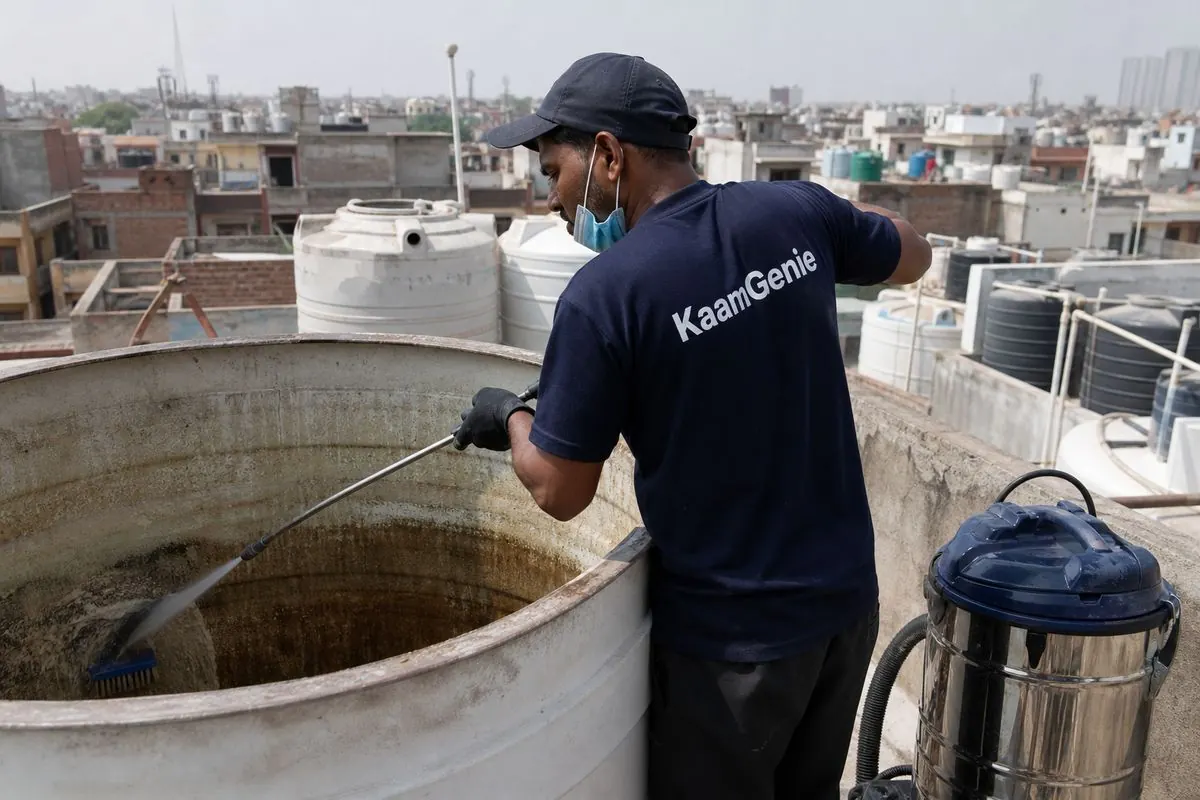
The first thing residents notice is colour. Water drawn in the morning runs faintly brown or leaves an orange ring in the bucket, and that comes straight from iron settling inside the rooftop tank. Left in place, the rust layer thickens on the base and the scale on the walls grows rougher, which only holds more sediment next time. By the time the water looks bad, the tank has usually been dirty for a while.
Density makes it worse. In these lanes one tank often supplies many families across several floors, so it is drawn down and refilled constantly and never stays still long enough for anyone to spot the buildup. A hard-working shared tank in this belt really needs cleaning every three months. That keeps the metallic smell and the brown first-draw away and the water safe to drink and cook with.
No travel charge anywhere in Mustafabad. The final price is confirmed on the call before we come — it depends only on tank size and access.
See it done in 45 seconds
Watch our web story on how a tank is really cleaned — drain, de-sludge, jet-wash, disinfect.
We reach every pocket of Mustafabad — and there’s no travel charge to any of them:
Every locality in Delhi stores different water, and that decides how fast a tank fouls. This is Mustafabad’s profile from The Delhi Water Index, built from our field observations across 250+ localities.
Indicative field characterisation, not a certified lab test. BIS IS 10500: TDS 500 mg/L acceptable, 2,000 permissible. Check any Delhi area →
“Is the rusty water from my tank safe to use?” Iron staining looks alarming but the bigger risk is the sediment and bacteria that collect with it. A proper drain, scrub and anti-bacterial disinfectant wash removes the layer the germs live in and clears the colour. After a clean the first draw runs clear again.
“Can you come the same day in Mustafabad?” Usually yes, we cover this belt daily and can often fit a same-day slot if you call in the morning. If the day is full we will give you the next available time. A single rooftop tank does not take long, so we can slot it in easily.
“Can you get the rust stains off an old plastic tank?” We scrub the walls and base by hand to lift the iron layer and loose scale, and most tanks come back close to their original colour. Very deep-set staining on old plastic may leave a faint tint, but the tank is fully cleaned and disinfected. We will show you the result in the photos.
“How do I book a clean?” Call or WhatsApp us with your building location off Karawal Nagar Road and the number of tanks. We confirm a time, arrive with our own ladder and equipment, and you pay after the job. There is nothing to arrange at your end beyond roof access.
“How often does a Mustafabad tank need doing?” With water this hard and tanks this busy, every three months is the safe interval. Buildings with fewer families can stretch a little longer. We are happy to flag when your next clean is due.
See our complete water tank cleaning services in Delhi NCR — pricing, process, tank types and full city coverage.
Beyond water tank cleaning, KaamGenie is rolling out a full lineup of home services across Delhi NCR — see our complete list of 12 home services we offer or will be launching through 2026. New to tank cleaning? Read our guide on how to pick the right water tank cleaning service in Delhi — what to look for, what to avoid, and the questions that separate trustworthy crews from quick-job operators.
Rooftop plastic tanks
₹699+ →Kothi sumps & underground tanks
₹1,499+ →Apartments & RWAs
Bulk pricing →FSSAI-compliant cleaning
₹2,500+ →टंकी साफ़ करने वाले
हिन्दी पढ़ें →View all water tank cleaning guides →
All pockets and lanes of Mustafabad covered. If your specific block or society isn’t named in the sub-areas above, just call — we almost certainly cover it.
Same crew, same 6-step process, same-day where possible. Pick any locality below for local pricing and the tanks we typically find there.
Book a slot — we can usually fit you in today or tomorrow.