
How Often Should You Clean Your Water Tank?
Raj Babbar · 7 min read
Home › Water Tank Cleaning › Overhead Tank Cleaning › Roop Nagar
A Roop Nagar landlord recently found his rooftop tank lid propped half-open, dust settling on the water his tenants were drinking. It is a common sight in this student pocket, where tanks refill all day and covers rarely stay shut. KaamGenie sets it right. From ₹699.
Roop Nagar is a compact residential pocket right next to Delhi University's North Campus, and many of its older independent houses and floors have been converted into student PGs and rentals. The tanks are fed by DJB piped water lifted onto the roof, and with high student occupancy they refill repeatedly through the day as the floors draw water. All that refilling keeps sediment stirred rather than settled, so the water carries a faint permanent haze. The bigger problem is the lids: on busy student blocks they are often left ajar or slid aside and never replaced. Open covers let terrace dust, insects and algae spores straight into the water. Between the churn and the open lids, these tanks need cleaning on a far tighter schedule than the family homes they used to be.
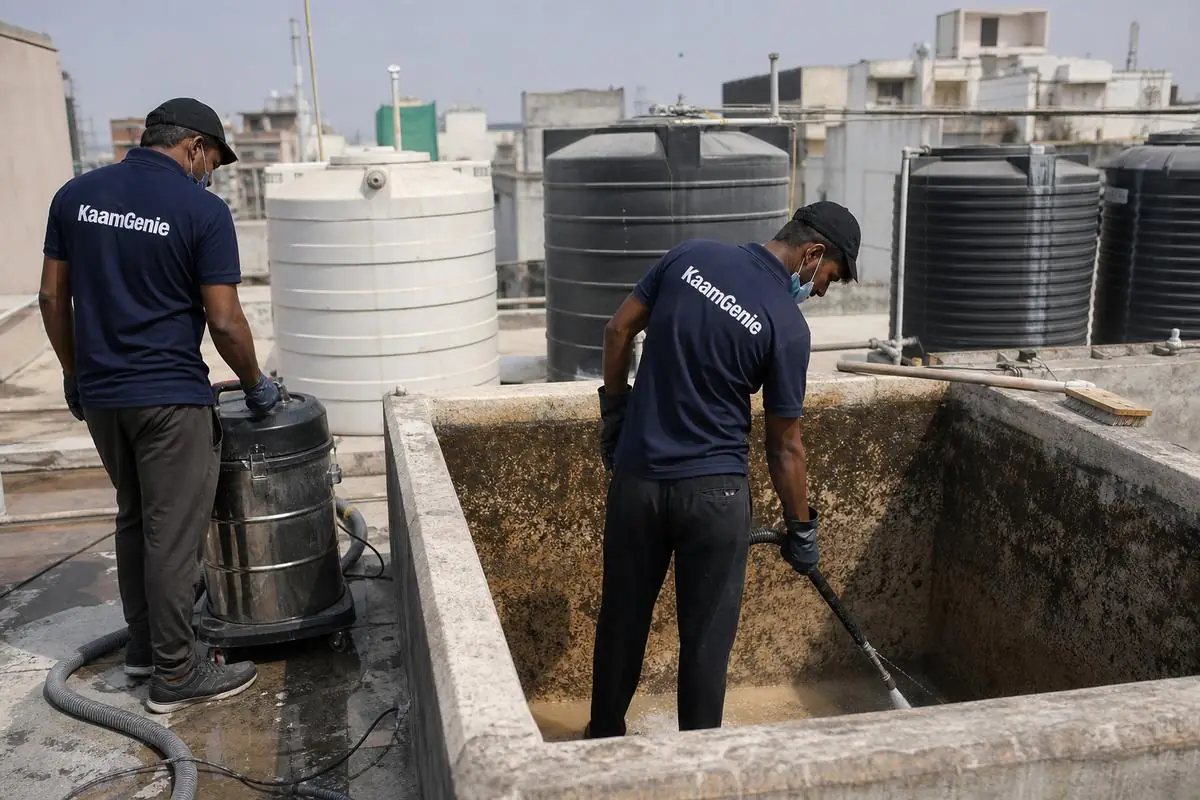
We give these hard-worked rooftop tanks a proper clean. The crew drains the tank, removes the settled sludge, jet-washes the walls, hand-scrubs the corners and inlet where film gathers, then finishes with an anti-bacterial disinfectant wash before refilling, and reseats the lid on the way out. Owners get dated before-and-after photos on WhatsApp. This page is part of our wider water tank cleaning in Roop Nagar service and is specifically about the overhead (rooftop) tanks feeding the taps.
Open lids do most of the damage here. A rooftop tank left uncovered over a dusty campus lane takes in grit, leaf litter, insects and algae spores that a sealed tank never would, and warm daylight reaching the water speeds algae growth on top. The result is a tank that fouls not from bad supply but from simple exposure. Getting the lid shut and the tank cleaned together is what actually holds the improvement.
The student turnover adds the churn. With a floor of tenants drawing water all day, the tank refills constantly and never lets its sediment settle and stay down, so the grit rides through the taps. Nobody among the short-stay residents feels responsible for opening and checking the tank, so it goes unattended even as it is worked hard. For a converted family home now housing a dozen students, cleaning every four to six months is the sensible pace.
No travel charge anywhere in Roop Nagar. The final price is confirmed on the call before we come — it depends only on tank size and access.
See it done in 45 seconds
Watch our web story on how a tank is really cleaned — drain, de-sludge, jet-wash, disinfect.
We reach every pocket of Roop Nagar — and there’s no travel charge to any of them:
Every locality in Delhi stores different water, and that decides how fast a tank fouls. This is Roop Nagar’s profile from The Delhi Water Index, built from our field observations across 250+ localities.
Indicative field characterisation, not a certified lab test. BIS IS 10500: TDS 500 mg/L acceptable, 2,000 permissible. Check any Delhi area →
“The tank lid keeps getting left open. Can you help keep it sealed?” Yes. When we finish we reseat the lid properly, and if the existing cover is broken or missing we will tell you the right size to buy and fit it next time. A sealed lid is half the fight in Roop Nagar, because most of the dust and insects here get in through open covers rather than the supply.
“There are insects in my rooftop tank. Is that normal, and can you clear it?” It is common when the lid has been left open, and yes, we clear it. We drain the tank, remove anything that has got in, scrub and jet-wash the walls, then apply an anti-bacterial disinfectant wash. Once the tank is clean and the lid is sealed the problem usually does not come back until the cover is left open again.
“How often should a student-let tank be cleaned?” Every four to six months for a PG or student block, rather than once a year. The constant refilling and the open lids mean sediment and algae return faster than in a family home. Many Roop Nagar owners put us on a standing cycle so the water stays clear without them having to chase it.
“Can you schedule it when the students are out?” We usually clean in the late morning when most tenants are at classes or coaching, so the water is off at the quietest time and back before the evening rush. A single block tank takes about ninety minutes to two hours. Tell us your block's routine and we will fit around it.
“What does it cost for a converted-house rooftop tank?” A single 500-litre tank starts at ₹699 and a 1,000-litre one is ₹899. Larger shared tanks of 1,001 to 2,000 litres are ₹1,299 to ₹1,499. To clean every tank on the building in one visit we quote ₹2,400 to ₹3,000 with a bulk discount for four or more.
See our complete water tank cleaning services in Delhi NCR — pricing, process, tank types and full city coverage.
Beyond water tank cleaning, KaamGenie is rolling out a full lineup of home services across Delhi NCR — see our complete list of 12 home services we offer or will be launching through 2026. New to tank cleaning? Read our guide on how to pick the right water tank cleaning service in Delhi — what to look for, what to avoid, and the questions that separate trustworthy crews from quick-job operators.
Rooftop plastic tanks
₹699+ →Kothi sumps & underground tanks
₹1,499+ →Apartments & RWAs
Bulk pricing →FSSAI-compliant cleaning
₹2,500+ →टंकी साफ़ करने वाले
हिन्दी पढ़ें →View all water tank cleaning guides →
All pockets and lanes of Roop Nagar covered. If your specific block or society isn’t named in the sub-areas above, just call — we almost certainly cover it.
Same crew, same 6-step process, same-day where possible. Pick any locality below for local pricing and the tanks we typically find there.
Book a slot — we can usually fit you in today or tomorrow.