
Water Tank Cleaning Rules & Norms
Raj Babbar · 9 min read
Home › Water Tank Cleaning › Sintex / Plastic Tank Cleaning › Alipur
Alipur’s borewell water runs iron-tinged, and it shows — orange-stained plastic tank walls, rust-flavoured water and washing that never looks quite white. KaamGenie removes the iron staining and sediment from Sintex and plastic tanks across the town, the farmhouses and the GT Road front. From ₹699.
Alipur is the rural-belt town on GT Karnal Road toward the Singhu border — the old village core, new builder floors, roadside commercial serving the highway economy, and a farmhouse belt on the Palla side. The borewell water is hard and distinctly iron-tinged: it arrives clear, then oxidises in the tank into the orange-brown staining Alipur residents know on their buckets, their bathroom fittings and — most visibly — the once-blue walls of their plastic tanks. Homes run large tanks against unpredictable supply, which gives the iron all the standing time it needs.
KaamGenie’s clean reverses what the iron has done — drain, wet-vacuum the rust-brown sediment, treat and scrub the orange staining off the walls with plastic-safe methods, jet-wash, then a anti-bacterial disinfectant rinse with before-after photos that show the original wall colour again. Farmhouse estates with multiple tanks get one coordinated multi-tank visit. Sumps and other storage are on water tank cleaning in Alipur; this page covers the plastic tanks.
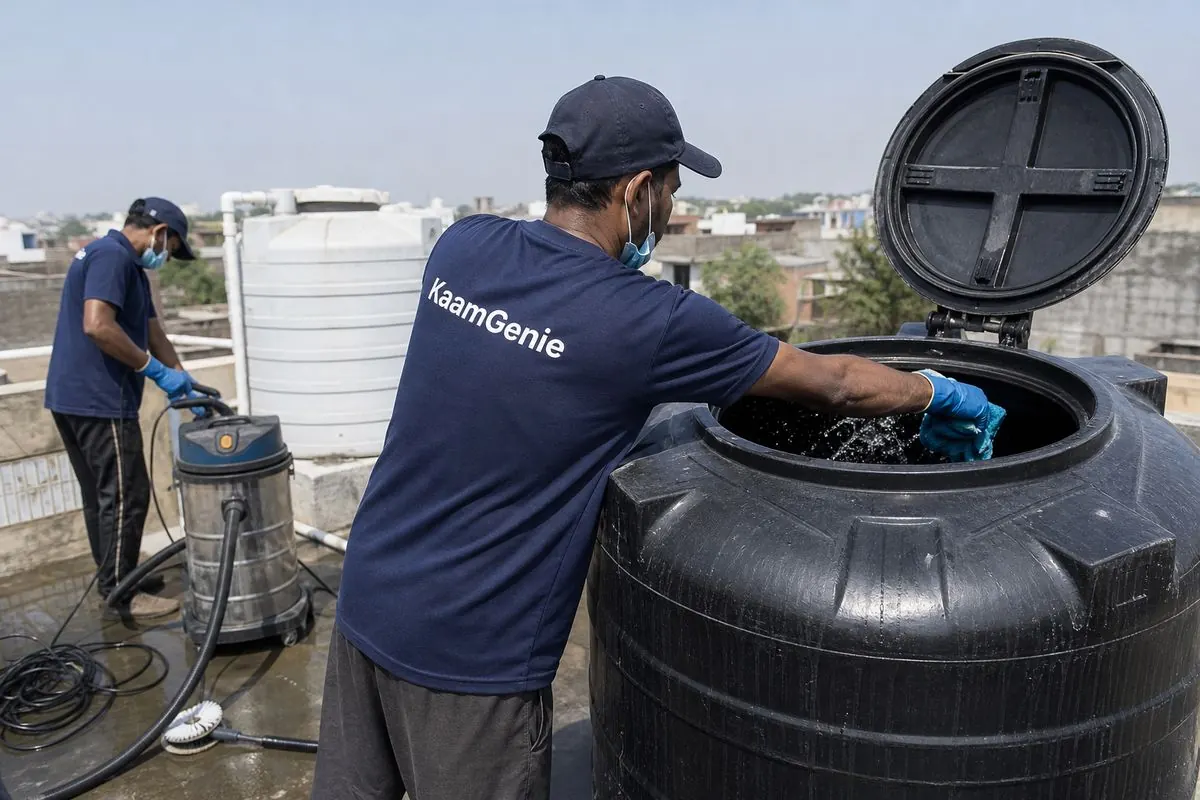
Dissolved iron is invisible when the borewell delivers it, but standing in a warm rooftop tank it oxidises — effectively rusting inside your water — and precipitates as the orange-brown particles that settle on the floor and cling to plastic walls. A translucent tank in full sun accelerates the reaction, and because Alipur homes keep large tanks full against supply gaps, the water gets long standing hours. The staining then works into the plastic’s surface, which is why household scrubbing lightens it but never quite removes it.
Layered under the iron is the ordinary hard-water story — calcium scale on the ribbed floor, heavier in the biggest tanks — and over it all, on the GT Road front, the grit of a working truck corridor drifting into any unsealed lid. The farmhouse belt runs the same water through multi-tank estate setups, staff quarters included, where one neglected tank quietly serves the most people. We clean those the way we do the southern farmhouse zones: every tank on the property, one visit, one documented report.
No travel charge anywhere in Alipur. The final price is confirmed on the call before we come — it depends only on tank size and access.
See it done in 45 seconds
Watch our web story on how a tank is really cleaned — drain, de-sludge, jet-wash, disinfect.
We reach every pocket of Alipur — and there’s no travel charge to any of them:
Every locality in Delhi stores different water, and that decides how fast a tank fouls. This is Alipur’s profile from The Delhi Water Index, built from our field observations across 250+ localities.
Indicative field characterisation, not a certified lab test. BIS IS 10500: TDS 500 mg/L acceptable, 2,000 permissible. Check any Delhi area →
“Can the orange staining inside our tank actually be removed?” Mostly, yes. Fresh iron staining comes off fully; staining that has worked into the plastic over years lightens dramatically but may leave a faint shadow at the deepest points. Either way the loose rust sediment, the scale under it and the film over it all come out, and the before-after photos will show you the difference honestly.
“Will the tank stain again after cleaning?” Gradually, yes — the iron is in the borewell water, so it returns over months. What the clean changes is that it starts from a smooth, sediment-free surface instead of an established rust bed, so it builds far slower. On Alipur’s water we recommend a clean every six months; many households pair it with an iron-removal filter at the inlet.
“Do you cover the farmhouses on the Palla side?” Yes, the farmhouse belt is a regular part of our Alipur round. Estate properties typically run several tanks — main house, staff quarters, garden lines — and we clean all of them in one coordinated visit at a per-tank rate, with a single report covering the property. Caretakers can manage the whole visit if the owner is away.
“What does the service cost?” ₹699 for tanks up to 500 litres and ₹899 for 501-1,000L; Alipur’s common larger tanks are quoted per size before we start. Iron-stain treatment is part of the standard clean here, not a surcharge. Farmhouse multi-tank visits get per-tank rates that drop as the count rises.
“Can you come the same day this far up GT Road?” Usually, if you call before 10 AM on 95603 66362 — Alipur closes our GT Road run past Samaipur and Badli, so morning bookings ride the same route. For farmhouse multi-tank visits we prefer a day’s notice to allot enough crew time; single household tanks fit same-day slots readily.
See our complete water tank cleaning services in Delhi NCR — pricing, process, tank types and full city coverage.
Beyond water tank cleaning, KaamGenie is rolling out a full lineup of home services across Delhi NCR — see our complete list of 12 home services we offer or will be launching through 2026. New to tank cleaning? Read our guide on how to pick the right water tank cleaning service in Delhi — what to look for, what to avoid, and the questions that separate trustworthy crews from quick-job operators.
Rooftop plastic tanks
₹699+ →Kothi sumps & underground tanks
₹1,499+ →Apartments & RWAs
Bulk pricing →FSSAI-compliant cleaning
₹2,500+ →टंकी साफ़ करने वाले
हिन्दी पढ़ें →View all water tank cleaning guides →
All pockets and lanes of Alipur covered. If your specific block or society isn’t named in the sub-areas above, just call — we almost certainly cover it.
Same crew, same 6-step process, same-day where possible. Pick any locality below for local pricing and the tanks we typically find there.
Book a slot — we can usually fit you in today or tomorrow.