
How Often Should You Clean Your Water Tank?
Raj Babbar · 7 min read
Home › Water Tank Cleaning › Sintex / Plastic Tank Cleaning › Maurya Enclave
The metro corridor’s construction dust is Maurya Enclave’s standing complaint — a fine grey grit that settles on every rooftop and works into every plastic tank whose lid is less than perfect. KaamGenie removes it with the uniformed, photographed service this colony expects. From ₹699.
Maurya Enclave is the premium plotted pocket of the Pitampura belt along Madhuban Chowk’s inner lanes — large rebuilt family homes of trading and professional families, with lifts, stilt parking and basements standard, and sump-plus-rooftop water systems to match. The recurring contamination complaint here is specific: construction dust off the nearby metro corridor works, a fine cement-grey grit that drifts over the lanes, settles on roofs and lids, and shows up as a pale sediment in tanks that were cleaned barely a year before. Expectations run accordingly — uniformed crews, before-after photos, fixed schedules.
KaamGenie serves the colony on those terms. The clean covers the plastic rooftop tanks fully — drain, wet-vacuum the cement-fine sediment before it hardens, plastic-safe jet wash, soft-pad scrub, anti-bacterial disinfectant rinse — delivered by a uniformed crew with per-tank photos, and we check the lid seat on every tank because the metro dust enters exactly there. Sumps and the full chain are covered on water tank cleaning in Maurya Enclave; this page is for the Sintex and plastic tanks.
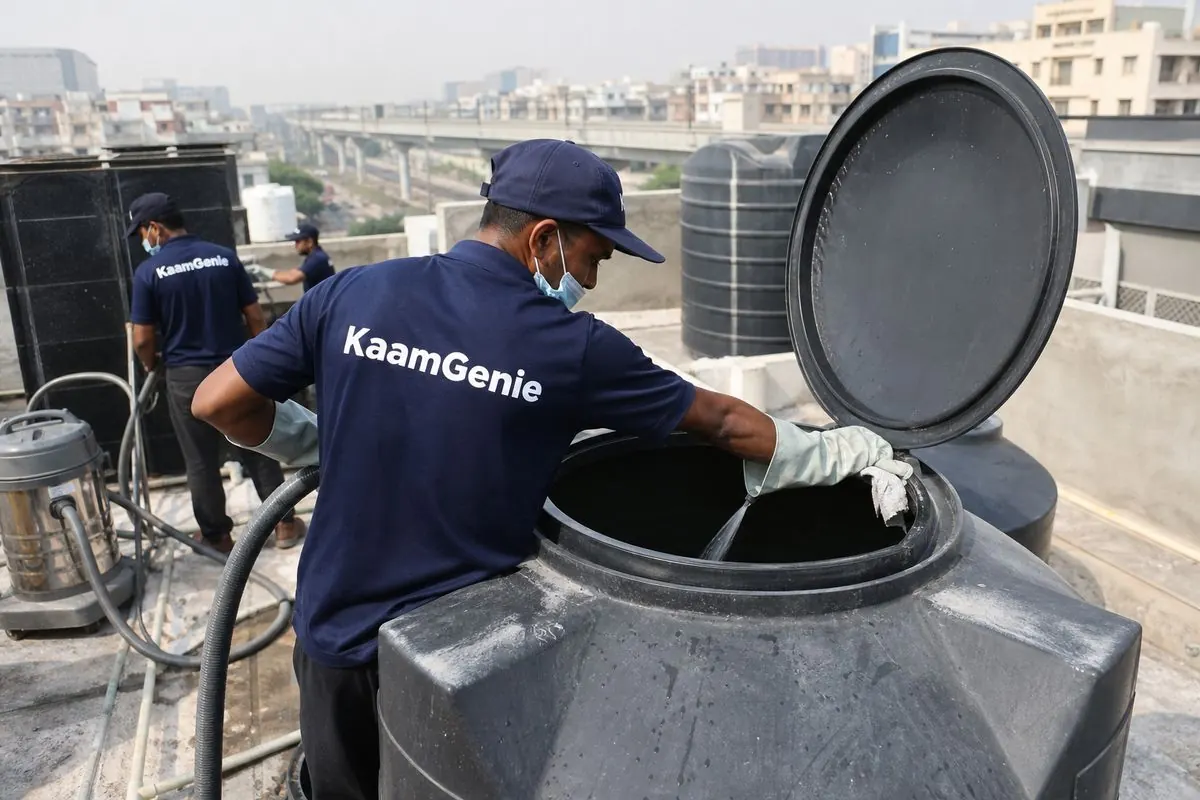
Construction dust is finer than road dust — fine enough to hang in the air across several lanes and to slip through the smallest gap where a lid has warped in the sun or was never re-seated after the last plumber. In the tank it behaves badly: cement fines settle into the ribbed floor grooves and, given damp and time, begin to harden the way cement does, bonding with the hardness scale already there. A tank collecting metro dust for a year carries a pale, part-set layer that household rinsing does not touch and that only gets more stubborn with waiting.
The colony’s twin-tank premium systems add the standing-time factor — generous storage means slower turnover, and slow-turning water in sunlit translucent tanks builds film on top of the settling grit. Our recommendation while corridor works continue is a six-monthly cycle rather than annual, with the lid check each visit; once the construction ends, homes on our schedule drop back to the yearly date automatically. Either way the photos each visit let you see exactly how much the corridor is sending your way.
No travel charge anywhere in Maurya Enclave. The final price is confirmed on the call before we come — it depends only on tank size and access.
See it done in 45 seconds
Watch our web story on how a tank is really cleaned — drain, de-sludge, jet-wash, disinfect.
We reach every pocket of Maurya Enclave — and there’s no travel charge to any of them:
Every locality in Delhi stores different water, and that decides how fast a tank fouls. This is Maurya Enclave’s profile from The Delhi Water Index, built from our field observations across 250+ localities.
Indicative field characterisation, not a certified lab test. BIS IS 10500: TDS 500 mg/L acceptable, 2,000 permissible. Check any Delhi area →
“We cleaned the tank last year and there is already grey sediment. Why?” That is the metro corridor’s construction dust — fine enough to enter around an imperfect lid and heavy in the air while works continue. It is not a failed clean; it is a faster-than-normal deposit rate. We recommend six-monthly cleans until the corridor work ends, and we re-seat or flag the lid each visit to slow the entry.
“Is your crew presentable for a gated home visit?” Yes — uniformed, carrying company ID, arriving in the booked slot with all equipment carried in, not dragged. We cover the stair route, keep the roof tidy and leave no wash-water mess on the stilt parking. Most of our Maurya Enclave homes came by referral, which we take as the standard to keep.
“What does the service cost?” ₹699 per plastic tank up to 500 litres, ₹899 for 501-1,000L; twin-tank homes get a package quote with the sump if you want the full chain done. Fixed-schedule homes lock their rate for the cycle. Photos and the dated quality report come with every tank, every visit.
“Can the cement-like layer be removed once it has hardened?” Yes, though it takes more than a rinse — we soften the part-set layer, work the ribbed grooves with pads and vacuum the residue, at pressures safe for plastic. The earlier we get to it the easier it comes out, which is the practical argument for the six-monthly cycle while corridor works continue.
“How quickly can you come?” Call before 10 AM on 95603 66362 for a same-day slot — Maurya Enclave is minutes off our daily Pitampura-belt route. Scheduled homes book fixed dates a cycle ahead; for a first visit we can usually offer the same day or the next morning, timed to your household’s convenience.
See our complete water tank cleaning services in Delhi NCR — pricing, process, tank types and full city coverage.
Beyond water tank cleaning, KaamGenie is rolling out a full lineup of home services across Delhi NCR — see our complete list of 12 home services we offer or will be launching through 2026. New to tank cleaning? Read our guide on how to pick the right water tank cleaning service in Delhi — what to look for, what to avoid, and the questions that separate trustworthy crews from quick-job operators.
Rooftop plastic tanks
₹699+ →Kothi sumps & underground tanks
₹1,499+ →Apartments & RWAs
Bulk pricing →FSSAI-compliant cleaning
₹2,500+ →टंकी साफ़ करने वाले
हिन्दी पढ़ें →View all water tank cleaning guides →
All pockets and lanes of Maurya Enclave covered. If your specific block or society isn’t named in the sub-areas above, just call — we almost certainly cover it.
Same crew, same 6-step process, same-day where possible. Pick any locality below for local pricing and the tanks we typically find there.
Book a slot — we can usually fit you in today or tomorrow.