
Water Tank Disinfection Explained
Raj Babbar · 10 min read
Home › Water Tank Cleaning › Sintex / Plastic Tank Cleaning › Gulabi Bagh
When the water in a Gulabi Bagh home turns cloudy, the plastic Sintex tank on the crowded roof is usually already coated. KaamGenie cleans it gently, hygienically and with before-and-after photos. From ₹699.
In Gulabi Bagh, residents tend to notice the tank only when the water clouds at the tap, and by then the problem is well set. This dense middle-class North Delhi colony of independent houses and stacked builder floors runs largely on DJB piped water lifted into rooftop tanks, many of them Sintex or plastic. The tightly built plots and multi-family occupancy mean these tanks are used hard through the day, yet they sit forgotten on crowded roofs between fills. A translucent plastic tank passes rooftop sunlight into the water and warms it, so a slow algae film grows, while the older pipes on some plots add rust and settled silt for the film to grip. All of it accumulates out of sight. The heavy usage keeps sediment stirred so it never settles cleanly, and the cloudy water at the tap is simply the point where the build-up finally shows, which is exactly when a mechanical clean is overdue.
Our plastic-safe method clears it properly: we check the tank and lid, drain it, scoop the slimy sediment off the bottom, wet-vacuum the residue, jet-wash at a pressure set for plastic and hand-scrub the algae with soft pads, then finish with an anti-bacterial disinfectant wash and photograph before and after. Where a Gulabi Bagh building also has a sump or an RCC tank to see to, our full water tank cleaning in Gulabi Bagh handles them. This page focuses on Sintex and plastic tanks.
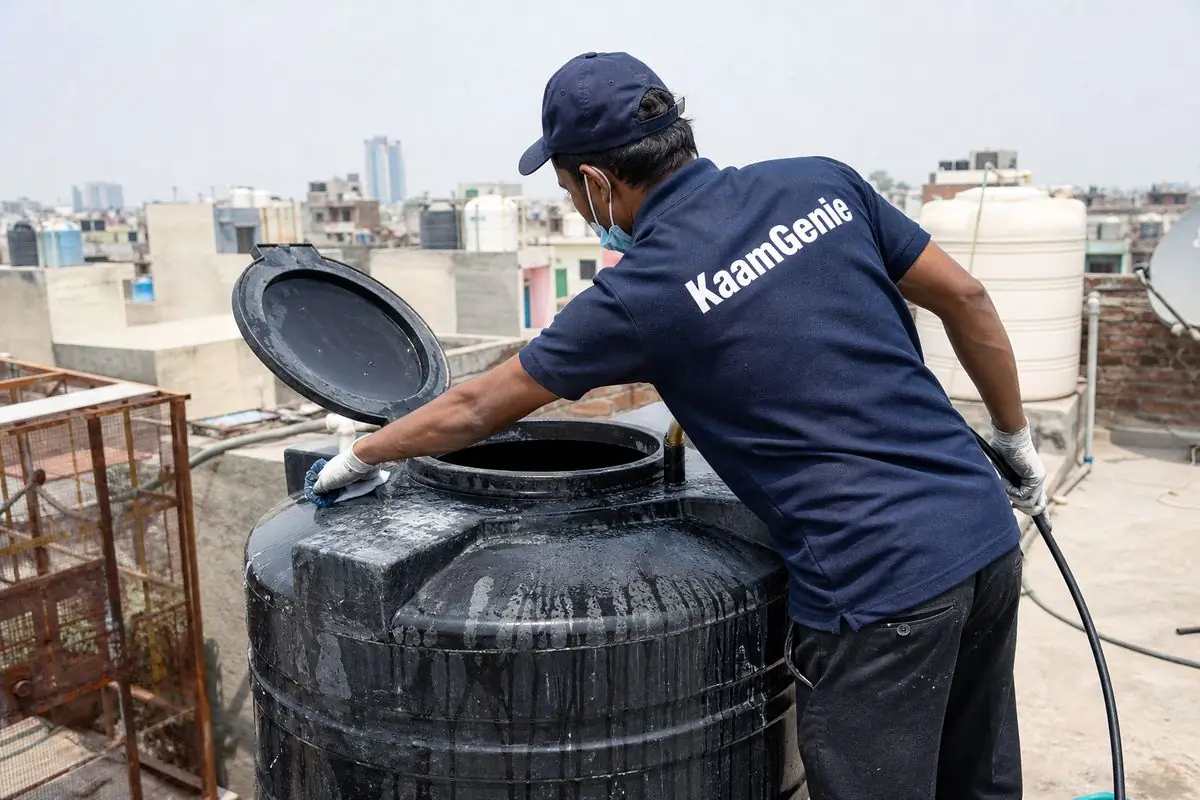
Cloudy water is sediment on the move. In a Gulabi Bagh tank used hard by several families, the constant drawing and refilling keeps fine silt and rust suspended rather than settled, so it comes through at the tap as cloudiness. The heavier the multi-family usage, the more the water is stirred, and a plastic tank on a crowded roof rarely gets the still time that would let the sediment drop out of the way.
Underneath that is the algae the plastic invites. A translucent Sintex wall lets rooftop sunlight into the water and warms it, growing a film that a dark concrete tank would resist, and on the older plots here rust from ageing pipes gives that film a rough surface to hold. Because the tanks sit forgotten on tight, crowded roofs, nobody disturbs the build-up. Film, rust and stirred silt accumulate together, and the cloudy tap is the first hint most residents get that the tank is due a clean.
No travel charge anywhere in Gulabi Bagh. The final price is confirmed on the call before we come — it depends only on tank size and access.
See it done in 45 seconds
Watch our web story on how a tank is really cleaned — drain, de-sludge, jet-wash, disinfect.
We reach every pocket of Gulabi Bagh — and there’s no travel charge to any of them:
Every locality in Delhi stores different water, and that decides how fast a tank fouls. This is Gulabi Bagh’s profile from The Delhi Water Index, built from our field observations across 250+ localities.
Indicative field characterisation, not a certified lab test. BIS IS 10500: TDS 500 mg/L acceptable, 2,000 permissible. Check any Delhi area →
“Our tap water has gone cloudy, does that mean the tank is dirty?” Very often, yes. Cloudy water is usually sediment stirred up inside the tank by heavy household use. Once we scoop, vacuum and jet-wash that sediment out and disinfect the tank, the standing water stops carrying it, so the tap runs clear again. If it stays cloudy after a clean, the issue may be upstream in the supply.
“Several families share our building’s tank, how should we split a clean?” That is up to the building, but the clean is priced by the tank, not per family. A shared rooftop Sintex is one job regardless of how many homes it feeds, so the households usually split the single tank charge between them. We send the photos to whoever books so everyone can see it was done.
“How often does a hard-used family-block tank need cleaning?” With multi-family usage keeping it busy, every four to six months keeps a Gulabi Bagh tank from clouding the water. If the plumbing is old and rust-prone, a slightly closer interval helps, since the rust adds to what the algae grips onto inside the tank.
“What does it cost for a rooftop Sintex here?” A 500 litre Sintex is ₹699, a standard 1000L is ₹899, and a 1000 to 2000 litre tank runs ₹1,299 to ₹1,499. If the building keeps more than one plastic tank, a bulk per-tank rate applies, bringing the whole-building cost down.
“Will you show us what the inside looked like?” Yes. We photograph the tank before we start and again after the clean, so you can see the film and sediment that came out and the clean, rinsed inside we hand back. For a shared building tank that many families rely on, those before-and-after photos are a straightforward way to confirm the job was done properly.
See our complete water tank cleaning services in Delhi NCR — pricing, process, tank types and full city coverage.
Beyond water tank cleaning, KaamGenie is rolling out a full lineup of home services across Delhi NCR — see our complete list of 12 home services we offer or will be launching through 2026. New to tank cleaning? Read our guide on how to pick the right water tank cleaning service in Delhi — what to look for, what to avoid, and the questions that separate trustworthy crews from quick-job operators.
Rooftop plastic tanks
₹699+ →Kothi sumps & underground tanks
₹1,499+ →Apartments & RWAs
Bulk pricing →FSSAI-compliant cleaning
₹2,500+ →टंकी साफ़ करने वाले
हिन्दी पढ़ें →View all water tank cleaning guides →
All pockets and lanes of Gulabi Bagh covered. If your specific block or society isn’t named in the sub-areas above, just call — we almost certainly cover it.
Same crew, same 6-step process, same-day where possible. Pick any locality below for local pricing and the tanks we typically find there.
Book a slot — we can usually fit you in today or tomorrow.