
Waterborne Diseases & Tank Cleaning
Raj Babbar · 10 min read
Home › Water Tank Cleaning › Sintex / Plastic Tank Cleaning › Sadar Bazar
Above Sadar Bazar’s wholesale lanes, a small Sintex tank sits caked in market dust and diesel haze, barely ever opened. KaamGenie cleans it gently, hygienically and with photos. From ₹699.
Look up from the crush of Sadar Bazar, one of Delhi’s largest wholesale markets, and you see small terrace tanks perched above a maze of shopfronts, godowns and cramped upper-floor dwellings. Many are Sintex or plastic, running on intermittent DJB supply and sitting fully exposed to the market’s constant grime and diesel haze. Between the set supply hours the water stands in these small tanks, and in a translucent plastic shell it warms in the daylight through the walls, so an algae film grows. On top of that, the dust and soot that hang over the trading lanes settle in through lids left loose above the roofs. With business owners focused on trade and living quarters squeezed onto the terraces, the tanks are almost never opened. Road dust, soot and green film cake the walls together until the water is visibly fouled, which in a market where nobody has time to check can take a long while.
The plastic-safe clean is straightforward on these market tanks: we open and check the tank and lid, drain it, scoop the caked dust-laden sediment off the bottom, wet-vacuum the residue, jet-wash at a plastic-safe pressure and scrub the film with soft pads, then an anti-bacterial disinfectant wash and photos before and after. Where a Sadar Bazar building has a larger tank or a sump as well, our full water tank cleaning in Sadar Bazar covers it. This page is about the Sintex and plastic terrace tanks.
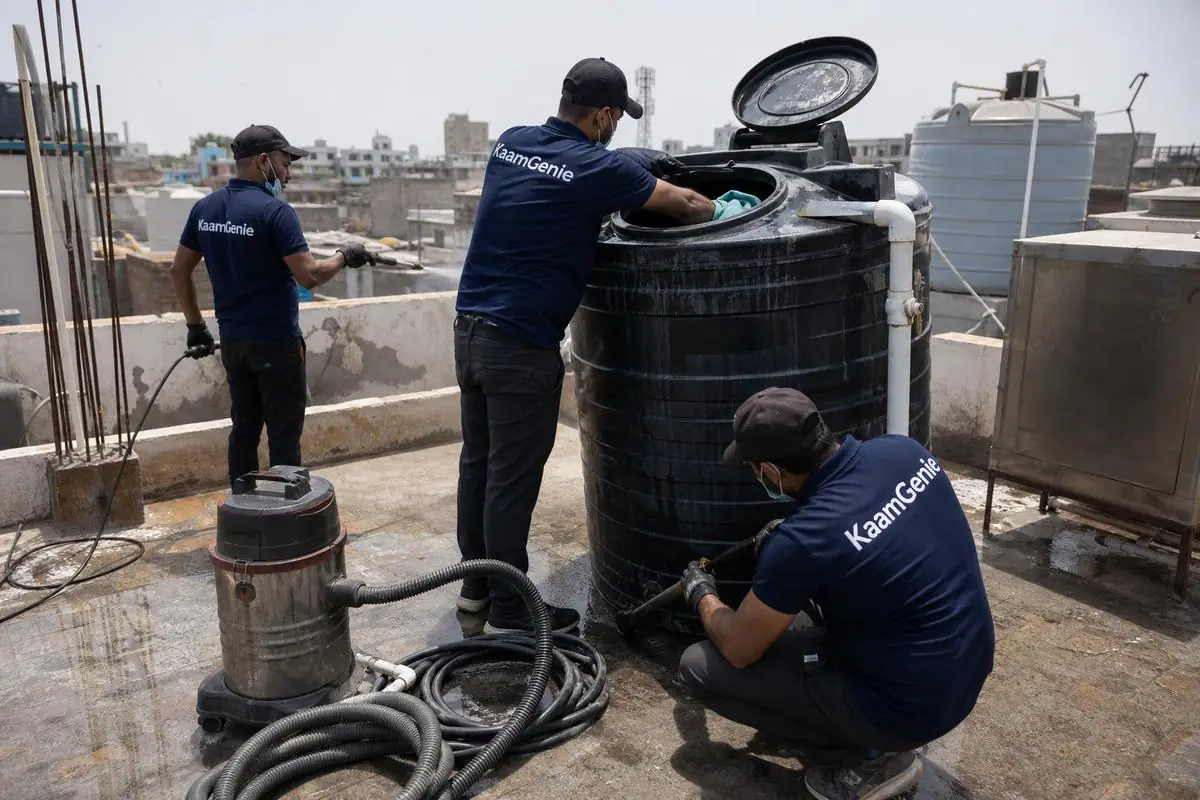
The market air is relentless here. Sadar Bazar’s lanes throw up constant road dust, soot and diesel haze, and all of it settles into the small terrace tanks through lids left loose above the shops. That grime cakes onto the walls and floor and clouds the water on its own, a heavier dust load than a residential rooftop ever sees, because the trading and traffic below never let up.
The plastic tank then grows its film on top of the dust. A translucent Sintex wall lets the daylight in and warms the standing water between the intermittent fills, feeding algae that grips onto the caked grime. Because shop owners live and trade below and rarely climb to the terrace, the tanks go unopened for long stretches, so dust, soot and green film compound until the water is plainly off. In a busy market that is often the only signal anyone acts on.
No travel charge anywhere in Sadar Bazar. The final price is confirmed on the call before we come — it depends only on tank size and access.
See it done in 45 seconds
Watch our web story on how a tank is really cleaned — drain, de-sludge, jet-wash, disinfect.
We reach every pocket of Sadar Bazar — and there’s no travel charge to any of them:
Every locality in Delhi stores different water, and that decides how fast a tank fouls. This is Sadar Bazar’s profile from The Delhi Water Index, built from our field observations across 250+ localities.
Indicative field characterisation, not a certified lab test. BIS IS 10500: TDS 500 mg/L acceptable, 2,000 permissible. Check any Delhi area →
“We run a shop and rarely go up to the terrace, can you handle it start to finish?” Yes. Give the crew access to the terrace and confirm your supply hours, and we do the whole clean without you needing to be up there. We send before-and-after photos so you can see the caked tank and the clean one from the shop below, without leaving the counter for long.
“The market throws up so much dust and diesel, is cleaning even worth it?” It is, because most of what fouls the tank is the settled grime and algae we scoop and jet-wash out, and sealing the lid afterwards keeps a lot of fresh dust from getting back in. The tank will pick up some market air over time, but a sealed, cleaned tank stays usable far longer than an open, caked one.
“How often should a market terrace tank be cleaned?” Because the dust and soot load is so heavy here, every three to four months is sensible, more often than a residential tank. The first clean after a long gap usually lifts a thick caked layer, after which the regular interval keeps the small tank from fouling the water again.
“What does it cost for a small terrace tank above the shops?” A small Sintex up to 500 litres is ₹699 and a standard 1000L is ₹899. Larger 1000 to 2000 litre tanks run ₹1,299 to ₹1,499. If a building has several plastic tanks, a bulk per-tank rate applies, so doing them together costs less than one at a time.
“Can you come at a time that does not clash with market trade?” Yes. We plan the visit around your supply hours and can aim for a quieter part of the day so it does not clash with peak trade. Call 95603 66362 to book a slot that fits, and the drain-and-refill window on a small terrace tank is short.
See our complete water tank cleaning services in Delhi NCR — pricing, process, tank types and full city coverage.
Beyond water tank cleaning, KaamGenie is rolling out a full lineup of home services across Delhi NCR — see our complete list of 12 home services we offer or will be launching through 2026. New to tank cleaning? Read our guide on how to pick the right water tank cleaning service in Delhi — what to look for, what to avoid, and the questions that separate trustworthy crews from quick-job operators.
Rooftop plastic tanks
₹699+ →Kothi sumps & underground tanks
₹1,499+ →Apartments & RWAs
Bulk pricing →FSSAI-compliant cleaning
₹2,500+ →टंकी साफ़ करने वाले
हिन्दी पढ़ें →View all water tank cleaning guides →
All pockets and lanes of Sadar Bazar covered. If your specific block or society isn’t named in the sub-areas above, just call — we almost certainly cover it.
Same crew, same 6-step process, same-day where possible. Pick any locality below for local pricing and the tanks we typically find there.
Book a slot — we can usually fit you in today or tomorrow.