
How Often Should You Clean Your Water Tank?
Raj Babbar · 7 min read
Home › Water Tank Cleaning › Sintex / Plastic Tank Cleaning › Jawahar Nagar (Kamla Nagar)
Why does the Sintex tank on a Jawahar Nagar PG go green so much faster than the one on a family home nearby? Heavy student use and a sun-warmed plastic wall together, and KaamGenie clears it. From ₹699.
Why does a shared PG tank in Jawahar Nagar foul so quickly? The answer is in how these houses are used. Beside the Kamla Nagar market and DU North Campus, an old house is packed with student rooms, and all of them draw on one small overhead Sintex tank fed by the DJB supply. Constant occupancy fills and drains that tank all day, so the water is never still, and because the plastic wall is translucent, the rooftop sun passes through and warms it, which is exactly what algae and biofilm need to spread. Dust off the market lanes drifts in through loose lids and lays grit on the plastic floor. A concrete tank would keep the light out, but the plastic one lets it in, so it greens fast under the heavy student load. With landlords juggling many tenants, cleaning is skipped, and the film and grit build unchecked.
We clean these shared plastic tanks gently and fully: check the body and lid, drain, hand-scoop the slimy sediment, wet-vacuum the base and jet-wash at a plastic-safe pressure. The algae film lifts with soft pads rather than wire brushes, and we finish with an anti-bacterial disinfectant wash before sending before-and-after photos. If the building's underground store or an RCC tank also needs doing, see our full water tank cleaning in Jawahar Nagar (Kamla Nagar). This page focuses specifically on Sintex and plastic tanks.
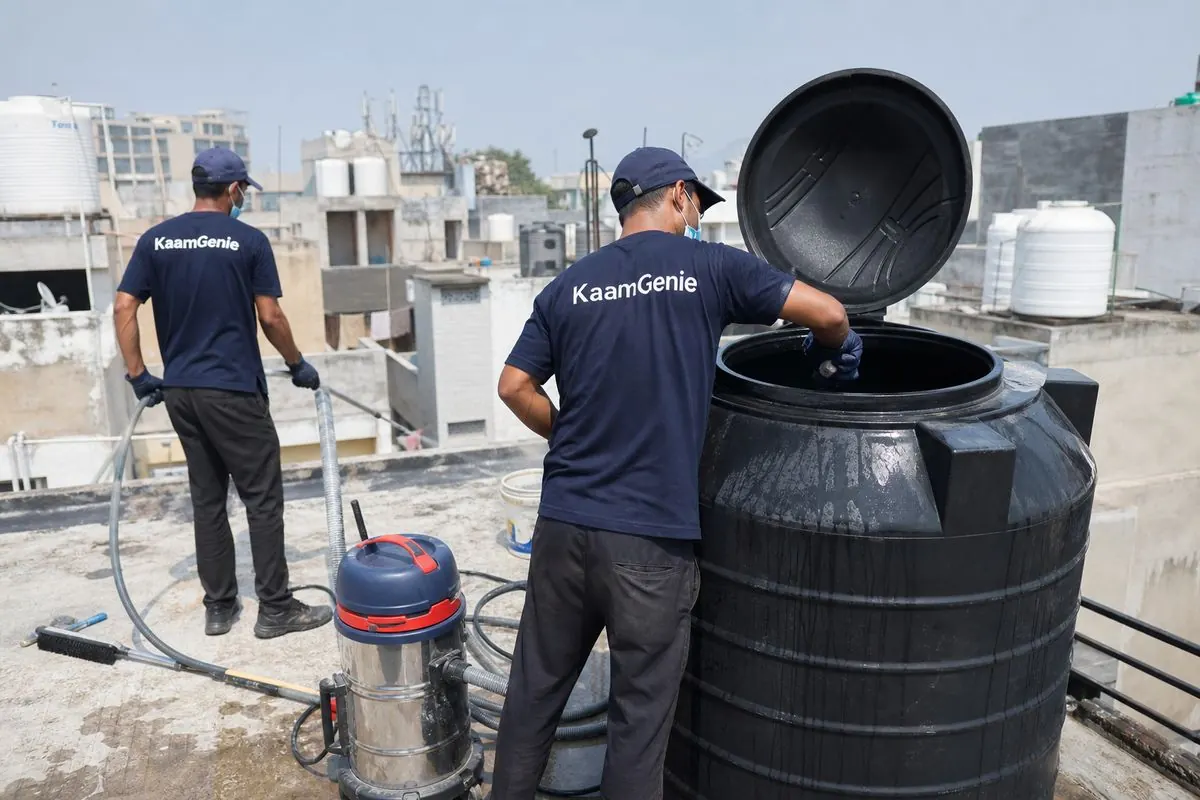
It comes down to heat and use together. A Sintex tank shared by a full PG house is drawn down and refilled all day, so the water is constantly warm and moving, and the translucent plastic wall lets the rooftop sun warm it further. That warmth is what algae and biofilm live on. A family's concrete tank stays shaded, cool and less disturbed, so it holds up, while the exposed, heavily worked PG plastic tank greens. On the same DJB supply, the difference in use and material is why the PG tank fouls so much sooner.
The shared, high-turnover use adds the grit. With many tenants drawing water at once the tank never settles, and market dust keeps drifting in through loose lids to lay a rough film on the plastic floor for the algae to grip. Because a shared tank has no single owner watching it, cleaning is put off until the water smells, by which point the film has spread up the walls. Only a regular scheduled drain and scrub keeps a busy PG tank ahead of the bloom, and it holds off far longer than a rinse.
No travel charge anywhere in Jawahar Nagar (Kamla Nagar). The final price is confirmed on the call before we come — it depends only on tank size and access.
See it done in 45 seconds
Watch our web story on how a tank is really cleaned — drain, de-sludge, jet-wash, disinfect.
We reach every pocket of Jawahar Nagar (Kamla Nagar) — and there’s no travel charge to any of them:
Every locality in Delhi stores different water, and that decides how fast a tank fouls. This is Jawahar Nagar’s profile from The Delhi Water Index, built from our field observations across 250+ localities.
Indicative field characterisation, not a certified lab test. BIS IS 10500: TDS 500 mg/L acceptable, 2,000 permissible. Check any Delhi area →
“Why does our PG tank go green faster than the neighbours' family tank?” Because it is a small translucent plastic tank worked hard all day. Constant PG use keeps the water warm and moving, and the sun through the plastic warms it further, feeding algae. A shaded, less-disturbed concrete tank holds up longer, but the busy PG Sintex greens sooner.
“With a full house of tenants, how often should the tank be cleaned?” Because a shared PG tank is worked hard and stays warm, we suggest cleaning it every three months. Heavy use and rooftop sun bring the algae film back faster than in a low-occupancy home, so a tighter schedule keeps it clear.
“What does a landlord pay to clean a 1000-litre plastic tank?” A standard 1000L Sintex is ₹899, and a smaller tank up to 500 litres starts at ₹699. If the house has several plastic tanks across floors, we quote a bulk per-tank rate to keep the whole property affordable.
“Can you clean without cutting the tenants off for long?” Yes. We time the drain and clean to your supply window so the tank refills before tenants need it, and a single plastic tank is usually finished within the morning, so the students barely notice.
“Is the green film actually a health issue for the students?” A green algae film and slimy biofilm affect the taste, smell and hygiene of the stored water, which matters in a full PG house. Clearing it and finishing with an anti-bacterial disinfectant wash restores the tank, and the before-and-after photos show it done.
See our complete water tank cleaning services in Delhi NCR — pricing, process, tank types and full city coverage.
Beyond water tank cleaning, KaamGenie is rolling out a full lineup of home services across Delhi NCR — see our complete list of 12 home services we offer or will be launching through 2026. New to tank cleaning? Read our guide on how to pick the right water tank cleaning service in Delhi — what to look for, what to avoid, and the questions that separate trustworthy crews from quick-job operators.
Rooftop plastic tanks
₹699+ →Kothi sumps & underground tanks
₹1,499+ →Apartments & RWAs
Bulk pricing →FSSAI-compliant cleaning
₹2,500+ →टंकी साफ़ करने वाले
हिन्दी पढ़ें →View all water tank cleaning guides →
All pockets and lanes of Jawahar Nagar (Kamla Nagar) covered. If your specific block or society isn’t named in the sub-areas above, just call — we almost certainly cover it.
Same crew, same 6-step process, same-day where possible. Pick any locality below for local pricing and the tanks we typically find there.
Book a slot — we can usually fit you in today or tomorrow.