
Signs Your Water Tank Needs Cleaning
Raj Babbar · 8 min read
Home › Water Tank Cleaning › Sintex / Plastic Tank Cleaning › Jangpura
In Jangpura’s builder floors and Bhogal’s old lanes, one plastic Sintex tank often serves two or three tenant floors — and nobody watches what grows inside it. KaamGenie cleans it plastic-safe and hygienic, photos included. From ₹699.
Jangpura is one of Delhi’s pre-partition rehabilitation colonies — Jangpura A and B, Jangpura Extension and Bhogal — where old single-family homes have turned into 2-3 storey builder floors between Mathura Road and the Defence Colony flyover. DJB supply off the Sonia Vihar line is decent but morning-only in the Bhogal lanes, so nearly every roof carries 500-1000L plastic tanks, and many of them are shared between the floor tenants. A shared translucent tank that cycles empty and full every morning grows algae and layers silt faster than anyone in the building realises.
KaamGenie cleans Sintex and plastic tanks across Jangpura — draining, wet-vacuuming the slimy sediment, soft jet-washing at a plastic-safe pressure and hand-scrubbing the algae film with soft pads instead of wire brushes, finished with a anti-bacterial disinfectant wash and dated photos each tenant can see. If your building also has an underground sump or an RCC tank, see our full water tank cleaning in Jangpura. This page is specifically about Sintex and plastic tanks.
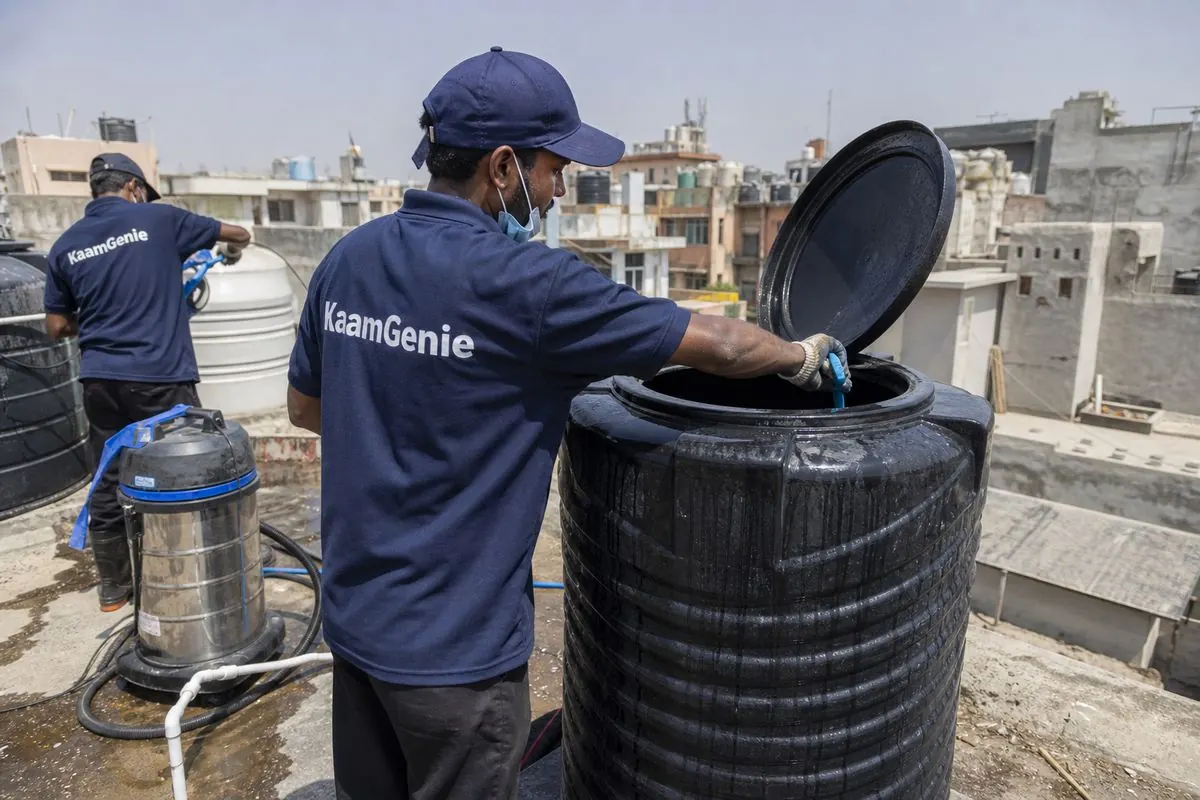
Because Bhogal and much of Jangpura get DJB water in a timed morning window, the rooftop plastic tank fills once and then drains through the day as two or three floors draw from it. Each refill stirs the bottom layer, and the sunlight coming through the translucent Sintex wall warms the standing water through the afternoon — exactly what algae need. A concrete tank would keep that water dark; the plastic tank on a Jangpura builder floor does not.
The sharing itself is the second problem. When one tank serves the landlord’s floor and the tenants above, no single household owns the cleaning schedule, so the tank quietly goes years between services. Lids get left ajar after motor repairs, Mathura Road dust drifts in, and the sediment keeps building until someone finally tastes it. For a shared builder-floor tank here, a clean every six months — split between the floors — keeps everyone’s taps clear.
No travel charge anywhere in Jangpura. The final price is confirmed on the call before we come — it depends only on tank size and access.
See it done in 45 seconds
Watch our web story on how a tank is really cleaned — drain, de-sludge, jet-wash, disinfect.
We reach every pocket of Jangpura — and there’s no travel charge to any of them:
Every locality in Delhi stores different water, and that decides how fast a tank fouls. This is Jangpura’s profile from The Delhi Water Index, built from our field observations across 250+ localities.
Indicative field characterisation, not a certified lab test. BIS IS 10500: TDS 500 mg/L acceptable, 2,000 permissible. Check any Delhi area →
“Do you clean shared plastic tanks in Bhogal’s lanes?” Yes. Bhogal’s tighter lanes are on our regular Jangpura round along with the A and B blocks and the Extension. Our crew carries the pump and hoses up the internal staircase, cleans the shared Sintex tank plastic-safe, and hands over dated before-after photos so the landlord and every tenant floor can see exactly what was done.
“How do we split the cost when three floors share one tank?” A plastic tank up to 500 litres is ₹699 and a standard 1000L tank is ₹899, so most Jangpura buildings split ₹300 or less per floor. We give one bill with the quality report, and many buildings here simply add it to the common maintenance split. If the roof carries more than one tank, we quote a combined rate for the visit.
“Can you finish before our morning DJB supply so we do not lose water?” Yes, that is how we plan Jangpura jobs. Call before 10 AM on 95603 66362 and we can often come the same day, timing the clean for when the tank is nearly empty in the evening or before the morning fill, so the freshly cleaned Sintex tank catches the next DJB window and no paid water is wasted.
“Our tank was installed decades ago — can it still be cleaned safely?” Usually yes. Older plastic tanks in Jangpura go brittle and chalky from years of UV exposure, so we use a soft jet pressure set for aged plastic and soft pads rather than wire brushes. We also check the lid and walls for cracks while we are up there and tell you honestly if the tank is nearing replacement age.
“How often should a shared builder-floor tank here be cleaned?” Every six months is right for a Jangpura tank shared by two or three floors, because the daily empty-full cycle on morning-only supply layers sediment faster than a single-family tank. If your water already smells or shows green tint on the walls, book now rather than waiting for the six-month mark.
See our complete water tank cleaning services in Delhi NCR — pricing, process, tank types and full city coverage.
Beyond water tank cleaning, KaamGenie is rolling out a full lineup of home services across Delhi NCR — see our complete list of 12 home services we offer or will be launching through 2026. New to tank cleaning? Read our guide on how to pick the right water tank cleaning service in Delhi — what to look for, what to avoid, and the questions that separate trustworthy crews from quick-job operators.
Rooftop plastic tanks
₹699+ →Kothi sumps & underground tanks
₹1,499+ →Apartments & RWAs
Bulk pricing →FSSAI-compliant cleaning
₹2,500+ →टंकी साफ़ करने वाले
हिन्दी पढ़ें →View all water tank cleaning guides →
All pockets and lanes of Jangpura covered. If your specific block or society isn’t named in the sub-areas above, just call — we almost certainly cover it.
Same crew, same 6-step process, same-day where possible. Pick any locality below for local pricing and the tanks we typically find there.
Book a slot — we can usually fit you in today or tomorrow.