
Water Tank Cleaning Cost in Delhi (2026)
Raj Babbar · 8 min read
Home › Water Tank Cleaning › Society / RWA Tank Cleaning › Bawana
Committee and association tank cleaning across Bawana — resettlement blocks pooling one service day, DSIIDC units documenting canteen tanks, and village homes in between. From ₹1,500 per tank, before-and-after photos for every booking.
Bawana holds three different water worlds on Delhi’s north-west edge: the DSIIDC industrial estate’s sheds, the resettlement blocks built after the 2004 relocations, and the old Bawana village. In the resettlement rows, small tanks are shared across many households at once; in the estate, units run their own storage for processes and canteens; and over all of it, hard borewell water and the estate’s constant dust settle into every open or loose-lidded tank.
KaamGenie works Bawana at the group level, because that is how Bawana’s water is actually organised. Block committees in the resettlement colony pool a service day and we clean a whole row’s tanks in one round at a pooled rate; DSIIDC units book canteen and process tanks with audit-grade documentation; village homes and dairies book multi-tank visits. Single-tank household bookings are covered at water tank cleaning in Bawana — this page is for committees, unit owners and landlord groups.
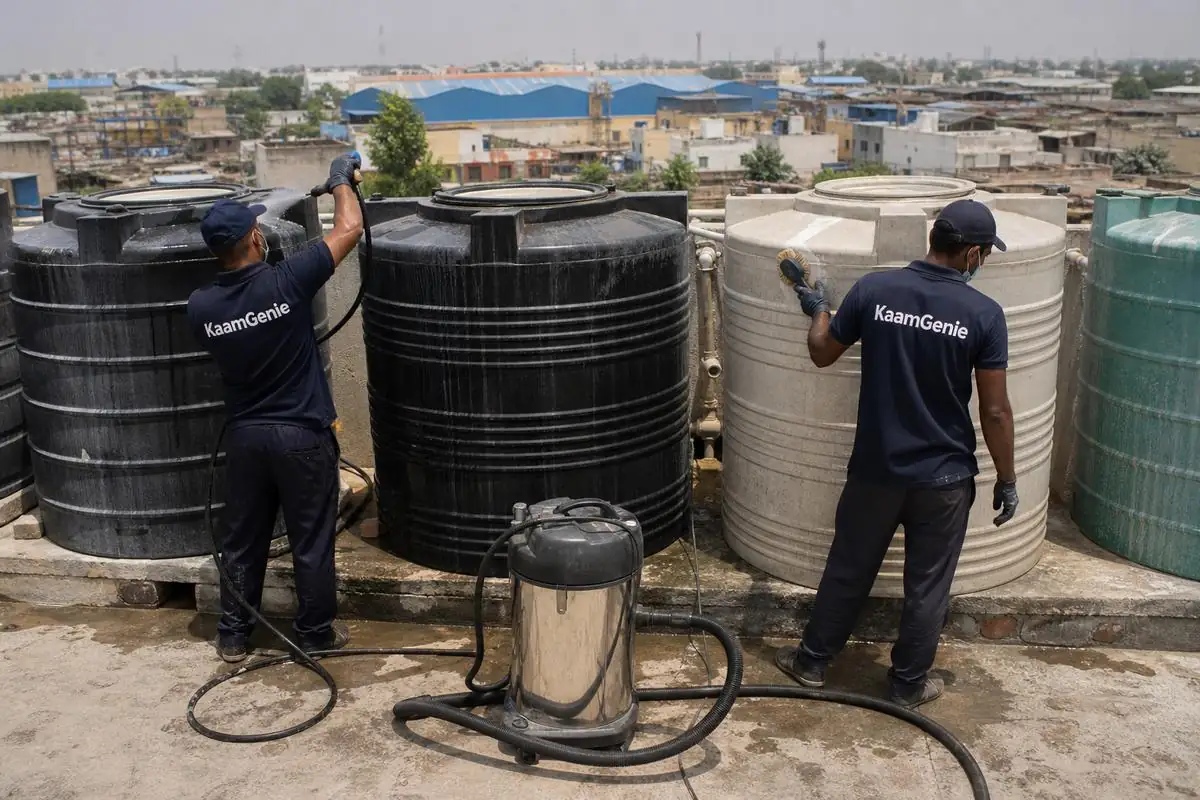
A resettlement-row tank is small, shared, and refilled constantly — the hardest life a tank can live. With several households drawing on it, sediment never settles clear, and because no single family owns the tank, no single family cleans it. The estate’s dust makes it worse: it films every roof and washes into any tank whose lid does not seal. The honest arithmetic is that these small shared tanks need cleaning more often than large private ones, yet they get cleaned least.
Pooling flips that arithmetic. When a block pradhan or committee collects a row’s bookings onto one date, the crew moves door to door down the row in a single day, the per-tank cost drops well below one-off pricing, and every household still gets its own before-and-after photos. On the estate side the logic is compliance rather than cost: a DSIIDC unit’s canteen tank needs the dated quality report an inspector asks for, and an AMC keeps that file current quarter after quarter without the unit manager chasing it.
No travel charge anywhere in Bawana. The final price is confirmed on the call before we come — it depends only on tank size and access.
See it done in 45 seconds
Watch our web story on how a tank is really cleaned — drain, de-sludge, jet-wash, disinfect.
We reach every pocket of Bawana — and there’s no travel charge to any of them:
Every locality in Delhi stores different water, and that decides how fast a tank fouls. This is Bawana’s profile from The Delhi Water Index, built from our field observations across 250+ localities.
Indicative field characterisation, not a certified lab test. BIS IS 10500: TDS 500 mg/L acceptable, 2,000 permissible. Check any Delhi area →
“How does a block-level pooled booking work in the JJ Colony?” The block pradhan or committee collects households onto one service date and shares the row’s tank count with us. We bring a full crew, work door to door down the row in one day, and every household’s tank gets the same drain-scrub-disinfect treatment with its own photo record. Pooled rows get our lowest per-tank rate in Bawana — the more households join, the less each pays.
“What do DSIIDC units get for ₹1,500 per tank?” The full documented service: drain, sludge removal, high-pressure jet wash, hand scrub, anti-bacterial disinfection, before-and-after photos on WhatsApp. Units running canteen, drinking-water and process storage together get a combined visit quote, and neighbouring units on one estate road can share a service day for a grouped rate.
“Our shared tank serves six families — how often should it be cleaned?” Every three to four months, honestly. A small tank under six households’ draw cycles so hard that sediment stays stirred, and Bawana’s dust and hard borewell water add to the load. That sounds expensive until it is pooled — on a committee service day the per-household share of a quarterly clean is small, and it is the difference between clear and cloudy water for everyone on the row.
“Do you also clean tanks in Bawana village and the dairies?” Yes. Village homes run large tanks against unpredictable supply and we clean them per visit or on a schedule, including the cattle-trough and dairy storage setups where scale crusts fast on hard borewell water. Village landlord groups with several rental buildings can club them into one multi-building booking.
“Can you come the same day if a block’s tank turns visibly dirty?” Call 95603 66362 before 10 AM and we will aim to reach Bawana the same day. A visibly dirty shared tank is a health matter for every family on it, so we prioritise these calls — drain, inspect, full scrub and disinfection, with photos so the committee can show the row what came out.
See our complete water tank cleaning services in Delhi NCR — pricing, process, tank types and full city coverage.
Beyond water tank cleaning, KaamGenie is rolling out a full lineup of home services across Delhi NCR — see our complete list of 12 home services we offer or will be launching through 2026. New to tank cleaning? Read our guide on how to pick the right water tank cleaning service in Delhi — what to look for, what to avoid, and the questions that separate trustworthy crews from quick-job operators.
Rooftop plastic tanks
₹699+ →Kothi sumps & underground tanks
₹1,499+ →Apartments & RWAs
Bulk pricing →FSSAI-compliant cleaning
₹2,500+ →टंकी साफ़ करने वाले
हिन्दी पढ़ें →View all water tank cleaning guides →
All pockets and lanes of Bawana covered. If your specific block or society isn’t named in the sub-areas above, just call — we almost certainly cover it.
Same crew, same 6-step process, same-day where possible. Pick any locality below for local pricing and the tanks we typically find there.
Book a slot — we can usually fit you in today or tomorrow.