
Water Tank Cleaning Rules & Norms
Raj Babbar · 9 min read
Home › Water Tank Cleaning › Society / RWA Tank Cleaning › Dwarka Sector 2
Society & RWA water tank cleaning in Dwarka Sector 2 — we clean the banks of shared overhead and underground tanks in the sector’s CGHS towers and DDA MIG blocks, usually ₹1,500–2,000 per tank when the whole society is done together.
Sector 2 is a quiet residential sector where DDA MIG and SFS flats sit alongside a number of cooperative group housing societies built in the late 1990s. Those CGHS towers run large overhead-plus-underground sump systems that feed every flat, while the DDA blocks rely on rooftop overhead tanks managed by their own committees. Water is the usual Dwarka mix of Sonia Vihar DJB pipeline supply and DDA borewells, so it arrives hard and mineral-heavy across the whole sector.
A late-1990s society tank that has been topped up but never opened will hold a season’s worth of borewell scale and grit at its floor, which is exactly what our survey looks for. We count the overhead and sump tanks feeding each tower, then schedule cleaning tank by tank so the flats above never lose their supply for long. Residents who want their in-flat storage refreshed at the same time can add our water tank cleaning in Dwarka Sector 2 while the crew is already in the building.
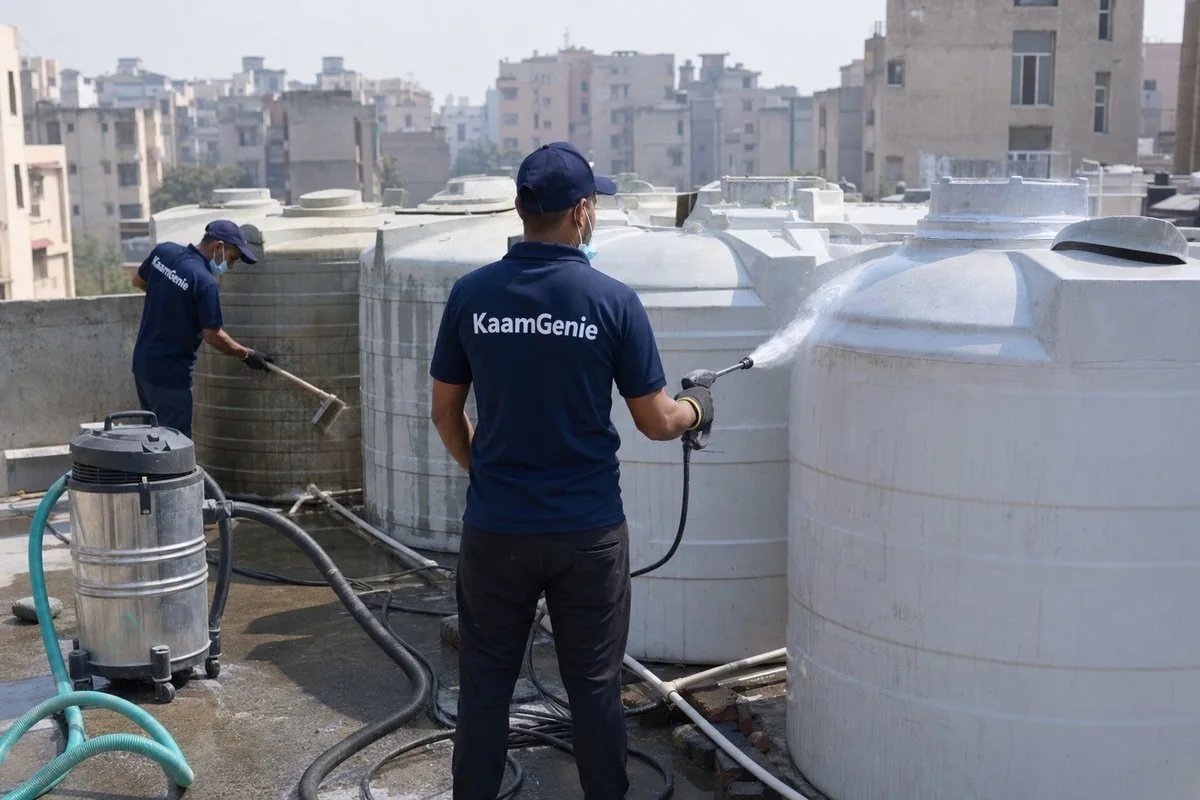
The cooperative societies that define Sector 2 were built around a shared storage model, where one underground sump feeds a rooftop overhead tank that in turn serves a stack of flats. Every litre a resident drinks or cooks with has passed through that shared chain, so sludge in the sump or scale on the overhead walls reaches all of them. With Dwarka’s hard borewell-blended supply, three to four months is enough to lay down a firm mineral crust and a soft organic layer that can turn the water cloudy.
For an AOA or RWA the maths is simple: a maintained tank is quick and inexpensive to clean, while one neglected for years needs heavy desludging and long downtime. A 3–4 month cycle keeps every tower’s storage clear, protects the pumps from grit and gives the managing committee a documented trail. Our crew isolates and drains each tank in turn, lifts out the sludge, jet washes and hand-scrubs, disinfects with a hygienic solution, then refills and confirms supply before signing off.
No travel charge anywhere in Dwarka Sector 2. The final price is confirmed on the call before we come — it depends only on tank size and access.
See it done in 45 seconds
Watch our web story on how a tank is really cleaned — drain, de-sludge, jet-wash, disinfect.
We reach every pocket of Dwarka Sector 2 — and there’s no travel charge to any of them:
Every locality in Delhi stores different water, and that decides how fast a tank fouls. This is Dwarka Sector 2’s profile from The Delhi Water Index, built from our field observations across 250+ localities.
Indicative field characterisation, not a certified lab test. BIS IS 10500: TDS 500 mg/L acceptable, 2,000 permissible. Check any Delhi area →
“Can our CGHS society in Sector 2 have every tower cleaned in one booking?” Yes. On the site survey we map the sump and overhead tanks for each tower in the society and plan a running order across the blocks. Larger societies are usually spread over two days so no tower is offline for long, and the managing committee gets one consolidated quality report at the end. Before and after photos are taken for every tank.
“Will the flats lose water while a society tank is being cleaned?” Only the tank currently being worked on is isolated, and only for the short time it takes to drain, scrub and disinfect it. The moment it is refilled and supply is confirmed we move to the next tank, so the rest of the society runs normally. In practice most residents in the late-1990s towers here never notice the interruption.
“Do you provide a quality report the AOA can keep on file?” Yes, every job closes with a dated RWA or AOA quality report that lists each tank, its capacity, the disinfectant used and the cleaning crew. Sector 2 committees keep it in the maintenance file as proof for residents and for society audits. It comes with the before and after photo set, issued the same day.
“How often should a society off the Sector 2 SFS pockets clean its tanks?” Every 3 to 4 months is the right cycle for Dwarka’s hard, high-TDS water, which lays scale down fast in shared tanks. A society that has not cleaned in a year or more should begin with a full desludge and then hold the quarterly rhythm. Many AOAs here sign an annual AMC so the visits are fixed and the rate is locked in advance.
“What is the bulk price if our society has around 10 tanks?” Individual society tanks run about ₹1,500–2,000 each, and a full set of roughly 10 done in one booking is quoted at a bundled rate below the straight per-tank total. The final number depends on tank sizes and sludge levels, which we confirm on the survey. No separate visit or call-out fee is added once the society books.
See our complete water tank cleaning services in Delhi NCR — pricing, process, tank types and full city coverage.
Beyond water tank cleaning, KaamGenie is rolling out a full lineup of home services across Delhi NCR — see our complete list of 12 home services we offer or will be launching through 2026. New to tank cleaning? Read our guide on how to pick the right water tank cleaning service in Delhi — what to look for, what to avoid, and the questions that separate trustworthy crews from quick-job operators.
Rooftop plastic tanks
₹699+ →Kothi sumps & underground tanks
₹1,499+ →Apartments & RWAs
Bulk pricing →FSSAI-compliant cleaning
₹2,500+ →टंकी साफ़ करने वाले
हिन्दी पढ़ें →View all water tank cleaning guides →
All pockets and lanes of Dwarka Sector 2 covered. If your specific block or society isn’t named in the sub-areas above, just call — we almost certainly cover it.
Same crew, same 6-step process, same-day where possible. Pick any locality below for local pricing and the tanks we typically find there.
Book a slot — we can usually fit you in today or tomorrow.