
Overhead vs Underground Tank Cleaning
Raj Babbar · 9 min read
Home › Water Tank Cleaning › Society / RWA Tank Cleaning › Shiv Vihar
Walk the Shiv Vihar lanes near the border and you pass tall, tightly packed buildings, each capped with a shared rooftop tank feeding the floors below. We service the whole building in one coordinated visit, staggering the tanks so no floor runs dry mid-clean. The building is quoted in bulk and the cost splits across the flats.
Out on the far edge of Shiv Vihar, close to the Delhi-UP border, the buildings run tall and packed with tenants stacked floor on floor. The shared rooftop tanks up top turn over constantly because occupancy is high and people move in and out through the year. Those tanks feed several floors from one outlet, filled from a hard borewell that leaves scale and grit on the walls. With so many drawing from one tank, the water is never still and the sediment stays stirred up. Nobody living below actually owns the rooftop tank, so its cleaning keeps getting postponed. One coordinated visit for the whole building is the practical fix for a shared tank like this.
If you only need your own flat's tank and supply line seen to, our standard water tank cleaning in Shiv Vihar covers exactly that. This page deals with the shared building tanks that feed several floors at once, where a single survey and one split invoice beat every flat arranging its own. We tally the shared tanks on the roof and quote the building as one bulk job. Each flat then pays its portion of a single figure instead of booking piecemeal.
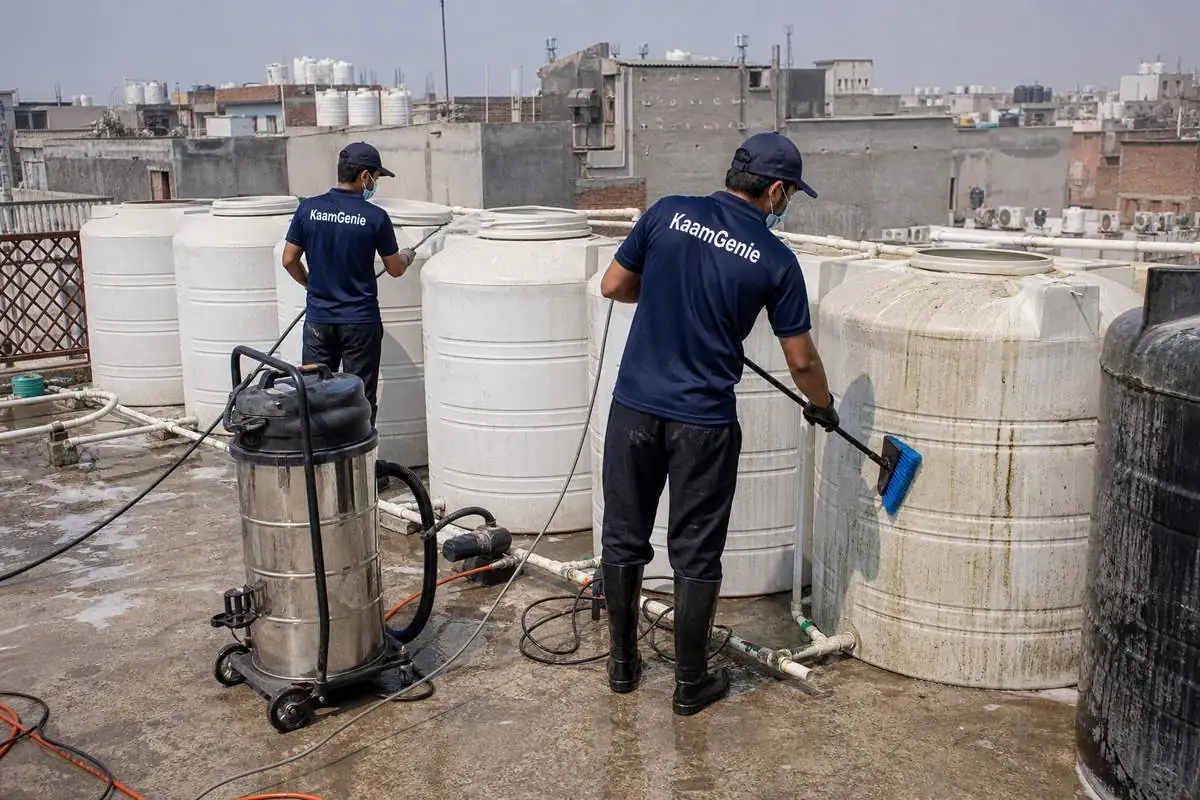
The metallic taint and gritty film show up at every tap in these buildings, top floor to ground, and that is the tell of a shared tank left too long. Because one tank feeds the whole stack, whatever settles in it reaches all of the flats equally. Tenants often blame the pipes or the pump when the real source is the uncleaned rooftop tank they all share. Cleaning that shared tank clears the symptom for the entire building in one go.
High turnover is exactly why these tanks get skipped: tenants come and go, and a clean nobody owns is a clean nobody books. We take the whole thing off the building's hands. One contact points us at the roof, we survey and quote a bulk price for all the shared tanks, clean them in a staggered sequence so no floor loses water, and hand back a single invoice split across the flats. A shared 2,000 to 3,000L tank runs about ₹1,500 to ₹2,000, buildings with many small tanks nearer ₹699 to ₹899 each, and the whole building together saves roughly 15 to 20 percent.
No travel charge anywhere in Shiv Vihar. The final price is confirmed on the call before we come — it depends only on tank size and access.
See it done in 45 seconds
Watch our web story on how a tank is really cleaned — drain, de-sludge, jet-wash, disinfect.
We reach every pocket of Shiv Vihar — and there’s no travel charge to any of them:
Every locality in Delhi stores different water, and that decides how fast a tank fouls. This is Shiv Vihar’s profile from The Delhi Water Index, built from our field observations across 250+ localities.
Indicative field characterisation, not a certified lab test. BIS IS 10500: TDS 500 mg/L acceptable, 2,000 permissible. Check any Delhi area →
“In a building full of tenants, who arranges the clean?” Any one person can book it for the whole building, whether that is the landlord, the caretaker or a long-staying tenant who collects the shared costs. We only need one point of contact to survey the tanks and lock a date. The split invoice then makes it simple to recover each flat's share afterwards.
“Will water be cut off to the floors while you clean?” No. We stagger the shared tanks, cleaning one at a time while the rest stay live, so the building keeps its supply throughout. On a tall stack with tenants on every floor that continuity matters, and we plan the sequence around it. Only the single tank being worked on is briefly offline.
“How is the price divided across the flats?” We put one bulk figure on the building and divide it by the flats drawing from the shared tanks. A standard 2,000 to 3,000L tank is around ₹1,500 to ₹2,000, and a building running many small stairwell tanks can be quoted nearer ₹699 to ₹899 per tank. You receive a single invoice for the whole job rather than a bill per flat.
“How often should a heavily used shared tank here be cleaned?” With constant turnover and hard borewell water, twice a year keeps a Shiv Vihar shared tank in reasonable shape. Heavy occupancy stirs and rebuilds sediment faster than a lightly used tank. Our annual plan sets both visits in advance at about 20 to 25 percent off.
“Do you photograph each tank so residents can see the work?” Yes. We record the before and after state of every shared tank we clean, which matters when the cost is split and residents want to see what they paid for. The photos go to the person who booked the job. It keeps the whole building confident the work was done.
See our complete water tank cleaning services in Delhi NCR — pricing, process, tank types and full city coverage.
Beyond water tank cleaning, KaamGenie is rolling out a full lineup of home services across Delhi NCR — see our complete list of 12 home services we offer or will be launching through 2026. New to tank cleaning? Read our guide on how to pick the right water tank cleaning service in Delhi — what to look for, what to avoid, and the questions that separate trustworthy crews from quick-job operators.
Rooftop plastic tanks
₹699+ →Kothi sumps & underground tanks
₹1,499+ →Apartments & RWAs
Bulk pricing →FSSAI-compliant cleaning
₹2,500+ →टंकी साफ़ करने वाले
हिन्दी पढ़ें →View all water tank cleaning guides →
All pockets and lanes of Shiv Vihar covered. If your specific block or society isn’t named in the sub-areas above, just call — we almost certainly cover it.
Same crew, same 6-step process, same-day where possible. Pick any locality below for local pricing and the tanks we typically find there.
Book a slot — we can usually fit you in today or tomorrow.