
Water Tank Cleaning Rules & Norms
Raj Babbar · 9 min read
Home › Water Tank Cleaning › Society / RWA Tank Cleaning › Keshavpuram
Society and RWA tank cleaning in Keshavpuram — DDA stairwell tanks pooled block by block along the Red Line, plotted stacks done whole, and the Lawrence Road organic dust that feeds algae cleared before summer. From ₹1,500 per tank.
Keshavpuram is a DDA colony on the Red Line between Ashok Vihar and Lawrence Road — flats in lettered blocks sharing stairwell RCC tanks, plotted lanes toward Tri Nagar stacking per-floor plastic on their rebuilds. Its particular water story comes from its industrial neighbour: the Lawrence Road area’s flour and food units put a fine organic dust into the air, and unlike mineral grit, organic dust feeds things. In sun-exposed tanks it becomes the nutrient base for the green algal film residents find on their tank walls each summer.
KaamGenie’s Keshavpuram service runs on the block pooling: a stairwell’s shared RCC tank plus opt-in flat tanks cleaned in one visit with the shared cost split, and neighbouring stairs sequenced on the same date for pooled pricing. Plotted buildings book full stacks. We time the colony’s heavier clean for late spring — clearing the organic load before the heat turns it into algae — and photograph wall condition so blocks can see the seasonal difference. For a single tank, see water tank cleaning in Keshavpuram; this page is for block, stairwell and whole-building work.
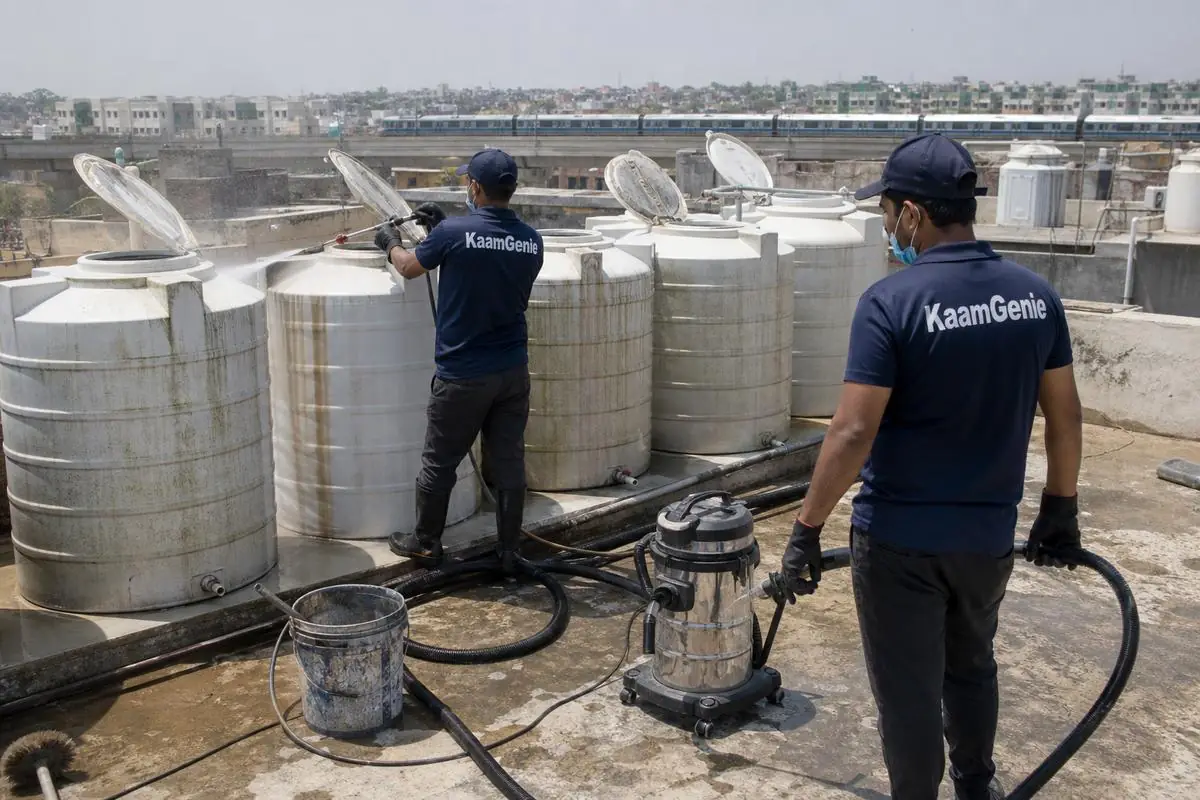
Algae needs three things: light, warmth and food. Sun-exposed rooftop tanks provide the first two everywhere in Delhi; Keshavpuram’s flour-and-food-unit dust supplies the third. The organic particles settle through lid gaps, dissolve slowly, and by May the sunlit walls of an RCC stairwell tank carry a green film that taints taste and clogs float valves. RCC makes it stickier — the porous concrete holds both nutrients and spores through a casual rinse, which is why blocks that ‘cleaned it last year’ find the film back by mid-summer.
The counter is timing plus thoroughness. A late-spring clean that jets and hand-scrubs the walls, clears the nutrient sediment and disinfects properly resets the tank before peak algae season; a mid-winter follow-up keeps the layering from re-establishing. Blocks on this two-visit rhythm stop seeing the green film altogether. Lid discipline does the rest — we seat covers and close gaps on every visit, because a sealed tank starves the algae of its food supply no matter what Lawrence Road sends over.
No travel charge anywhere in Keshavpuram. The final price is confirmed on the call before we come — it depends only on tank size and access.
See it done in 45 seconds
Watch our web story on how a tank is really cleaned — drain, de-sludge, jet-wash, disinfect.
We reach every pocket of Keshavpuram — and there’s no travel charge to any of them:
Every locality in Delhi stores different water, and that decides how fast a tank fouls. This is Keshavpuram’s profile from The Delhi Water Index, built from our field observations across 250+ localities.
Indicative field characterisation, not a certified lab test. BIS IS 10500: TDS 500 mg/L acceptable, 2,000 permissible. Check any Delhi area →
“Our stairwell tank gets a green film every summer. Can you stop it recurring?” Yes, with the two-visit rhythm: a thorough late-spring clean that removes the film, the nutrient sediment and the spores held in the RCC pores, then a winter follow-up. Blocks on this cycle stop seeing the film. A single clean helps for a season; the timing is what breaks the recurrence.
“How does a stairwell pooling work and what does each flat pay?” One resident collects the stair, we clean the shared RCC tank plus any flat tanks that opt in, and the shared tank’s cost — from ₹1,500 — splits among participants, typically a few hundred rupees each. Adjacent stairs booking the same date share pooled pricing on top.
“Is the algae actually harmful or just unpleasant?” The film itself mostly affects taste and smell, but it marks a tank that is feeding microbial growth, and it clogs float valves and outlets as it sloughs off. Either way it means the tank has nutrients, light and time — all three fixable with cleaning, lid seating and the seasonal cycle.
“Do the plotted lanes toward Tri Nagar have the same problem?” Less algae — plastic tanks run darker inside than RCC — but the same organic dust settles as sediment, and stacked floor tanks plus a common tank still need the whole-stack clean. Full stacks book together with per-floor billing; neighbouring buildings can share a lane date.
“Can we get a same-day visit if the tank smells earthy or green?” Usually — call 95603 66362 before 10 AM; Keshavpuram is on our daily Red Line-side route. An earthy smell is the algae-and-sediment signature, and one visit — drain, scrub, disinfect, lid seated — resets the tank the same day.
See our complete water tank cleaning services in Delhi NCR — pricing, process, tank types and full city coverage.
Beyond water tank cleaning, KaamGenie is rolling out a full lineup of home services across Delhi NCR — see our complete list of 12 home services we offer or will be launching through 2026. New to tank cleaning? Read our guide on how to pick the right water tank cleaning service in Delhi — what to look for, what to avoid, and the questions that separate trustworthy crews from quick-job operators.
Rooftop plastic tanks
₹699+ →Kothi sumps & underground tanks
₹1,499+ →Apartments & RWAs
Bulk pricing →FSSAI-compliant cleaning
₹2,500+ →टंकी साफ़ करने वाले
हिन्दी पढ़ें →View all water tank cleaning guides →
All pockets and lanes of Keshavpuram covered. If your specific block or society isn’t named in the sub-areas above, just call — we almost certainly cover it.
Same crew, same 6-step process, same-day where possible. Pick any locality below for local pricing and the tanks we typically find there.
Book a slot — we can usually fit you in today or tomorrow.