
Water Tank Disinfection Explained
Raj Babbar · 10 min read
Home › Water Tank Cleaning › Society / RWA Tank Cleaning › Nand Nagri (A Block)
Nand Nagri's A-block reads as a numbered DDA grid, straight allotment rows of EWS and LIG plots grown vertical, where a run of neighbouring units draws on one roof vessel. Emptying and clearing that shared vessel and putting it on paper is the work here. From ₹1,500 per tank.
A-block belongs to the grid the DDA marked out for Nand Nagri, straight allotment rows of EWS and LIG plots that residents have raised into floors over the decades. The uniform plan gives the storage a recognisable shape: one plastic roof vessel per structure, or per short run of adjoining units, feeding a cluster of neighbouring homes. The mains reach here only in patches, so most water is pulled up from a borewell or bought in by tanker, both arriving with a heavy suspended load. Sitting quiet between a fill and a slow draw, that load parts out and beds on the vessel floor. The neat allotment lines outside give no hint of the layer building up inside each roof vessel.
KaamGenie empties and clears the shared A-block vessel for a neighbouring cluster or the structure's caretaker, dropping in when the store runs low so no bought load is spilt. We pull the standing water off, ladle out the bedded matter, work the interior over thoroughly, follow with a potable-grade sanitising rinse and leave a dated photo log for the homes. A resident needing only their own line seen to can visit water tank cleaning in Nand Nagri (A Block). This page addresses the shared vessel an A-block cluster depends on.
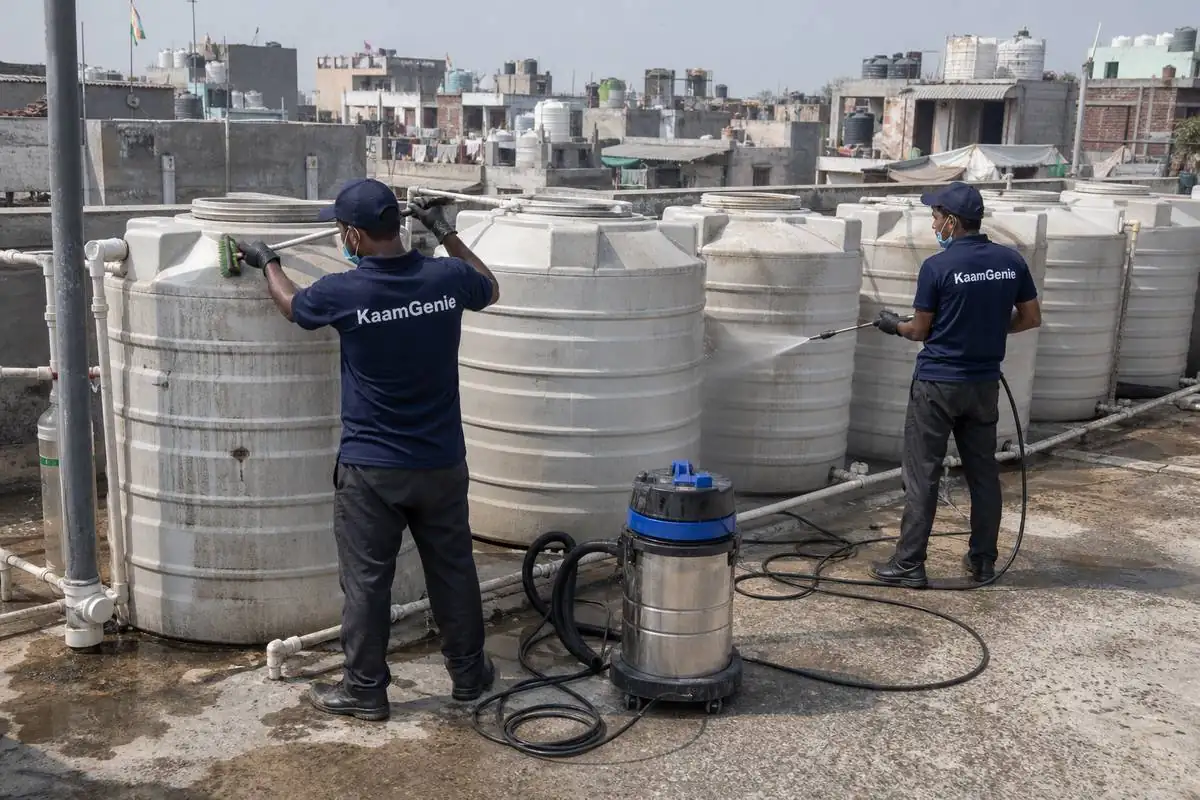
Borewell and bought-tanker water, the mainstay across the A-block grid, arrive with a far heavier suspended load than a treated main, and once it stands in a shared vessel that load parts out and beds on the floor. A store topped to the brim from a delivery and then drawn slowly across a cluster of homes rests long enough for thorough settling. Dissolved hardness lends its mineral share to the bed. In a handful of months an allotment-row vessel can hold a defined layer the neighbours never lay eyes on. The orderly grid outside changes nothing about what the water sets down.
That bedded layer is where microbes and film get a footing, and across a run of units on one vessel it surfaces as clouded water and a flat taste in every home. The same fines reach the common pump and the outlets, and worn fittings are an outlay an allotment household would rather do without. When water has been bought by the tanker load, guarding the store it rests in is only sensible. A routine clear-out keeps an A-block cluster's shared supply dependable.
No travel charge anywhere in Nand Nagri (A Block). The final price is confirmed on the call before we come — it depends only on tank size and access.
See it done in 45 seconds
Watch our web story on how a tank is really cleaned — drain, de-sludge, jet-wash, disinfect.
We reach every pocket of Nand Nagri (A Block) — and there’s no travel charge to any of them:
Every locality in Delhi stores different water, and that decides how fast a tank fouls. This is Nand Nagri (A Block)’s profile from The Delhi Water Index, built from our field observations across 250+ localities.
Indicative field characterisation, not a certified lab test. BIS IS 10500: TDS 500 mg/L acceptable, 2,000 permissible. Check any Delhi area →
“A run of A-block units shares one roof vessel. When should it be emptied?” When the vessel is nearly down, right before a borewell or tanker fill, so we can draw off the last of the old water and bedded matter without spilling a full bought load. We line the timing up with the caretaker so the clear-out and the next fill meet.
“The store is filled by tanker and borewell. Does that bed more matter?” Yes. Both bought-tanker and pulled-borewell water arrive with more suspended load than a treated main, so a shared roof vessel beds a floor layer faster than a mains-fed one. That is precisely why these vessels want opening on a set cycle.
“What is the charge for a shared A-block roof vessel?” The shared vessel is ₹1,500 to ₹2,000. Sitting outside a registered society adds nothing, and an allotment run with more than one vessel earns a bulk rate for the single call.
“We are an informal cluster, not a registered society. Can we still book and get paper?” Yes. A cluster of neighbouring homes sharing one vessel books just as a society would, and we hand over the same dated photo log afterwards. Many keep it as proof the shared store was looked after.
“How often does an A-block roof vessel want clearing?” Two or three times a year on this bought-and-pulled water. The load-heavy supply and the slow draw rebuild the floor layer within a few months, so a longer gap lets it deepen to where the whole run can taste it.
See our complete water tank cleaning services in Delhi NCR — pricing, process, tank types and full city coverage.
Beyond water tank cleaning, KaamGenie is rolling out a full lineup of home services across Delhi NCR — see our complete list of 12 home services we offer or will be launching through 2026. New to tank cleaning? Read our guide on how to pick the right water tank cleaning service in Delhi — what to look for, what to avoid, and the questions that separate trustworthy crews from quick-job operators.
Rooftop plastic tanks
₹699+ →Kothi sumps & underground tanks
₹1,499+ →Apartments & RWAs
Bulk pricing →FSSAI-compliant cleaning
₹2,500+ →टंकी साफ़ करने वाले
हिन्दी पढ़ें →View all water tank cleaning guides →
All pockets and lanes of Nand Nagri (A Block) covered. If your specific block or society isn’t named in the sub-areas above, just call — we almost certainly cover it.
Same crew, same 6-step process, same-day where possible. Pick any locality below for local pricing and the tanks we typically find there.
Book a slot — we can usually fit you in today or tomorrow.