
Which Chemicals Are Used for Tank Cleaning?
Raj Babbar · 11 min read
Home › Water Tank Cleaning › Underground Sump Cleaning › Ashok Vihar
Ashok Vihar’s societies run textbook sump-and-rooftop systems under active RWAs — but decades of layered sediment sit in the DDA wings’ shared tanks, and Wazirpur’s industrial fallout drifts over Phase I. KaamGenie cleans the buried half of the system, from ₹1,499.
Planned in phases I to IV around the Deep Market hub, Ashok Vihar mixes plotted homes, DDA flats and group-housing societies — and its water infrastructure is the planned-colony classic: society blocks with a common underground sump pumping to rooftop banks, plotted rebuilds with per-floor stacks over stilt sumps. The RWAs here are genuinely active, which keeps rooftop cleaning on calendar; the sumps, buried under parking and pump rooms, are where the cycle most often slips.
Our society service is built for committee handover: scheduled shutdown, ventilated and air-tested entry, pump-out, wet-vacuum of the layered bed, high-pressure wall wash, anti-bacterial disinfection, and a photo-documented quality report the RWA can minute and file. Plotted homes get the same routine at household scale. The rooftop banks above are covered at water tank cleaning in Ashok Vihar — this page is for the tank underneath.
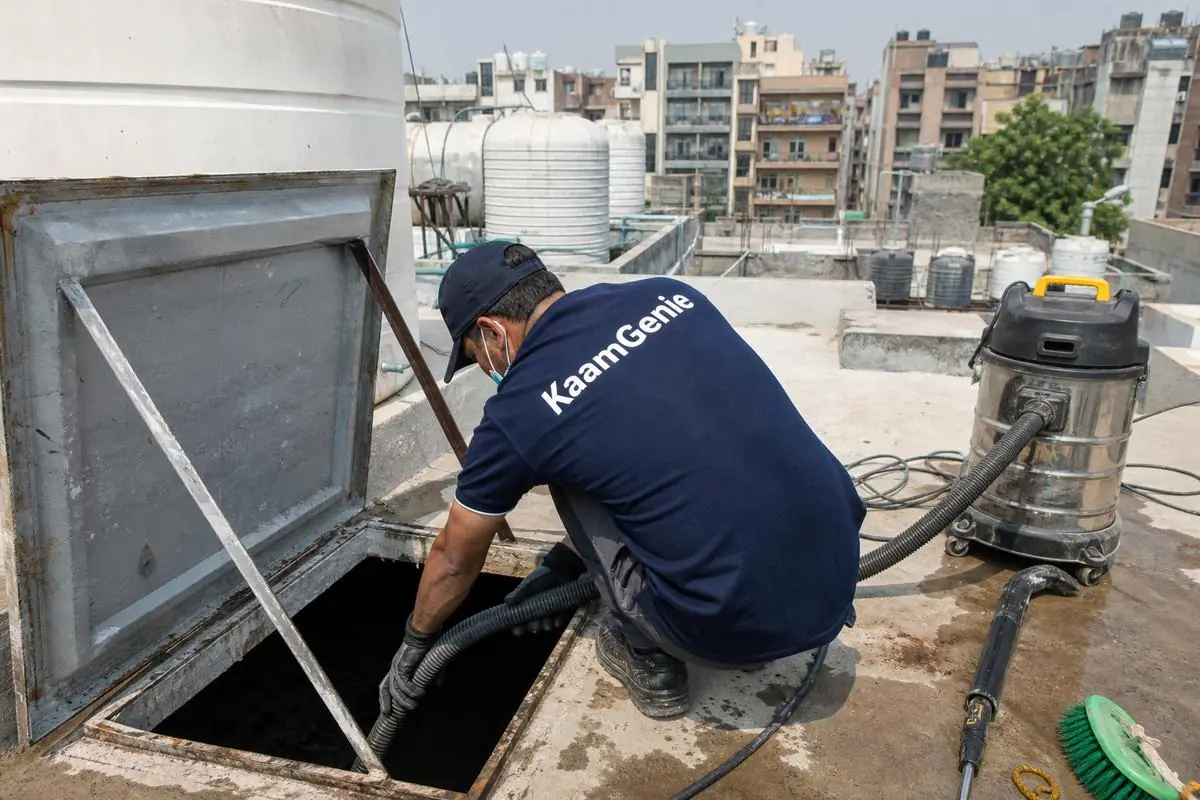
Some of Ashok Vihar’s shared tanks have served their wings since the colony was built, and when we open the older ones the sediment reads like tree rings: compacted dark silt at the bottom from decades past, looser recent layers above, scale bands marking years of harder supply. Draining never touched any of it. A bed like that narrows effective capacity, hosts biofilm through the warm months, and feeds grit to the pumps whenever summer draw pulls the level low.
Phase I adds a modern problem: it sits downwind of the Wazirpur industrial belt, and the fine metallic dust that visibly dirties open roof tanks there also reaches sump covers on parking floors, washing through unsealed seats with every rain. The sump-to-rooftop chain then moves it upstairs. For Phase I blocks we recommend the six-month cycle Wazirpur itself needs; the inner phases hold a solid annual rhythm — sump first, rooftop bank after, one shutdown for both.
No travel charge anywhere in Ashok Vihar. The final price is confirmed on the call before we come — it depends only on tank size and access.
See it done in 45 seconds
Watch our web story on how a tank is really cleaned — drain, de-sludge, jet-wash, disinfect.
We reach every pocket of Ashok Vihar — and there’s no travel charge to any of them:
Every locality in Delhi stores different water, and that decides how fast a tank fouls. This is Ashok Vihar’s profile from The Delhi Water Index, built from our field observations across 250+ localities.
Indicative field characterisation, not a certified lab test. BIS IS 10500: TDS 500 mg/L acceptable, 2,000 permissible. Check any Delhi area →
“Our DDA wing’s tank has never had a deep clean in living memory. What should we expect?” Layers — literally. Decades-old shared tanks here hold compacted sediment that draining never removed, and the first proper clean is a transformation: we vacuum the full bed out, pressure-wash the scale bands off the walls, and the before-and-after photos usually shock the wing into keeping an annual date. It is a longer job than a routine clean and we quote it honestly upfront.
“How do you work with our RWA’s schedule?” We fit the committee’s calendar: an agreed date, advance notice residents can circulate, an early start, and the shortest feasible shutdown — usually one morning covering sump and rooftop bank together. The quality report and photo set go to the committee for minuting. Most Ashok Vihar societies fix a pre-monsoon annual slot on 95603 66362.
“We are in Phase I near Wazirpur. Does the industrial dust really reach our sump?” It reaches the cover — the fine metallic dust settles on parking floors, and rain or floor-washing carries it to the cover seat, where any gap lets it through. We find the telltale dark, metallic-streaked sediment in Phase I sumps regularly. A gasket-tight cover plus a six-month cycle keeps it controlled.
“What does a society sump clean cost?” By capacity: ₹1,499 up to 1,000 litres, with block sumps of several thousand litres quoted after we confirm size. Multiple blocks booking together, or sump-plus-rooftop in one shutdown, brings the per-tank cost down — and a first-ever deep clean is priced as such before work starts, never revised midway.
“Can a plotted home get a same-day clean?” Usually — call before 10 AM and stilt sumps in the plotted lanes can typically be done the same day; society jobs need the scheduled route. A household sump runs two to three hours, water back by afternoon, photos and quality report on WhatsApp by evening.
See our complete water tank cleaning services in Delhi NCR — pricing, process, tank types and full city coverage.
Beyond water tank cleaning, KaamGenie is rolling out a full lineup of home services across Delhi NCR — see our complete list of 12 home services we offer or will be launching through 2026. New to tank cleaning? Read our guide on how to pick the right water tank cleaning service in Delhi — what to look for, what to avoid, and the questions that separate trustworthy crews from quick-job operators.
Rooftop plastic tanks
₹699+ →Kothi sumps & underground tanks
₹1,499+ →Apartments & RWAs
Bulk pricing →FSSAI-compliant cleaning
₹2,500+ →टंकी साफ़ करने वाले
हिन्दी पढ़ें →View all water tank cleaning guides →
All pockets and lanes of Ashok Vihar covered. If your specific block or society isn’t named in the sub-areas above, just call — we almost certainly cover it.
Same crew, same 6-step process, same-day where possible. Pick any locality below for local pricing and the tanks we typically find there.
Book a slot — we can usually fit you in today or tomorrow.