
Waterborne Diseases & Tank Cleaning
Raj Babbar · 10 min read
Home › Water Tank Cleaning › Underground Sump Cleaning › Kirari Suleman Nagar
In Kirari, tank cleaning is a health measure, not housekeeping — every monsoon, waterlogging pushes contaminated water toward shallow borewells, and it ends up in the ground drums and storage tanks every home depends on. KaamGenie cleans and disinfects ground-level and underground storage across the colony. From ₹1,499.
Kirari Suleman Nagar is one of Delhi’s largest unauthorised colonies, and its water chain is doubled: almost every home keeps ground-level drums or a storage tank fed by borewell or tanker, plus a small roof tank above — because supply is too erratic to trust either alone. The colony’s chronic monsoon waterlogging is the serious part. Standing floodwater seeps toward the shallow borewells many lanes rely on, and what those borewells pull up afterwards settles into the ground storage first.
That is why our Kirari service leads with disinfection, not just de-silting. We pump the tank down, remove the sediment where contamination concentrates, jet-wash the walls, then apply a anti-bacterial disinfectant and rinse to clear — documented with before-after photos. Ground drums get scrubbed and sanitised in the same visit. If your roof tank needs doing too, see water tank cleaning in Kirari Suleman Nagar; this page is about the storage at ground level, where the risk actually sits.
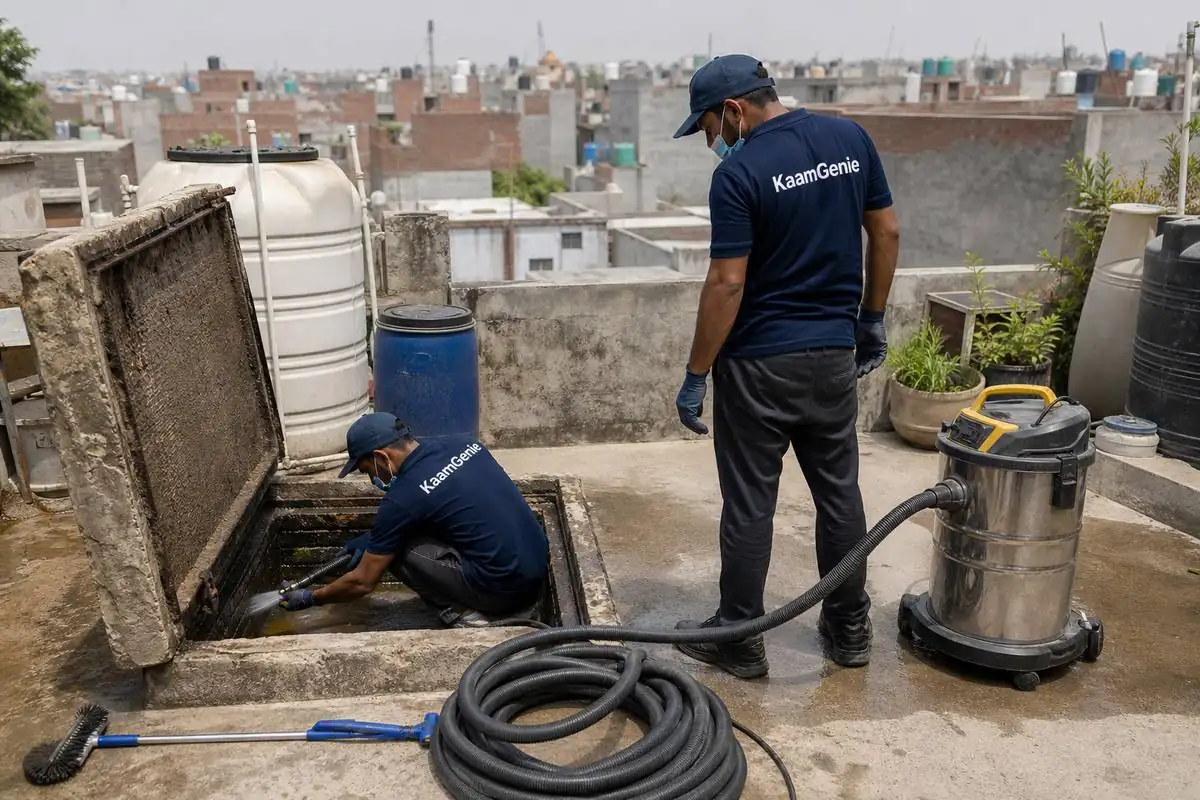
When the lanes waterlog — and in Kirari they do, every year — the standing water does not just block the road. It soaks down, and shallow borewells can draw that contamination for weeks after the surface has dried. The first place it collects is the bottom of the ground tank or drum, in the sediment bed, where bacteria have organic material and stagnant water to work with. A family filling cooking pots from that storage is exposed long after the flood is forgotten.
The colony’s doubled storage makes the cleaning surface double too: drums plus tank plus roof tank, all cycling the same questionable supply. Small roof tanks get occasional attention because they are visible; the ground storage rarely does. Our recommendation for Kirari is simple and honest — a full clean and disinfection right after the monsoon ends, and a second lighter one before summer peak. It costs little and it targets the actual risk window.
No travel charge anywhere in Kirari Suleman Nagar. The final price is confirmed on the call before we come — it depends only on tank size and access.
See it done in 45 seconds
Watch our web story on how a tank is really cleaned — drain, de-sludge, jet-wash, disinfect.
We reach every pocket of Kirari Suleman Nagar — and there’s no travel charge to any of them:
Every locality in Delhi stores different water, and that decides how fast a tank fouls. This is Kirari Suleman Nagar’s profile from The Delhi Water Index, built from our field observations across 250+ localities.
Indicative field characterisation, not a certified lab test. BIS IS 10500: TDS 500 mg/L acceptable, 2,000 permissible. Check any Delhi area →
“Our lane floods every year. When should we clean the tank?” Right after the waterlogging recedes is the highest-value time — that is when contamination drawn through shallow borewells has settled into your storage. A full clean and anti-bacterial disinfection then, plus a lighter clean before summer, covers Kirari’s two risk windows. Call 95603 66362 and we will slot you in.
“Do you clean drums as well as the tank?” Yes. Most Kirari homes run drums alongside the tank, and they hold the same water, so we scrub and sanitise them in the same visit at a small addition to the tank price. Cleaning the tank but not the drums just re-contaminates the chain the next time you transfer water.
“What does it cost? We are several tenant families sharing one tank.” From ₹1,499 for a tank up to 1,000 litres, everything included — pump-out, sediment removal, jet wash, anti-bacterial disinfection, photos. Shared between the families drawing from it, it usually works out to a couple of hundred rupees each. Larger tanks are priced by capacity, stated before we start.
“Can you come today? The water smells after the rain.” Call before 10 AM on 95603 66362 and we can usually reach a Kirari address the same day — post-rain weeks are exactly when we weight our routes this way. A smell after rain typically means contamination has reached the sediment bed, and the clean plus disinfection addresses it directly.
“Will the tank stay safe after cleaning if the borewell is the problem?” Cleaning removes the contaminated sediment and disinfects the storage, which is the biggest single step you control. If the borewell itself is drawing bad water, storage will gradually re-load — so we advise the post-monsoon timing, tight lids, and letting the first fills settle. We are straight with you about what cleaning can and cannot fix.
See our complete water tank cleaning services in Delhi NCR — pricing, process, tank types and full city coverage.
Beyond water tank cleaning, KaamGenie is rolling out a full lineup of home services across Delhi NCR — see our complete list of 12 home services we offer or will be launching through 2026. New to tank cleaning? Read our guide on how to pick the right water tank cleaning service in Delhi — what to look for, what to avoid, and the questions that separate trustworthy crews from quick-job operators.
Rooftop plastic tanks
₹699+ →Kothi sumps & underground tanks
₹1,499+ →Apartments & RWAs
Bulk pricing →FSSAI-compliant cleaning
₹2,500+ →टंकी साफ़ करने वाले
हिन्दी पढ़ें →View all water tank cleaning guides →
All pockets and lanes of Kirari Suleman Nagar covered. If your specific block or society isn’t named in the sub-areas above, just call — we almost certainly cover it.
Same crew, same 6-step process, same-day where possible. Pick any locality below for local pricing and the tanks we typically find there.
Book a slot — we can usually fit you in today or tomorrow.